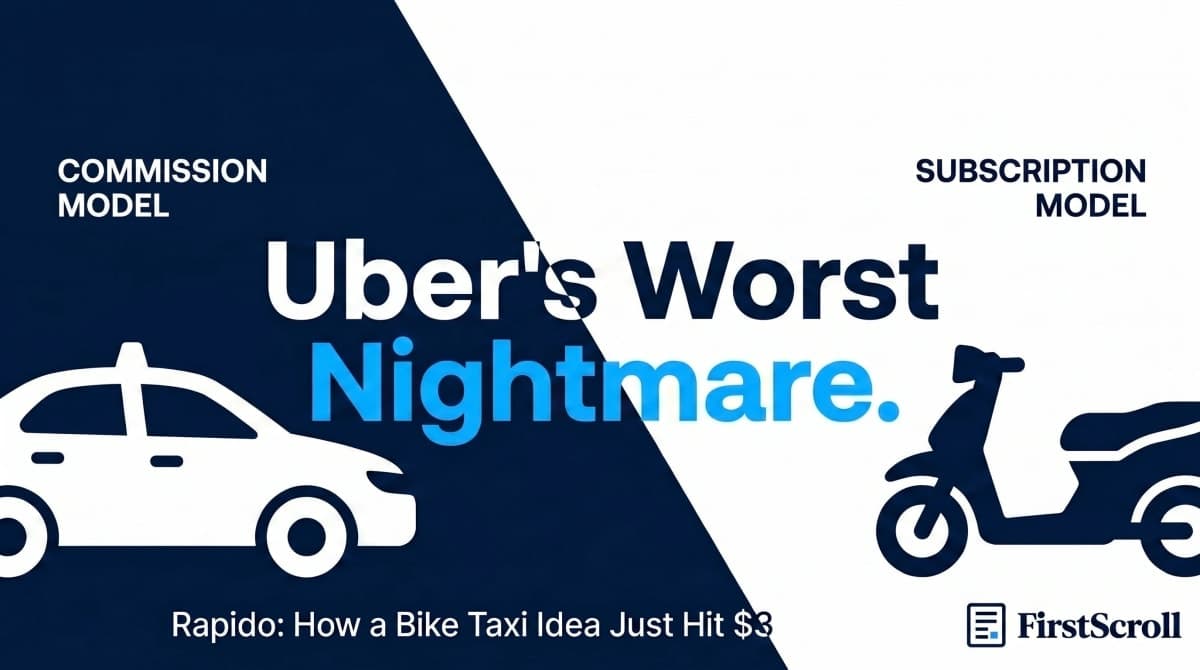
Ten years ago, the idea sounded almost too small to matter. Let people book a ride on the back of someone's motorbike. Today, that idea is worth $3 billion and has Uber genuinely worried.
In today's FirstScroll, we unpack Rapido's funding round, and why the simplest mobility idea in India turned out to be the smartest.
The Story
On May 15, 2026, Rapido confirmed it had raised $240 million in fresh funding. The round was led by Prosus, with existing investors WestBridge Capital and Accel also participating, and it forms part of a larger $730 million primary and secondary financing package.
The number that matters most is the valuation. The round values Rapido at $3 billion. Just nine months earlier, in a secondary transaction, the company had been valued at around $1.1 to $2.3 billion. To roughly triple, or at minimum sharply re-rate, in under a year is one of the most dramatic startup valuation jumps India has seen recently.
So what did investors actually see that justified writing cheques at three times the price?
To answer that, you need to understand what makes Rapido different, and it comes down to two deliberate choices the company made early on.
For the uninitiated, when you think of ride-hailing in India, you probably think of Ola and Uber, and you probably think of cabs. A four-wheeler arrives, you sit in the back, you pay a fare. Rapido looked at that model and made its first contrarian choice. Instead of starting with cars, it started with motorbikes. Bike taxis. You book a ride and a two-wheeler shows up, you put on a helmet, and you ride pillion.
This sounds small. It is not.
In India's congested cities, a motorbike weaves through traffic that a car cannot. It is dramatically cheaper for the rider, often a third or a quarter of a cab fare. It is faster for short distances. And for the driver, the barrier to entry is low, because tens of millions of Indians already own a motorbike. Rapido essentially looked at what the global giants overlooked, the two-wheeler and the autorickshaw, and built its entire business there. It later added autos, cabs, parcel delivery, and food delivery on top, but the bike was the foundation.
The second contrarian choice was the business model. Uber and Ola run on a commission model. The driver completes a ride, and the platform takes a percentage cut of every fare. Rapido, for its auto and cab drivers, runs on a subscription model instead. The driver pays a fixed daily or weekly fee to access the platform, and then keeps the fare. For a driver, this is a powerful difference. On a good day with many rides, the driver keeps far more of the money than they would under a commission cut.
Think of it like the difference between a landlord who takes a percentage of your shop's daily sales, and a landlord who charges a fixed monthly rent. On a high-sales day, the fixed-rent shopkeeper keeps everything above the rent. That predictability is attractive, and it has helped Rapido pull drivers onto its platform.
Now here is the part that should make you sit up.
These two choices have pushed Rapido into genuine leadership in Indian mobility. Across all rides, including bikes and three-wheelers, Rapido has reportedly emerged as India's largest ride-hailing platform with roughly 50% market share, compared with Uber's roughly 40%. On monthly active users, Rapido sits at around 31.8 million, just behind Uber India's 33.6 million and ahead of Ola's 28.6 million.
The most striking acknowledgment did not come from Rapido. It came from Uber. In August 2025, Uber's CEO Dara Khosrowshahi publicly named Rapido as Uber's biggest competitor in India, ahead of Ola. For a decade, Ola had held that position as the homegrown challenger to Uber. A bike taxi company had displaced it.
So why is everyone raising and spending so much money right now?
Because the battle is escalating, and all three players are loading up.
Uber is not standing still. The company recently infused around $330 million into its India business. India is Uber's third-largest market globally by trip volume. Uber has announced plans to expand its engineering and infrastructure operations in India, including new technology campuses and a local data centre partnership, and it is pushing aggressively into bike taxis, the very segment Rapido pioneered.
Ola, the original homegrown champion, has had a harder time, having been distracted and weighed down by the challenges in its electric vehicle business.
This is the context for Rapido's $240 million. It is fuel for a fight that is getting more expensive by the quarter.
So what does Rapido plan to do with the money? Three things.
The first is geographic expansion, specifically deeper into smaller cities. Rapido already operates across more than 400 Indian cities and is targeting 500 by the end of 2026. The strategic bet is Tier-2 and Tier-3 India, where demand for affordable transport is rising fast but organised supply is still thin. Co-founder Aravind Sanka described it as going deeper into markets where demand exists but supply remains fragmented.
The second is strengthening the driver network, which the company calls its captains, currently around 9 million captains and delivery partners. In ride-hailing, supply is everything. If a rider opens the app and no vehicle is nearby, they lose trust quickly.
The third is technology and platform efficiency, the back-end that decides how fast a ride is matched and how reliably it arrives.
So why does this matter to you, beyond it being a startup story?
Three takeaways.
One, if you use these apps, the competition is, for now, good news. When three well-funded players are fighting for the same rider, the rider tends to benefit through competitive pricing, faster pickups, and better app experiences. The flip side is that this intensity is being subsidised by investor capital, and that does not last forever.
Two, watch the IPO signal. Rapido has indicated it plans to prepare for a public listing by the end of 2026. That fits a broader pattern you have seen across Indian startups this year, with Zepto, Swiggy, and others, where late-stage companies are lining up for the public markets. A Rapido IPO would give retail investors a direct way to bet on Indian urban mobility, and it would put the company's financials under public scrutiny.
Three, look at the unit economics, because they tell the real story. In FY2025, Rapido crossed ₹1,000 crore in total income, reporting ₹1,003 crore, and narrowed its net loss to ₹258 crore. A narrowing loss alongside growing revenue is the pattern investors want to see before an IPO. It suggests the business is moving toward sustainability, not just buying growth.
But let's be clear about what this raise is not.
It is not a guarantee that Rapido wins. India is widely regarded as one of the toughest ride-hailing markets in the world, because of intense price competition, the constant struggle to balance driver supply with rider demand, high driver incentive costs, and evolving local regulations on things like bike taxis. Capital helps, but every ride-hailing platform globally has discovered that money alone does not solve the supply-demand balancing act. Execution does.
And the $3 billion valuation, while large, is worth keeping in perspective. It still sits well below Ola's peak valuation of around $7 billion, a peak Ola reached before its struggles. A high valuation is a statement of investor confidence, not a finished achievement. Valuations can compress as fast as they expand, as Ola itself demonstrated.
Step back, and there is a genuinely interesting lesson here. For years, the assumption in Indian startups was that the winning move was to import a proven global model and localise it. Uber worked in San Francisco, so a version of Uber should work in Bengaluru. Rapido's rise complicates that assumption. Its two biggest bets, the motorbike instead of the car, and the subscription instead of the commission, were not copied from Silicon Valley. They were designed for the specific texture of Indian streets, Indian incomes, and Indian drivers.
The bike taxi was never the small idea it looked like. It was the idea that actually fit the country. And nine months from a roughly $1 billion valuation to $3 billion is the market finally agreeing.
Until next time…