What even is Instamart?
Swiggy isn't just the app you order biryani from. A few years ago, it built a second business Instamart to deliver groceries and daily essentials to your door in under 15 minutes. Dark stores, dense city networks, the whole playbook.
The bet was simple: food delivery is good, but groceries are something people buy every single day. Nail that, and you have a monster business.
The problem? Nailing it requires spending a lot of money for a long time before you see any returns. And Swiggy just... stopped spending.
Here's what's actually happening
Swiggy's management made a call: instead of going all-in on Instamart, they'd slow down and try to show investors that the business could stop losing so much money.
Sounds sensible, right?
Except here's the thing about quick commerce groceries delivered in 10 minutes. It's a game of density. The player with the most dark stores, in the most neighbourhoods, with the fastest delivery wins. Customers don't loyalty-shop. They open whichever app delivers faster and cheaper that day.
So when you slow down, you don't just grow slower. You hand your customers to someone else.
And Blinkit Zomato's quick commerce arm has been doing exactly the opposite. It's been expanding hard and fast. Zepto too. And now Flipkart and Amazon are showing up to the party.
Instamart is bringing a notebook to a knife fight.
The numbers are brutal
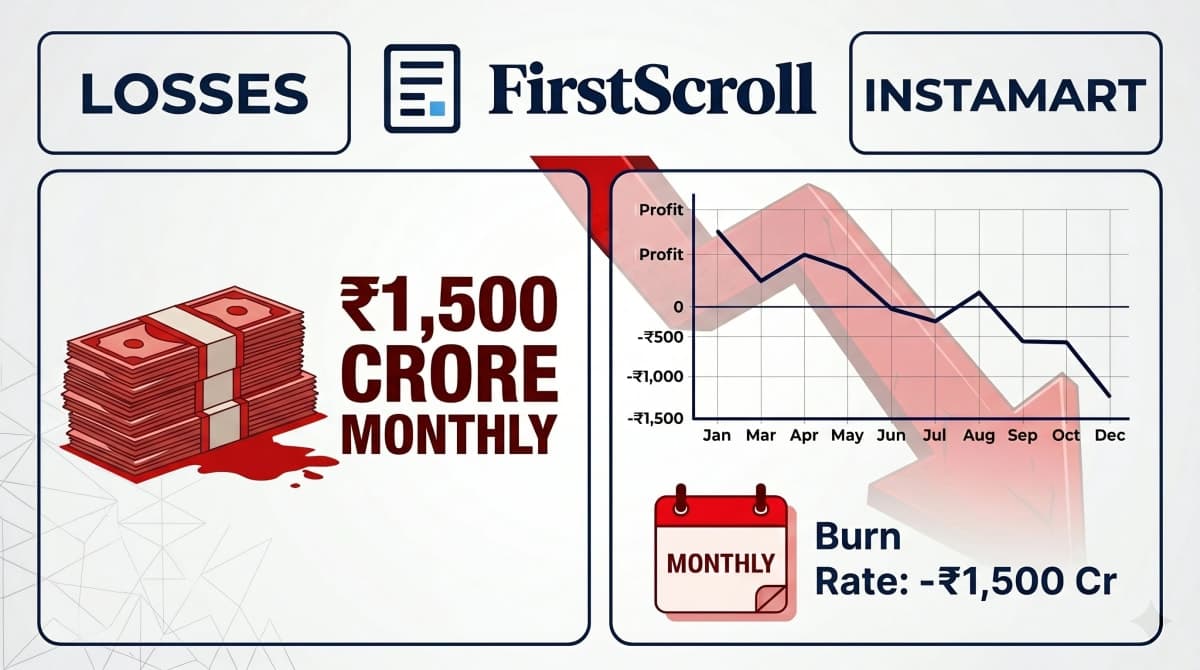
Instamart lost ₹9,000 crore in just the first half of FY26. That's roughly ₹1,500 crore every single month gone.
And the losses aren't really shrinking.
Q2 was ₹9.1 billion.
Q3 was ₹9.0 billion.
Q4 is expected to be ₹8.5 billion.
At this rate, analysts expect Instamart to still be losing massive amounts of money through FY28 and possibly beyond.
Meanwhile, the business growth is also slowing down. Instamart was growing at 72–76% year-on-year for most of FY26. That's now expected to drop to 61% and fall further from there.
Slower growth. Still enormous losses. That is not a great combination.
They keep missing their own targets
After Swiggy's IPO, management made some promises. Here's how those aged:
Promise | Original timeline | Latest status |
|---|---|---|
Instamart contribution margin breakeven | Q3 FY26 | Pushed to Q1 FY27 likely to miss again |
Instamart EBITDA breakeven | Q2 FY27 | No timeline. Stopped guiding after Q2 FY25 |
Consolidated group EBITDA breakeven | Q3 FY26 | No timeline. Stopped guiding after Q2 FY25 |
But what about their cool features?
Swiggy tried. They really did.
They launched Swiggy One a membership that gives you free deliveries for ₹1 for three months. They got a co-branded credit card with a major bank. They launched Maxxsaver bundles to make orders cheaper. They even started their own grocery brand.
None of it worked. The membership hasn't made customers stick. The private label products haven't gotten any buzz. Maxxsaver got people to spend more per order, but fewer people placed orders at all.
You can't out-feature your way out of a distribution problem. If Blinkit reaches you in 8 minutes and Instamart takes 15, the credit card offer doesn't matter.
The food delivery business is fine. Just not fine enough.
Here's the silver lining in this story: Swiggy's food delivery app the OG biryani business is doing pretty well.
It's growing at about 20% a year, margins are improving, and it's expected to make around ₹9,900 crore in operating profit in FY26, rising to ₹15,100 crore in FY27.
But and this is the key that profit gets completely swallowed by Instamart's losses. Food delivery is a profitable business propping up a grocery business that burns cash faster than it makes it.
It's like running a great bakery and using all the profits to fund a restaurant that nobody's eating at.
The ₹10,000 crore question
Late last year, Swiggy raised ₹10,000 crore from investors through a share sale. At the time, many hoped they'd use it to go on the offensive build more dark stores, hire more delivery partners, fight for market share.
Instead, they've been cautious with it. The cash is sitting on the balance sheet for now but it's shrinking every quarter as losses pile up. By FY28, analysts expect it to have halved.
Money raised to win a war, being used to survive a siege.
So what happens next?
Three possible endings here:
Option A - Swiggy goes aggressive.
Management changes course, deploys capital into Instamart hard, and fights for market share. This means bigger losses in the short term and angry investors. But it's the only way Instamart actually wins.
Option B - Instamart slowly fades.
Swiggy keeps prioritising profitability metrics, growth slows further, competitors take share, and Instamart becomes irrelevant within 2-3 years. A ₹28,000 crore business that just... quietly stopped mattering.
Option C - Someone buys Swiggy.
A larger player Zomato, a conglomerate, a global tech giant acquires Swiggy. Instamart gets folded into a bigger network, the losses get absorbed, and shareholders get a decent exit.
Right now, analysts think Option C is the most realistic good outcome for investors.
That's a pretty damning thing to say about a company that was worth ₹47,000 crore just a year ago.
The stock tells the story
Swiggy's share price peaked at ₹474 last year. It now trades around ₹269. That's a 43% fall.
At this price, investors are essentially paying only for the food delivery business. Instamart which handles over ₹28,000 crore in orders every year is valued at zero. The market has written it off completely.
Either that's the opportunity of the decade if you believe Swiggy turns it around. Or it's the market being coldly rational about a business that's running out of time.
Quick commerce is a brutal game. You either scale fast or you don't scale at all. Instamart picked the worst possible option the middle.