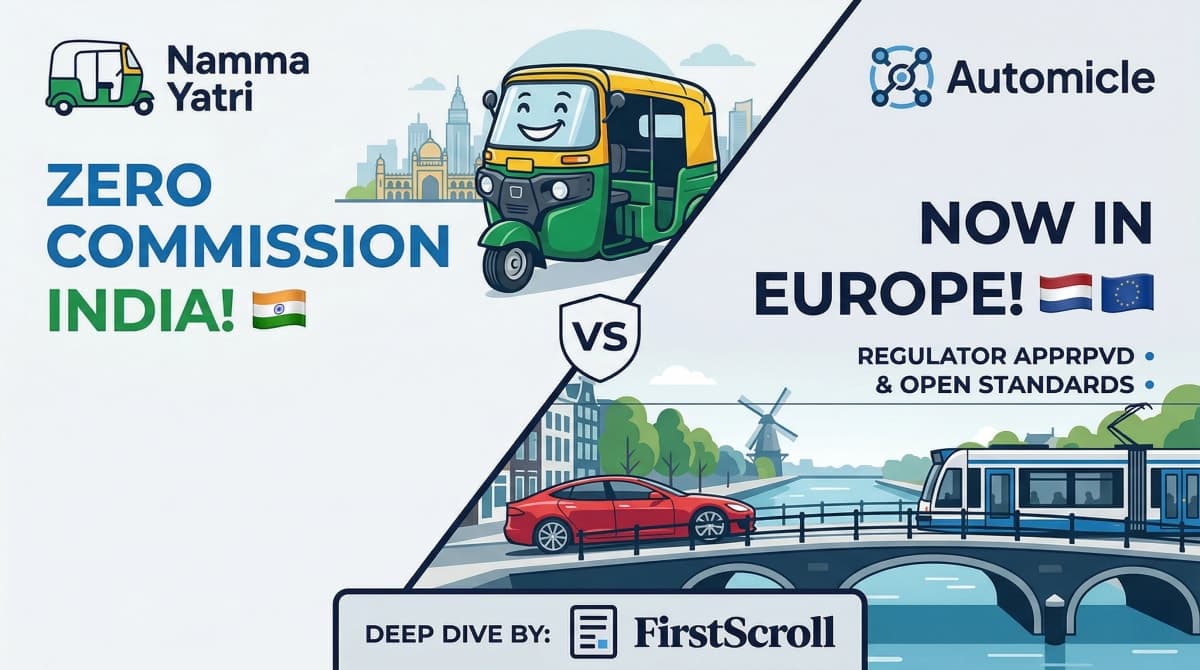
In today's FirstScroll, we tell the story of how a Bengaluru auto-hailing app that charges drivers nothing just made its first move into Europe and why that could be a headache for Uber.
There's a number that Uber would rather you not think too hard about. Every time you book a ride, somewhere between 25% and 30% of what you pay never reaches the driver. It goes straight to the platform. That's not a bug in ride-hailing economics. It's the entire business model. Uber built a $150 billion empire on it. Bolt, Free Now, and BlaBlaCar followed the same playbook across Europe. And then, quietly, from a tech park in Bengaluru, a tiny app said: what if we just... didn't do that?
This week, that app booked its first international ride.
The Story
On March 26, Moving Tech Innovations, the Bengaluru-based company behind Namma Yatri, announced the acquisition of Automicle Holding BV, a Netherlands-based mobility startup. The financial terms weren't disclosed. But the intent was stated clearly: what worked on the streets of Bengaluru, they believe, can work in Amsterdam.
To understand why this matters, you need to understand what Namma Yatri actually is. Because it really is unlike anything else in its category.
Sidebar: Zero-Commission Model. Most ride-hailing apps charge drivers a commission of 20% to 35% per trip. So if you pay ₹200 for a ride, the driver might keep ₹140 while the platform pockets ₹60. Namma Yatri does none of that. Drivers pay a flat daily subscription of ₹25 for auto drivers and ₹45 for cab drivers, and every rupee of the fare goes directly to them.
Moving Tech says the platform has completed over 150 million trips and put more than ₹2,500 crore directly into driver pockets without skimming a single commission. Those are serious numbers for a company that most people outside Bengaluru, Delhi-NCR, and Chennai have never heard of.
The model works because Namma Yatri isn't built like a typical app. It runs on open digital protocols, shared and transparent infrastructure that any platform can plug into, rather than one company locking in all the value. Think of it like UPI, but for mobility.
Sidebar: Beckn Protocol. An open-source standard developed in India that lets different apps, drivers, and city transit systems connect and transact without being tied to one platform. The same way UPI lets you pay from any bank app to any other, Beckn lets different mobility services talk to each other seamlessly.
Automicle, the Dutch startup Moving Tech just acquired, is built on the same open-protocol philosophy. Founded in 2022 by Amit Pal, Mohit Mishra, and Jef Heyse, it builds smart parking systems and integrated public transport platforms, working closely with city governments across Europe. So Moving Tech isn't just buying a customer base. It's buying relationships with the exact people who decide how European cities organise their transport.
And Europe, it turns out, has a problem that Namma Yatri thinks it can solve.
Uber, Bolt, Free Now, and BlaBlaCar currently dominate the European ride-hailing market. What ties them all together is high commissions, anywhere between 10% and 50% depending on the country. European drivers have been protesting for years. Cities from London to Barcelona have been scrambling to regulate platform power. Into this environment walks an Indian startup saying: we already figured this out. Here's the proof.
But here's where it gets really interesting. Namma Yatri's impact in India wasn't limited to its own growth. Its arrival pushed Rapido to pivot to a subscription model and nudged Ola toward a zero-commission structure. One app rewired the incentives for an entire industry. If Moving Tech can do even a fraction of that in Europe, the ripple effects for Uber and Bolt could be significant.
The co-founders of Moving Tech, Magizhan and Shan MS, put it plainly. "When we built Namma Yatri, we put cities and their people first. We proved that zero-commission models work, that drivers deserve dignity and better earnings, and that public transport can be seamlessly integrated. With Automicle, we are taking those learnings beyond India. These are not local solutions. They are universal principles."
That's a bold claim. And whether it holds up in Amsterdam depends on things no press release can guarantee: whether European drivers actually switch, whether city governments open their doors, and whether Uber and Bolt decide to fight back or simply copy the model.
The zero-commission revolution started in Bengaluru. It just booked its first international ride.
Until then...