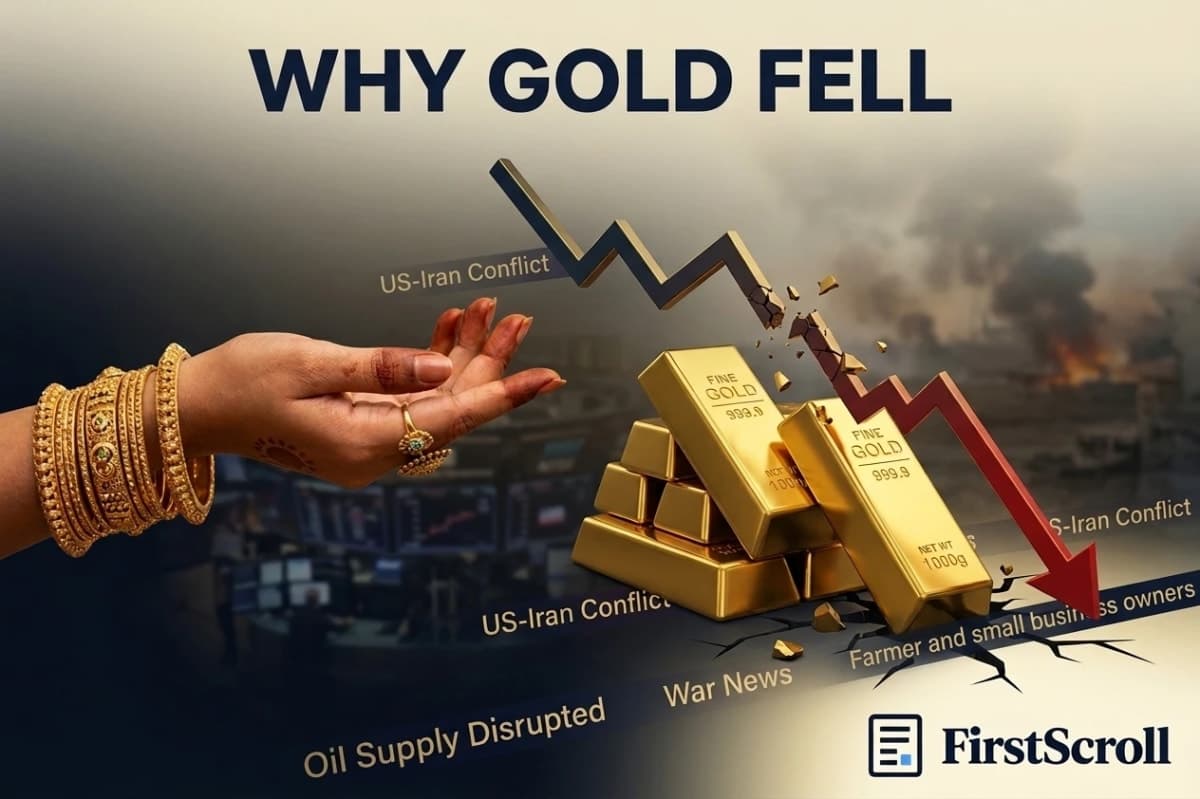
There is a saying every Indian grandmother knows. When the world goes crazy, buy gold.
Wars, inflation, uncertainty, rupee falling, stock markets crashing. Gold is supposed to be the one thing that holds its value when everything else is wobbling. It is the original safe haven. It is why Indian households collectively hold around 5 trillion dollars worth of the stuff. More than any country on earth.
So when the US, Israel, and Iran went to war in late February 2026, triggering the biggest oil supply disruption in history, you would have expected gold to shoot up, right?
It did not. It crashed.
In March 2026, gold prices in India fell by nearly 14%, which was the worst monthly drop since June 2013. In just seven days between March 16 and March 22, 24-karat gold fell by Rs 1,435 per gram. If you had 100 grams of gold sitting at home, that drop wiped Rs 1.43 lakh off its value in one week.
At the time of writing, 24-karat gold in India is trading around Rs 15,236 per gram. It has partially recovered from its lows, but it is still well below where it was before the war began.
So what on earth happened? Why did gold, the world's most famous safe-haven asset, fall during one of the most dangerous geopolitical moments in recent memory?
The answer reveals something really interesting about how money actually works.
The first thing you need to understand: gold competes with the dollar
Here is the thing most people do not think about when they see a gold price. Gold does not pay you interest. It does not give you dividends. You buy it, you hold it, and you hope its price goes up.
Now compare that to a US government bond, which currently pays around 4 to 4.5% per year in guaranteed interest. When interest rates are high and the dollar is strong, investors have a genuinely good alternative to gold. They can put their money in US bonds, earn a solid return, take almost zero risk, and not worry about gold price swings.
The moment investors feel they can earn decent returns in dollars without any drama, they start selling gold. And that is exactly what happened.
When the Iran war broke out, oil prices surged above 100 dollars a barrel. That pushed inflation expectations up globally. Higher inflation means central banks, especially the US Federal Reserve, are less likely to cut interest rates anytime soon. In fact, markets briefly priced in a 50% chance of a US Fed rate hike by October 2026.
Higher interest rates make gold less attractive. So investors sold gold to park money in bonds. Simultaneously, the US dollar surged because investors always run to the dollar during global uncertainty. A stronger dollar makes gold more expensive in other currencies, which reduces demand. More selling. Lower prices.
This is the paradox. The same war that was supposed to boost gold actually made the conditions for holding gold less attractive.
But wait, gold is supposed to rise during inflation
Yes, and that is where it gets slightly more nuanced.
Gold has two identities. It is an inflation hedge in the long run. Over decades, gold has preserved purchasing power brilliantly. But in the short run, gold is also a rate-sensitive asset. When interest rates rise quickly, gold falls because the opportunity cost of holding a zero-yield asset goes up.
Right now, we are in the short-run phase. Oil-driven inflation is pushing rate expectations higher. That is hurting gold even though, logically, inflation should eventually be good for gold.
Think of it like this. Imagine gold is a long-distance runner. In a sprint, it gets beaten by faster options. But in a marathon, it usually wins. The war created a sprint environment, not a marathon environment. And gold lost the sprint.
What does this mean for Indian households?
Here is where it gets personal.
If you are someone who has been wanting to buy gold but kept waiting because prices were too high, the last few weeks were actually a window. Prices came down significantly from their peaks of around Rs 1,67,000 per 10 grams. At current levels near Rs 1,52,000 per 10 grams, that is a meaningful discount.
If you are someone who holds gold as savings or as collateral for a gold loan, the drop has reduced the value of that collateral. Farmers and small business owners who use gold to borrow money have felt this directly. Lower gold price means lower loan amounts available. That squeezes working capital at exactly the wrong time.
If you invest in gold ETFs or sovereign gold bonds, the same logic applies. Your NAV fell during the crash but may recover if geopolitical uncertainty persists and rate expectations ease later in the year.
And if you are a jeweller, the last few weeks have been a headache. You probably have old stock bought at Rs 1,55,000 or higher per 10 grams. Selling it now means selling at a loss. Retail chains like Malabar Gold and Tanishq have reported more inquiries from buyers at lower prices, but the inventory math is painful.
Will gold bounce back?
The short answer is: probably yes, but not necessarily soon.
Gold has already started recovering. From its March lows it has bounced partially back. It is currently around 47% higher than it was a year ago, even after the crash. That long-run marathon performance is still very much intact.
If the US-Iran ceasefire holds, oil prices fall, inflation expectations cool, and the Fed signals it might cut rates later in the year, gold could see another strong run. Analysts note that central banks globally are still buying gold at record pace, which is a strong long-term support signal.
But if the ceasefire breaks down, oil spikes again, and rate hike fears return, gold could stay under pressure for another few months.
The broader structural story for gold remains solid. The US dollar's long-term dominance is being questioned by many economies. Geopolitical risk is structurally higher than it was five years ago. Central banks in India, China, Russia, and other emerging markets have been buying gold for years as a way to reduce dependence on the dollar.
Those tailwinds do not disappear in a few weeks of volatility.
The government loves when gold prices fall, actually
Here is a fun fact that most people do not know.
India imports almost all of its gold because we produce almost none of it. Gold is India's second largest import by value after oil. When gold prices fall globally, India's import bill shrinks. That improves the trade deficit and supports the rupee.
The government has also been trying for years to nudge people away from hoarding physical gold and toward paper gold like sovereign gold bonds and gold ETFs. Lower gold prices help that shift because buying a physical 10-gram bangle feels less urgent when the price is falling and digital alternatives feel more stable.
So while your household gold wealth fell on paper this March, the economy quietly benefited.
So should you buy gold now?
Quick disclaimer first. Nothing here is investment advice. Talk to a financial advisor before making decisions.
That said, here is how to think about it.
If you are a long-term holder who buys gold the way your parents did, as a savings buffer and cultural tradition, the dip is genuinely not something to panic about. Gold has always recovered. The structural reasons to hold gold have not changed.
If you are an investor trying to time the market, the next few months are likely to be volatile. Every ceasefire update, every oil price move, every Fed statement will swing gold prices. That kind of volatility is not for everyone.
If you have been waiting to buy physical gold for an upcoming wedding or festival, the current prices are lower than they were a month ago. Whether they go lower still depends on how the geopolitical situation plays out, which nobody actually knows.
The bottom line
Gold did the unexpected thing this time. It fell during a war. But the reasons make sense once you understand that gold is not just an emotion, it is a financial asset that competes with dollars and interest rates.
The crash does not mean gold is broken. It means we are in an unusual moment where the normal rules got flipped. Oil-driven inflation is hurting gold in the short run by keeping rates elevated. But the long-run story for gold, especially for Indian households, remains what it has always been.
When the dust settles from this war, when oil prices normalise, and when rate expectations shift again, gold will likely have its moment once more.
Until then, your grandmother's advice is not wrong. It is just temporarily early.