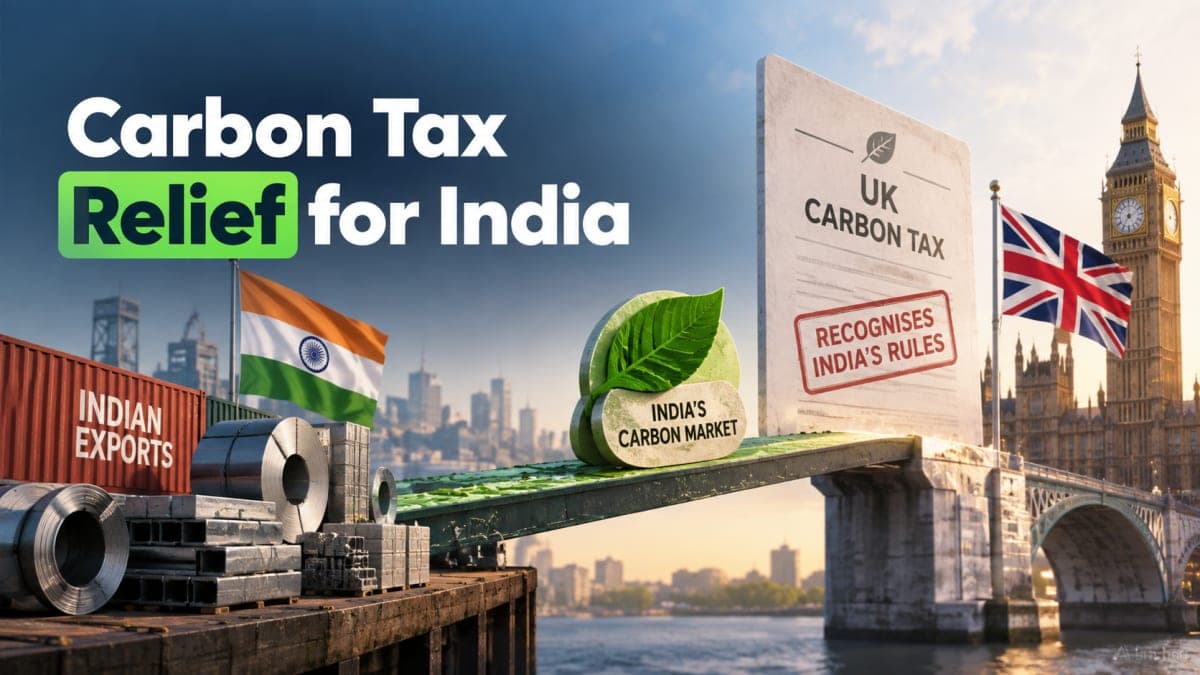
In today's FirstScroll, we break down how India quietly won relief from a British carbon tax it had already failed to escape, and why the trick was not a trade deal but getting the UK to trust India's own rules.
With that out of the way, let's dive into today's story.
The Story
Earlier this year, India signed a big trade agreement with the United Kingdom and, in the fine print, appeared to lose something important. Trade experts pointed out that India had failed to win an exemption from a looming British carbon tax. From January 2027, the UK could slap that tax on Indian steel and aluminium even while granting British goods duty-free entry into India. One trade analyst called it a serious asymmetry, and warned that Indian exports worth hundreds of millions of dollars were exposed.
Then, this month, a quieter piece of news landed that softens that blow considerably, and it arrived not through a negotiation but through a technical letter.
The UK's Treasury told India's Bureau of Energy Efficiency that it had recognised India's Carbon Credit Trading Scheme, India's own home-grown carbon market, as a qualifying carbon price under the UK's incoming tax. In plain terms, Britain agreed to give Indian exporters credit for carbon costs they had already paid at home.
So the question is, how does a country get relief from a foreign tax it explicitly failed to negotiate away, and why would Britain hand out that relief voluntarily?
To understand it, you first have to understand the tax itself, because it is one of the most important new ideas in global trade, and it is about to reshape what countries can sell to each other.
The tax is called a Carbon Border Adjustment Mechanism, or CBAM, and it exists to solve a specific problem. Rich countries like the UK force their own factories to pay for the carbon they emit, through carbon pricing. That makes a British steel mill more expensive to run than one in a country with no such rules. The fear is obvious: British firms would simply lose out to cheaper, dirtier imports, and the pollution would just move abroad rather than disappear. A CBAM fixes this by taxing carbon-intensive imports, steel, aluminium, cement, fertiliser, at the border, so a foreign product faces roughly the same carbon cost a British one would. It is a tariff, but priced in carbon rather than politics.
For India, a major exporter of exactly these goods, that is a real threat. The UK tax could add somewhere between 14% and 24% to the cost of affected Indian exports. On steel and aluminium, that is the difference between winning and losing an order.
Now here is the clever part, the bit that turns a failed exemption into a workable escape. A CBAM is not designed to tax carbon twice. Its whole logic is that an import should face the same carbon cost as a local product, no more. So if a product has already paid a carbon price in its home country, the importing nation is meant to deduct that amount from the border tax. Pay carbon at home, and you owe that much less at the British border.
This is where India's own carbon market suddenly matters enormously. India has been building the Carbon Credit Trading Scheme, a domestic system where Indian factories pay for their emissions by trading carbon credits. For years this looked like a purely internal affair. But the UK's recognition changes what it is worth. Because the British now accept the CCTS as a legitimate carbon price, every rupee an Indian steelmaker pays under India's own scheme becomes a rupee it can deduct from its UK carbon bill.
So India did not need an exemption after all. It needed Britain to trust its rules. Once the UK agreed that India's carbon price is real and countable, the double tax largely dissolves on its own.
But here's the twist, and it reframes the whole "win." Look closely at who actually benefits, and from what. This recognition does not make the carbon cost vanish. It simply decides who collects it. Without recognition, an Indian exporter pays carbon twice, once to India's scheme, once again to the UK Treasury. With recognition, it pays once, and the money it would have handed to London stays in India instead. The tax bill barely shrinks. What changes is that the payment lands in New Delhi's carbon market rather than Britain's coffers.
That flips the incentive in a fascinating way. Suddenly it is in India's own interest to make its carbon price higher, not lower. The more an Indian factory pays into India's own scheme, the more it can deduct from the British tax, and the more of that money stays on Indian soil funding Indian climate goals rather than flowing to the UK exchequer. A carbon market that Indian industry once viewed as a cost has quietly become a tool for keeping money at home.
Now, why should you care about a technical letter between two treasuries? Because this is the shape of the next era of trade, and it rewards something most people do not associate with winning trade fights: having your own credible rules. For decades, the way to protect exports was to negotiate lower tariffs. Increasingly, it will be to build domestic standards, on carbon, on data, on safety, that big markets are willing to recognise, so your exporters get counted as already-compliant rather than taxed at the door. The country with its own respected rulebook gets relief. The country without one pays full price.
None of this makes CBAM harmless for India. The relief only helps to the extent Indian firms actually pay a meaningful carbon price at home and can produce the paperwork to prove it, and India's carbon market is still young and its prices still low. And the EU, a far bigger market, has its own CBAM coming, where India will have to win the same recognition all over again. This was one battle in a long war over how the world prices carbon at its borders.
So the answer to the puzzle is that India did not escape the tax. It made its own rules count against it, so the cost is paid at home rather than abroad. A failed exemption became a quiet act of trust, and in the trade world taking shape, being trusted may be worth more than being exempt.
Whether India can build its young carbon market into something the far larger EU will respect too is the next, bigger test.
Until then…
If this made a baffling carbon-tax headline finally make sense, share it with a friend on WhatsApp, LinkedIn or X.