You know that panic when you are on a road trip, Google Maps is guiding you through a ghat section, and suddenly your phone shows zero bars.
Your music stops.
The map freezes.
And you start wondering if you missed a turn three kilometers back.
We have all accepted that dead zones are just part of life.
A launch that happened this morning at Sriharikota suggests they may not be for long.
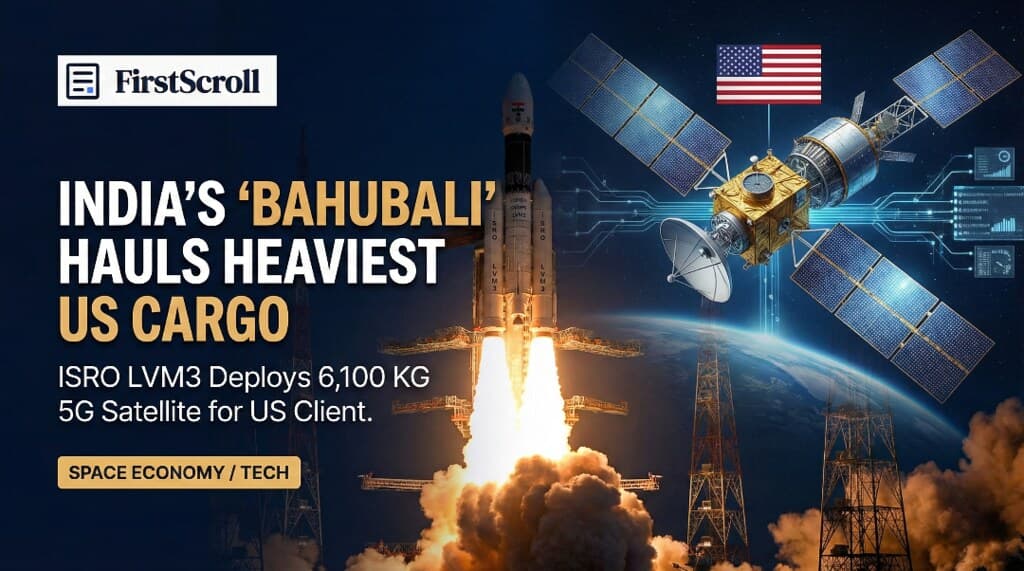
While you were likely sipping your morning chai, ISRO’s heavy lift rocket, the LVM 3, better known as Bahubali, roared into the sky at 8:55 AM.
Its mission was simple to describe and brutally hard to execute.
Carry the single heaviest commercial satellite ever launched from Indian soil.
ISRO successfully launched the Blue Bird Block 2 satellite for the US based company AST Space Mobile.
This was not a routine communications satellite.
The payload weighed roughly 6,100 kilograms.
To put that in perspective, ISRO just placed the equivalent of three large SUVs into an orbit about 520 kilometers above Earth.
The mission, officially called LVM 3 M 6, was a commercial launch handled by New Space India Limited, ISRO’s corporate arm.
The satellite was so heavy and complex that it pushed Bahubali close to its design limits.
And that is precisely why this launch matters.
India just proved it can play in a club previously dominated by Space X and Arianespace.
Think of your phone like a flashlight.
Normally, it shines its signal at a nearby wall, which is the cell tower. If the wall is too far, the light fades and you lose signal.
AST Space Mobile is putting a massive mirror in the sky. Instead of building millions of towers on Earth, your phone shines directly at space.
The best part is you do not need a satellite phone. Your regular Android or i Phone works as it is.
Once fully unfolded in space, the Blue Bird Block 2 satellite will deploy an antenna spanning roughly 223 square meters.
That makes it the largest commercial communications array ever placed in Low Earth Orbit.
Why so big.
Because catching a weak signal from a normal smartphone sitting 500 kilometers below requires extremely sensitive hardware.
The ambition here is massive.
Direct to device 5 G broadband.
Internet in the middle of the ocean.
Coverage over deserts.
Signal in the Himalayas.
This payload was about 40 percent heavier than the Chandrayaan 3 module that ISRO sent to the Moon.
1. Real money for ISRO
This was a dedicated commercial mission.
AST Space Mobile paid for the entire rocket.
As New Space India Limited wins more heavy lift contracts, India’s space program starts generating revenue instead of relying purely on taxpayer funding.
2. Credibility against Space X
Global customers do not want a single launch provider.
By executing a complex heavy launch perfectly, ISRO positioned itself as the world’s most reliable alternative.
3. The 5 G angle
Large parts of rural India are still expensive to connect using traditional infrastructure.
If this technology works at scale, satellite based direct to device networks could be the fastest way to bridge that gap.
The applause needs a pause.
While the launch was flawless, launch frequency remains a concern.
This was only the second LVM 3 launch in recent months.
Global competitors operate at a much faster cadence.
There is also the technology risk.
Cell towers in space sound great.
But whether they can handle millions of users simultaneously is still unproven.
Over the next few weeks, the satellite will slowly unfold its massive antenna.
This is the riskiest phase of the mission.
If deployment succeeds, testing begins.
For ISRO, attention shifts back to Gaganyaan.
The same rocket that lifted this satellite will soon be trusted with human lives.
India has moved from launching student satellites to hauling heavyweight corporate infrastructure for the world.
The Space Uber is officially open for heavy cargo.
Fun fact: When fully unfolded, this satellite’s antenna is roughly the size of a singles tennis court moving at nearly 27,000 kilometers per hour.
If markets stress you out, you are not alone.
That is exactly why we built First Scroll. It is a daily, five minute, mobile first finance read that explains what happened, why it matters, and what to remember without hype or panic.
Subscribe to First ScrollSources: Times of India | The Hindu | The Federal