Imagine you’re halfway through making a classic Sunday biryani, only to realize you’ve run out of saffron. Ten years ago, you would’ve sighed, turned off the stove, and walked to the local kirana store.
Today? You tap a button on your phone, and before you’ve even finished chopping the onions, a delivery partner is at your door with that tiny plastic box.
It feels like magic, right? But behind that 10-minute timer is a high-stakes financial war that is fundamentally changing how India spends its money.
But to understand this, we first have to talk about...
The "patience" era of the 2010s.
Remember when ordering groceries online meant picking a "delivery slot" for the next day? We thought BigBasket was revolutionary because we didn't have to carry heavy bags of flour.
Back then, the goal was efficiency. Companies had massive warehouses on the outskirts of the city. It was slow, but it worked. Then came the pandemic. We got used to staying home, and suddenly, waiting 24 hours felt like an eternity.
Companies realized that if they could bridge the gap between "I want it" and "I have it," they could own our entire wallets. Enter: Quick Commerce (Q-Comm).
How do they actually do it in 10 minutes? ⚡
You might be thinking, "Are the delivery partners racing like Formula 1 drivers?"
Well, not exactly. The secret isn't speed on the road; it’s the "Dark Store."
Think of a Dark Store as a mini-warehouse hidden in plain sight—maybe in that basement or cramped alleyway in your neighborhood. It isn't for browsing; it’s a high-tech "picking" center where employees can bag your 10 items in under 60 seconds.
It’s like a relay race where the first runner (the picker) is so fast that the second runner (the rider) only has to travel two kilometers to reach you.
So, why is everyone suddenly worried?
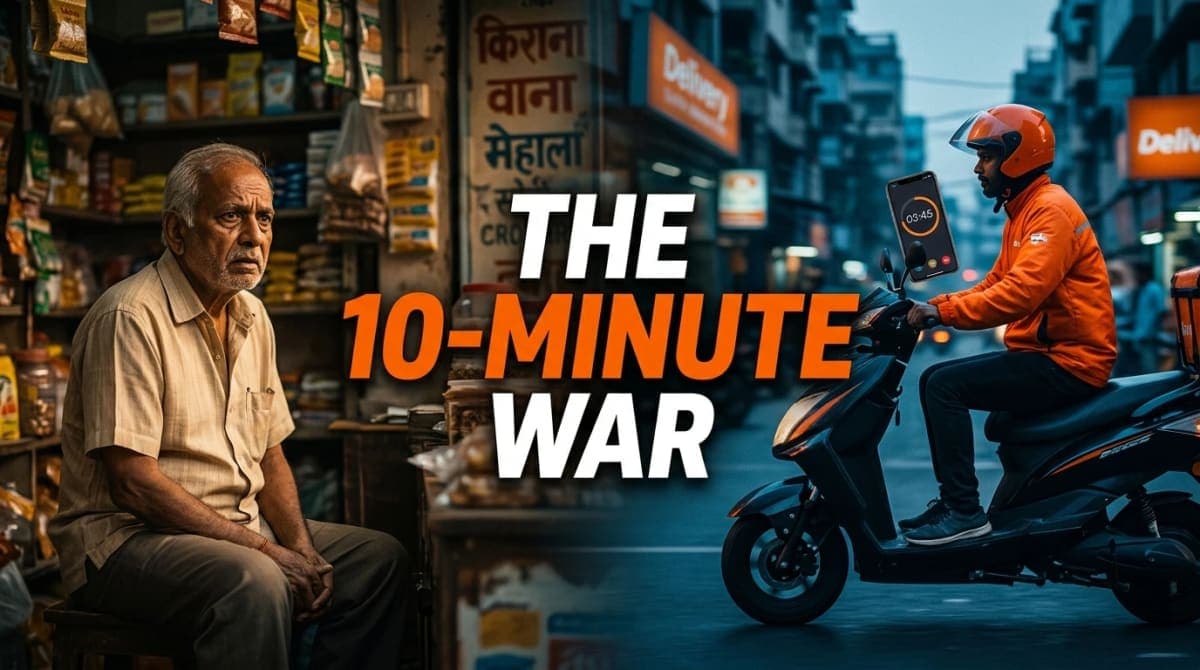
If it’s fast and convenient, what’s the problem? Here’s the thing: The neighborhood Kirana store is feeling the heat.
For decades, the local shopkeeper was the backbone of the Indian economy. They gave you credit when you were short on cash and knew exactly which brand of tea you liked. But they can’t compete with a "Dark Store" that has 10,000 items and deep pockets to offer massive discounts.
Is there a catch?
Absolutely. These Q-Comm giants are burning cash like a bonfire. 🔥
They are spending millions of dollars to acquire customers (that’s you!), hoping that once you’re addicted to the 10-minute life, they can eventually raise prices or delivery fees. It’s a classic "winner-takes-all" battle.
Is this sustainable?
Right now, companies like Zomato (Blinkit), Zepto, and Swiggy (Instamart) are acting like they’re in a high-speed chase. They are expanding into electronics, clothes, and even toys. If you can get an iPhone in 10 minutes, why go to a mall?
But as the markets act like a roller coaster, investors are starting to ask: When do we actually make a profit?
High rents for dark stores and the rising cost of petrol mean that every time you order a single packet of Maggi, the company might actually be losing money on that delivery.
What do you think?
We’ve traded the walk to the corner store for the convenience of the couch. It’s brilliant for our schedules, but it might be rewriting the DNA of our neighborhoods.
Are we okay with a future where the local shopkeeper is replaced by a "Dark Store" we never see?
Until then... keep an eye on that timer. ⏳