Imagine you have a friend, let’s call him Rahul. Rahul tells you he’s "technically" single. You celebrate! But then he whispers, "But my three exes are still living in my apartment, and they hate you."
Suddenly, the celebration feels... complicated.
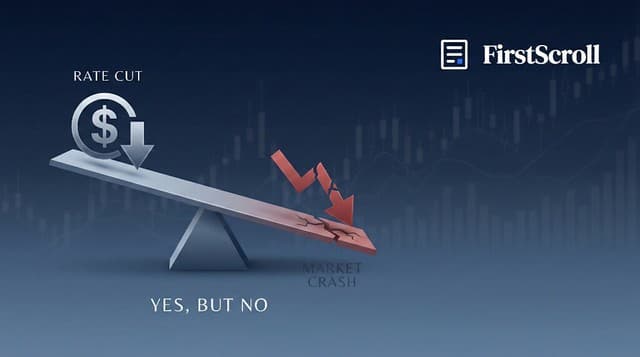
That is exactly what happened to the global economy yesterday. The US Federal Reserve (the "Rahul" of this story) announced it is cutting interest rates. On paper, this is great news. Lower rates mean cheaper loans, happier businesses, and green stock markets.
But the market didn't celebrate. The Sensex tanked over 530 points to close at 84,559, and the Nifty slipped below the psychological 25,900 mark.
Why? Because while the Fed said "Yes" to a rate cut, three key people in the room screamed "No."

Markets heard the rate cut but reacted to the warning behind it.
On Wednesday afternoon (US time), the Federal Open Market Committee (FOMC) voted to lower the benchmark interest rate by 25 basis points (0.25%). This brings the target range down to 3.50% to 3.75%.
This was widely expected and marks the third rate cut of 2025.
The plot twist: The vote was 9 to 3.
Three voting members Austan Goolsbee, Jeffrey Schmid, and Governor Stephen Miran dissented.
They voted against the cut.
This is a massive deal.
The Fed usually likes to look like a boring, united front. A three person dissent is a rebellion. It signals the era of "easy money" is facing serious internal resistance.
The dissenters believe inflation is still too sticky (hovering around 2.8% versus the 2% target) and that cutting rates now could be a mistake.
Think of the US economy as a car.
The driver: Jerome Powell (Fed Chair) The brake: Interest rates For years, Powell slammed the brakes to stop the car from speeding (inflation). Now that the car has slowed, he is lifting his foot gently. The problem? Three passengers in the back seat are yelling, "Don’t lift your foot, we are still going too fast!" When passengers panic, investors panic too and they sell.
Markets love certainty. This split vote destroyed it.
- Fed rate: 3.50% to 3.75%
- Inflation: Core PCE stuck at 2.8%
- Market reaction: Sensex down 0.63%
A divided Fed means future rate cuts are no longer guaranteed. If the Fed pauses in 2026, the entire bull market narrative weakens.
FIIs sold this much in Indian equities in a single day, even before the announcement.
You might wonder: why does an argument in Washington affect your SIP in Mumbai? Here’s the chain reaction.

A rate cut on paper. A disagreement in the room.
Higher US rates make the dollar more attractive. Money flows out of emerging markets.
Result: The rupee is hovering near record lows (around ₹90.27 per dollar), making imports like fuel and electronics more expensive.
If India cuts rates while the US holds steady, foreign money exits faster.
Verdict: Don’t expect EMI relief in early 2026. The RBI will likely prioritize currency stability over growth.
Indian equities are expensive. High valuations were justified by expectations of aggressive rate cuts.
That dream took a hit yesterday.
Why were there three dissenters?
Because dissenters often see risks before everyone else. If inflation resurfaces in 2026, the Fed may have to reverse course.
If that happens, this correction is just the appetizer. The main course would be a recession.
Watch the Fed’s dot plot and speeches from dissenting members. Their tone will decide the market’s direction.
For investors: this isn’t the moment to blindly buy dips. Stick to quality, profitable businesses.
The bottom line: The Fed delivered a rate cut wrapped in a warning label. Easy money is over. Volatility is the new normal.
Fun fact: The last three member Fed dissent happened in 2014, right before the post 2008 cycle ended.
If market noise stresses you out, you are not alone. That is exactly why we built First Scroll.
It is a daily, five minute, mobile first finance read that explains what happened, why it matters, and what to remember without hype or panic.
If this article helped you think clearly today, you will enjoy reading First Scroll every morning.
Subscribe to First ScrollSources: The Daily Economy | Times of India | Nuveen