I still remember the specific anxiety of booking a Tatkal ticket at 10:00 AM. You have exactly 45 seconds before the IRCTC site crashes or your “Confirmed” status turns into “WL 145”. It is a rite of passage for every Indian.
Yesterday, while we were busy scrolling through holiday photos, the government quietly nudged the price of that anxiety a little higher.
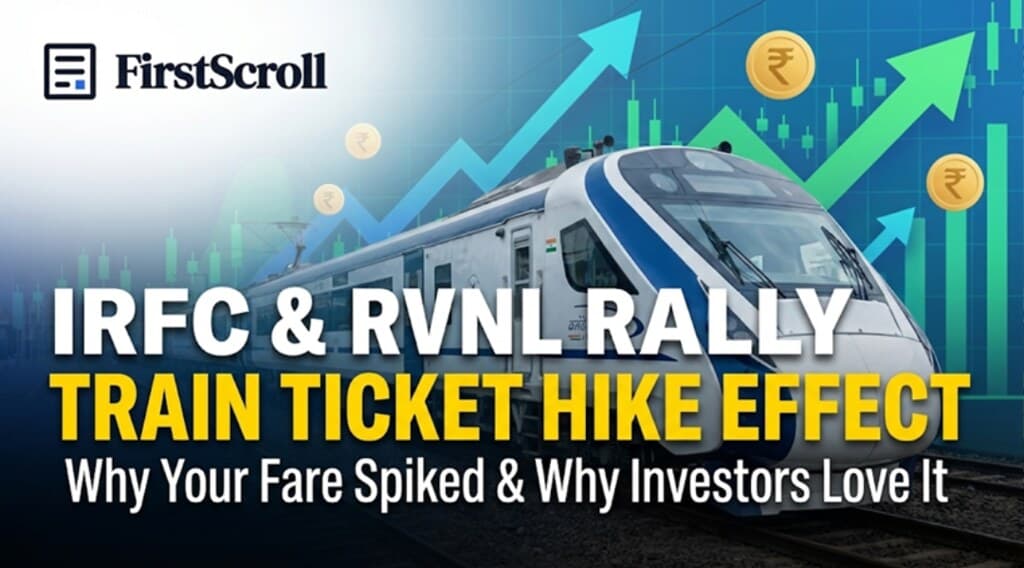
Effective today, passenger fares are up. And while you might be grumbling about the extra rupees, the stock market is absolutely throwing a party.
Specifically, the folks holding IRFC are having a very good Friday.
If you checked your portfolio this morning, you probably saw a sea of green in railway stocks.
IRFC surged over 7 percent, while RVNL jumped nearly 10 percent in early trade.
What triggered this?
The Ministry of Railways announced a fare rationalization (corporate speak for “price hike”) that kicked in today, December 26.
- The hike: 1 paisa per km for ordinary classes and 2 paise per km for Mail and Express trains
- The impact: On a 500 km journey, you pay roughly ₹10 extra
- The big picture: Multiply that ₹10 by billions of passengers and you get serious money
Imagine you want to buy a fancy bike but do not have the cash.
Your rich dad, IRFC, buys it for you. You get to ride it, but you pay him a fixed monthly rent.
Now, if you suddenly get a pay raise, your dad does not earn more immediately. But he is happy because you are less likely to default and might ask for another bike next year.
That is exactly how IRFC works with Indian Railways.
This is not just about ticket prices. It is a signal.
For years, Indian Railways subsidized passengers by using freight profits to cover losses.
This hike signals a shift toward financial sustainability.
1. The Pre-Budget Hype Train
We are weeks away from the Union Budget on February 1, 2026.
Markets see this hike as preparation for a large capex announcement, rumored to be around ₹1.3 trillion for safety and upgrades.
2. The Ecosystem Effect
When Railways earns more, it spends more.
This lifts lenders like IRFC, builders like RVNL, and service platforms like IRCTC.
Money is rotating from expensive tech stocks into policy driven infrastructure plays.
The last fare hike in July 2025 generated an additional ₹700 crore in revenue. That is enough to buy roughly six new Vande Bharat trains.
Let us pause the celebration.
Does a fare hike actually change IRFC’s profits?
Not directly.
IRFC operates on a cost plus model. It borrows, lends to Railways, and earns a fixed spread guaranteed by the government.
So why is the stock up?
Sentiment and volume.
A financially healthier Railways can borrow more for expansion.
But if the Budget disappoints on capex, this rally can unwind quickly.
Keep your eyes on February 1, 2026.
- Bull case: Record railway spending and rapid loan growth
- Bear case: Asset monetization and excess supply of shares
The bottom line: The fare hike is tiny for passengers but massive for market psychology.
Fun fact: IRFC has zero NPAs because its only borrower is the Government of India.
If markets stress you out, you are not alone.
That is exactly why we built First Scroll. It is a daily, five minute, mobile first finance read that explains what happened, why it matters, and what to remember without hype or panic.
Subscribe to First ScrollSources: Economic Times | India Today | Equitymaster