The Story
In today's FirstScroll, we break down the invisible 5.5% gap between what businesses pay and what you pay, and why it's a ticking time bomb for your budget.
Imagine you walk over to your favorite neighborhood chai stall. You pull out a ₹10 note, expecting your usual hot cup. The tea tastes the same, the cup is the same size, and the price hasn't budged. You walk away thinking everything in the economy is stable. But what you don't see is that the stall owner just paid 10% more for his milk delivery and 15% more for his gas cylinder this morning. He is losing money on every cup he sells you, just to keep you from walking over to the rival stall across the street.
To put things in perspective, this is exactly what is happening across India right now on a massive scale. If you look at the headlines, things seem calm. Retail inflation, or what the experts call the Consumer Price Index (CPI), is sitting at 4.4%. This is the number that tracks the prices of things you and I buy, from onions to iPhones. It is within the RBI's comfort zone, and it feels like we have dodged the global inflation bullet.
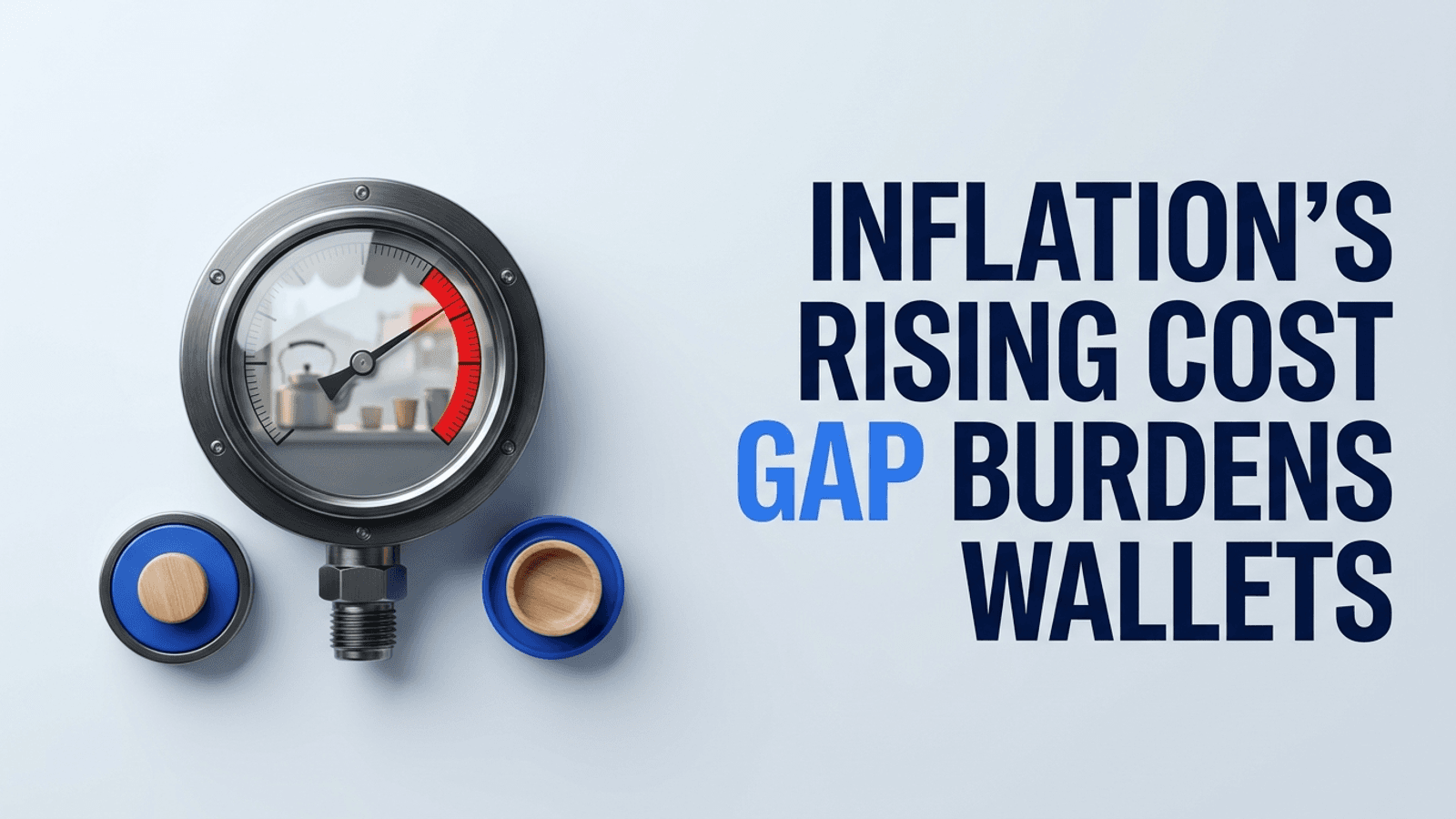
But there is a second number that tells a much scarier story. The Wholesale Price Index (WPI), which tracks the prices that businesses pay each other at the factory gate, has exploded. In June 2026, WPI inflation hit 9.87%. That is a 5.47% gap between what it costs to make things and what those things are being sold for at the mall.
Now I know what you're probably thinking: If businesses are paying more but I am not, isn't that a good thing for me? In the short term, yes. But in the long term, this Decoupling Gap is like a pressure cooker with a blocked valve. The steam is building up, and eventually, it has to go somewhere.
The Energy Shock at the Gate
The primary reason for this sudden spike is the reported blockade in the Strait of Hormuz. For context, this narrow strip of water is the world's most important oil artery. With tensions rising and tankers being diverted, the cost of crude oil and liquefied natural gas (LNG) has spiked. This has pushed energy prices toward $110 or roughly ₹9,240 per barrel.
Think of it this way. The WPI is much more sensitive to these industrial inputs. Factories need huge amounts of power to run machines. Logistics companies need diesel to move trucks. Manufacturers need chemicals and plastics derived from oil. While food carries more weight in the retail basket, the WPI feels the pain of the Hormuz blockade almost instantly because of its heavy reliance on global commodity prices. Retail prices, on the other hand, are food-heavy. Since the government manages grain stocks and monitors local vegetable prices, the CPI remains cushioned for a while.
But there's a catch here. A manufacturer might be able to eat the extra cost of electricity for a month or two. They might absorb the loss by cutting their marketing budget or delaying their office renovation. But eventually, those 9.87% higher costs will become too heavy to carry. They will have no choice but to pass the bill to you.
The Margin Squeeze and the Silent Time Bomb
When the gap between WPI and CPI is this wide, we call it a margin squeeze. It means corporate profits are being cannibalized. If a company that makes biscuits sees its flour and packaging costs go up by 10% while it keeps its packet price at ₹20, its profit disappears. To stay alive, that company usually does one of three things. They either shrink the packet size (shrinkflation), they stop hiring new staff to save money, or they wait for a big bang price hike.
The danger of the current situation is the lag effect. History tells us that WPI is a leading indicator. It is the early warning system for the economy. When factory prices stay high for more than a quarter, retail prices eventually catch up to close the gap. If the Strait of Hormuz remains blocked, the 4.4% retail inflation we are seeing today could reportedly jump to 7% or 8% by the end of the year.
So yeah, while your grocery bill feels okay today, the ghost of future inflation is already haunting the warehouses and factories of India. Businesses are currently acting as a shock absorber for the consumer. But every shock absorber has a limit before it snaps.
What Happens Next?
The RBI is in a difficult position. While they must monitor economic growth, their primary mandate is price stability. They can see this wholesale tidal wave coming. If they wait too long to act, they might be forced to hike rates aggressively later, which could hurt everyone's home loans and car EMIs. On the other hand, if the blockade clears up next week, the WPI might drop back down, and the crisis will be averted without you ever feeling the pinch.
But for now, the 5.47% gap is a critical number in Indian finance. It tells us that the real cost of living is currently higher than what we see on our receipts. It is a silent reminder that in a globalized world, a conflict thousands of miles away in the Middle East eventually finds its way into the cost of your morning chai and your evening commute.
Do you see this gap as a sign of business resilience that will eventually fade, or is it a warning that we are headed for a massive cost-of-living shock? How you answer that determines whether you should be preparing for potential price hikes or sticking to your current spending plan.
The gap between what it costs to make a product and what you pay for it is essentially a high-interest loan we are all taking from the future.
Until then…
If you found this breakdown helpful, why not share it with a friend who is tracking the recent reports of corporate hiring freezes?