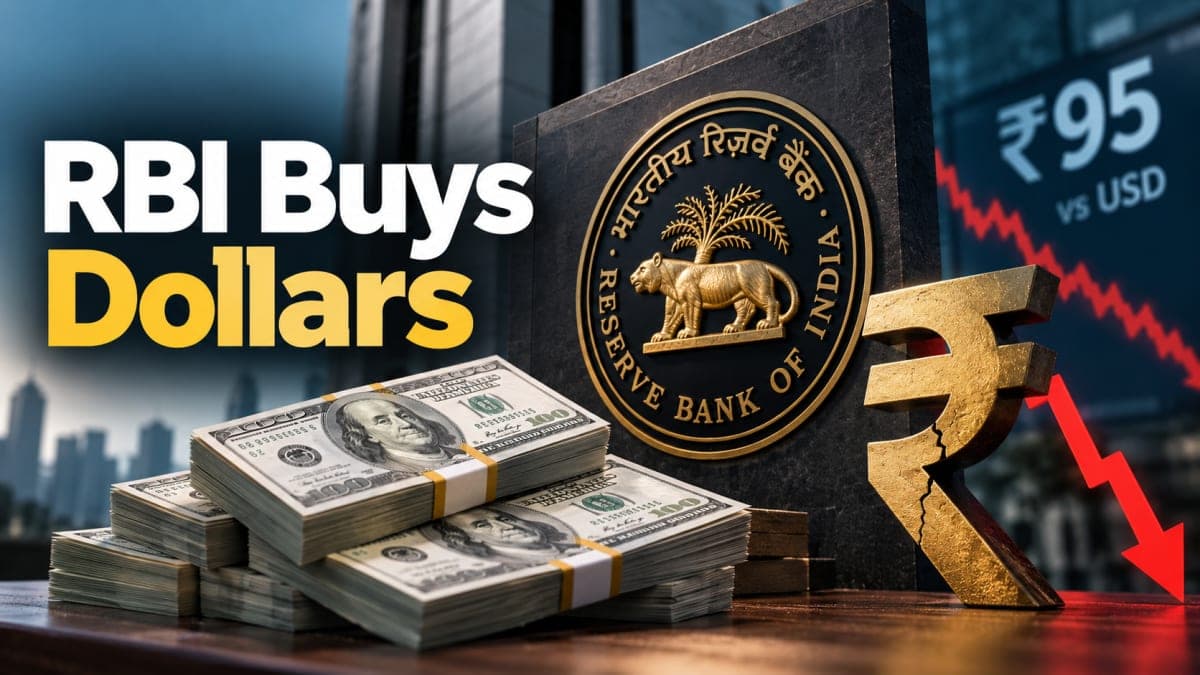
Why the RBI Buys Dollars When the Rupee Is Weak
In today's FirstScroll, we break down why the RBI buys dollars when the rupee is weak, and why India's record reserves are not quite what they seem.
The Story
Picture a family in Kochi with a son working in Dubai. For years, payday meant the same ritual: convert the salary, send the rupees home, and smile a little wider every time the rupee slipped.
This summer, the son got a different offer. His bank in India wanted his savings in dollars, not rupees, and it was willing to pay him far more than usual to keep them there for five years.
That offer did not come from nowhere. It came from Mint Street, and it sits at the heart of one of the strangest things the Reserve Bank of India has done in over a decade.
Then, the West Asia conflict hit and oil prices soared. As we saw in our story on [India's crude oil import bill](INTERNAL: india crude oil import bill 2026), India suddenly needed far more dollars to buy the same oil.
The RBI stepped in to slow the rupee's fall, and India's forex reserves fell by nearly $50 billion in a few months. Even so, by early September the rupee was trading near 95 to the dollar.
A central bank defending a falling currency is supposed to sell dollars. Yet the RBI spent the summer pulling dollars in at a record pace, and reserves just hit a record $785.7 billion.
So here's the question: why would the RBI buy dollars when the rupee is already weak, and isn't that the opposite of defending it?
You see, a central bank's dollar reserves work like a fire extinguisher. If you empty it on the first blaze, you have nothing left for the next one. Every dollar the RBI sells to prop up the rupee is a dollar it cannot sell tomorrow.
So the RBI has two jobs that pull in opposite directions. It must calm the rupee today, and it must refill the extinguisher for the next shock. The trick is doing the second without undoing the first.
This is where something called a currency swap comes in. In a swap, the RBI buys dollars from a bank today and promises to sell the same dollars back on a fixed future date. Buy now, return later.
In June, the RBI opened a special swap window for FCNR(B) deposits. FCNR(B) stands for Foreign Currency Non-Resident (Bank), which is simply a fixed deposit that NRIs hold in dollars instead of rupees. Banks could collect these deposits for three to five years and swap the dollars straight to the RBI.
Before this, NRIs had nearly stopped using these deposits. Inflows had shrunk to $946 million in FY26, down from $7.08 billion the year before.
For the NRI, the new logic was simple. The RBI agreed to bear the full hedging cost, which is the fee a bank pays to protect itself if the rupee moves. With that cost gone, banks could offer much fatter interest rates on dollar deposits.
And for the banks? Long-term money at a good price, with the currency risk quietly handed over to the RBI.
As for the RBI, it got a mountain of dollars. The window drew $136.37 billion in total inflows by August 31, when the deposit route shut, with FCNR(B) deposits making up roughly nine tenths of it.
But why doesn't all this buying push the rupee down further? Because these dollars were not bought from the open market, where the RBI would be competing with importers. They are fresh money that would never have entered India otherwise.
Now, reserve numbers sound like something only economists track, so why should you care? Because a weak rupee makes everything India imports costlier, from the petrol in your scooter to a sibling's tuition fees abroad. The size of the RBI's cushion decides how long it can fight that, and it shapes decisions like the ones in our [RBI monetary policy 2026 explained](INTERNAL: rbi monetary policy 2026 explained) story.
But here's the twist. These dollars are borrowed, not earned. Every single one comes with a promise to hand it back.
That promise lives in the RBI's forward book, a running tally of dollars it has committed to sell in the future. Its net short dollar position hit a record $136.77 billion at the end of July, with about $91.5 billion of that due after more than a year.
So the record $785.7 billion is real, but it is not all spare. Knock July's forward commitments off September's headline and, very roughly, the free cushion looks closer to $650 billion. The book has likely grown since July too, as more swaps were booked.
The subsidy is not free either. By absorbing the hedging cost, the RBI takes on the currency risk itself, which could shrink the surplus it usually passes on to the government.
Now to be clear, this is not a reckless new trick. The RBI ran a similar window in 2013 when the rupee was under intense pressure, and this time it started from a much stronger base of $682.3 billion.
The long lock-ins help as well. Deposits tied up for three to five years cannot flee in a panic, and they buy time for oil prices to cool.
So, is the RBI defending the rupee or refilling its tank? Both, and the swap is how it does the two at once. It bought time, and it paid for that time in future dollars.
The real test comes later. The fresh inflows have stopped, and the first repayments fall due from 2029. Whether India's economy is strong enough by then to hand those dollars back without leaning on the rupee again is something only time will tell.
Until then…
If this story helped you make sense of why the RBI buys dollars when the rupee is weak, share it with a friend on WhatsApp, LinkedIn, or X.