In today's FirstScroll, we break down why the Indian Rupee is hitting record lows, and why the falling oil prices that usually save it are failing to stop the slide.
The Story
Picture a currency trader in a glass tower in Mumbai, eyes darting across a bank of glowing monitors. On any normal Tuesday, if she saw headlines saying that global oil prices were crashing, she would expect to see the Indian Rupee strengthening. After all, India buys most of its oil from abroad, so cheaper crude usually means we need fewer dollars to pay our bills.
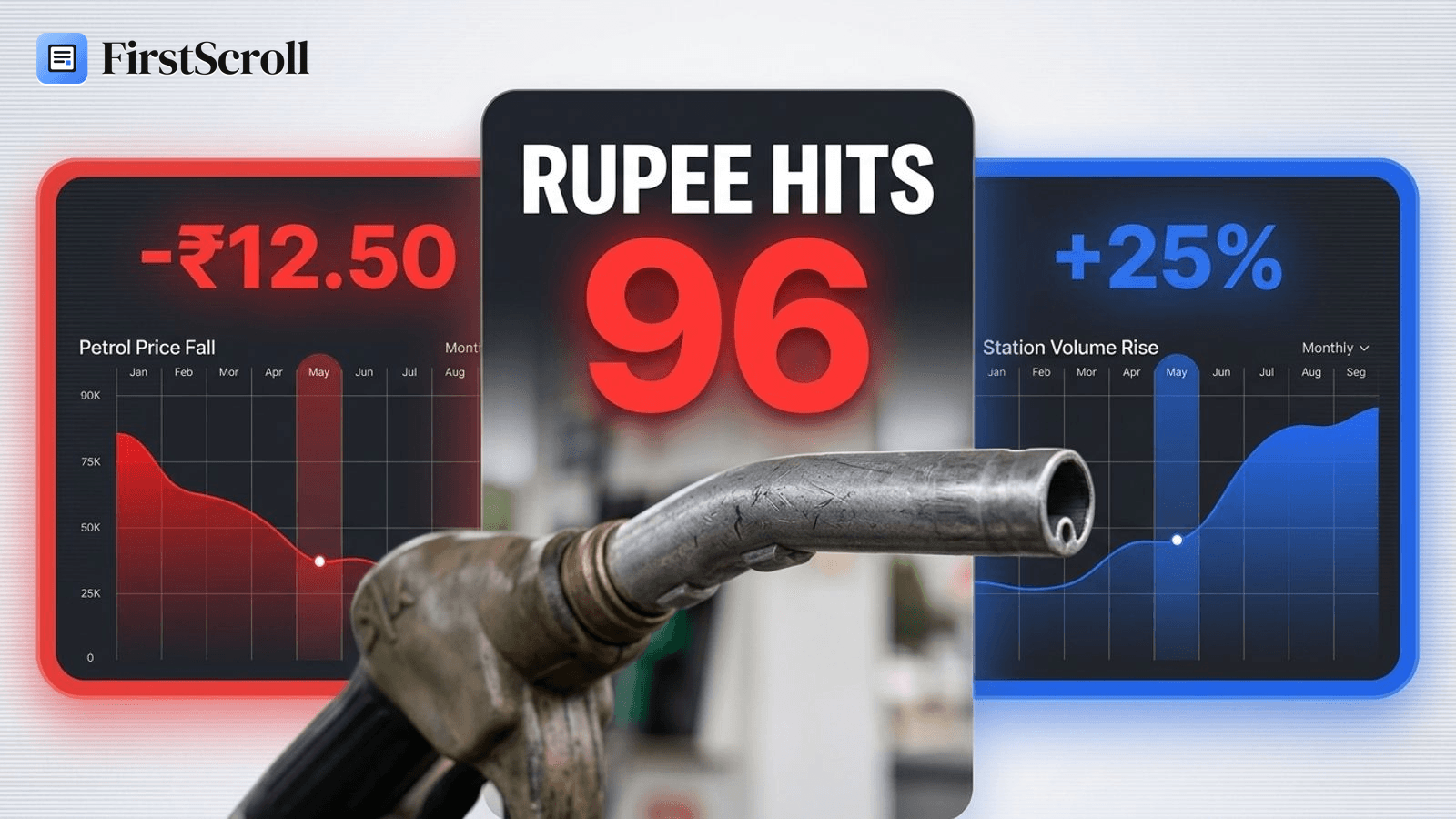
But this Tuesday was different. As the trader watched the screens, the number everyone fears finally flashed. The Indian Rupee briefly breached the 96 mark against the US dollar. It opened at 96.05 and touched a low of 96.15 before pulling back slightly to close at 95.98.
Then came the data on the very thing that was supposed to help. Crude oil prices actually settled down by 2.5% as supply from the Middle East began to recover. Brent crude futures closed at $102.59 a barrel, while US West Texas Intermediate dropped to $89.38.
And here is the strange part. Even though the pressure from oil was lifting, the Rupee stayed under relentless strain. It was a classic economic paradox where the usual rules of the game seemed to have been rewritten overnight.
So here's the question: if the high oil prices that usually crash the Rupee are finally falling, why is our currency still hitting record lows and why is rupee falling despite low oil prices?
You see, the problem is not what we are spending on oil. It is the sheer, gravitational pull of the US dollar. The global economy is currently caught in a storm where the dollar is acting like a giant magnet, sucking up cash from every other corner of the world.
Think of the US dollar as the most popular kid in school who just started giving out free candy. Everyone wants to be near that kid, and they are willing to leave their other friends behind to get there. In the financial world, that "candy" is high interest rates. Because the US Federal Reserve is expected to keep raising rates, investors are dumping other currencies to buy dollars and earn those higher returns.
Now add the second ingredient: it is not just the Rupee that is suffering. The euro fell to a 16-month low of $1.1312 this week. At the same time, the US 30-year bond yield, which represents the interest the US government pays to its lenders, rose to its highest level since 2002. When the safest government in the world offers its best returns in two decades, money flows out of emerging markets like India and back to America.
This explains why are FPIs selling Indian stocks 2026 at such a rapid pace. These Foreign Portfolio Investors are seeing better, safer deals back home, and as they sell their Indian assets, they convert their Rupees back into dollars, which pushes the Rupee down further.
So who wants what here? The Indian government and the Reserve Bank of India (RBI) want stability. They know that a crashing Rupee makes everything we import, from electronics to machinery, more expensive. This triggers inflation, which might force the central bank to hike rates.
You might be wondering what the repo rate actually does to your daily life. Simply put, if the RBI raises rates to protect the Rupee, your home and car loans get more expensive. It is a tough balancing act, protecting the currency without hurting the common man's pocket.
This is where the RBI’s war chest comes in. To stop the Rupee from falling off a cliff, the RBI has been selling its own stockpile of dollars. It is a massive operation. Foreign exchange reserves declined by $14.9 billion in just a single week, leaving the total at $765.9 billion. They are essentially flooding the market with dollars to make them less scarce and less expensive.
But the domestic bond market is adding another layer of complexity. Indian government bond supply may outweigh demand, which is pushing local yields higher. This means the Indian government has to pay more to borrow money, which complicates the RBI’s job of managing the economy's overall interest rates.
Now, global currency movements might feel like something that only affects big banks, so why should you care? Because even if oil is cheaper, a weak Rupee eats up those savings. If crude drops in price but the Rupee falls by a similar proportion, the price at your local petrol pump stays exactly the same. We are effectively losing the "oil discount" because our currency is losing its punch.
But here's the twist. India has actually been quite successful at attracting dollars lately through other routes. Large amounts of money have come in through foreign bank deposits and corporate borrowings. However, as economists have noted, this hasn't helped the Rupee because the RBI buys dollars to build up its reserves rather than letting that money enter the open market. They are saving for a rainy day, even if it makes the current sunny day feel a bit chilly.
There is also the matter of timing. Analysts point out that while the dollar rally is strong, it might be "stretched." Some indicators suggest the dollar is overbought, and we might see a "month-end rebalancing" where the Rupee gets a small breather.
Now to be clear, the Indian economy itself remains relatively strong. The Rupee’s fall is less about India’s failures and more about America’s runaway strength. While experts believe the currency could stay in a range of 94.5 to 96 in the near term, the pressure from high global interest rates isn't going away overnight.
So, is the Rupee’s record slide about oil? Not really. It is about a global financial tug-of-war where the US dollar is pulling harder than anyone else. India is fighting back with its massive reserves and steady intervention, but it is a battle against global tides.
Whether the RBI can keep the 96 mark as a temporary peak or if it becomes the new normal is something only time will tell.
Until then…
If this story helped you make sense of why is rupee falling despite low oil prices, share it with a friend on WhatsApp, LinkedIn, or X. You might also enjoy our story on why the RBI buys dollars when the Rupee is weak.