In today's FirstScroll, we talk about the India-Oman trade pact that kicked in this week, and why a deal with a small Gulf nation says a lot about where India is heading.
The Story
Quick. Name three things you associate with Oman.
If you're like most Indians, you probably drew a blank after the first one. Maybe you thought of the Gulf, of oil, of a relative who once worked in Muscat. Oman rarely makes our headlines. It's a quiet, modestly sized country tucked into the corner of the Arabian Peninsula.
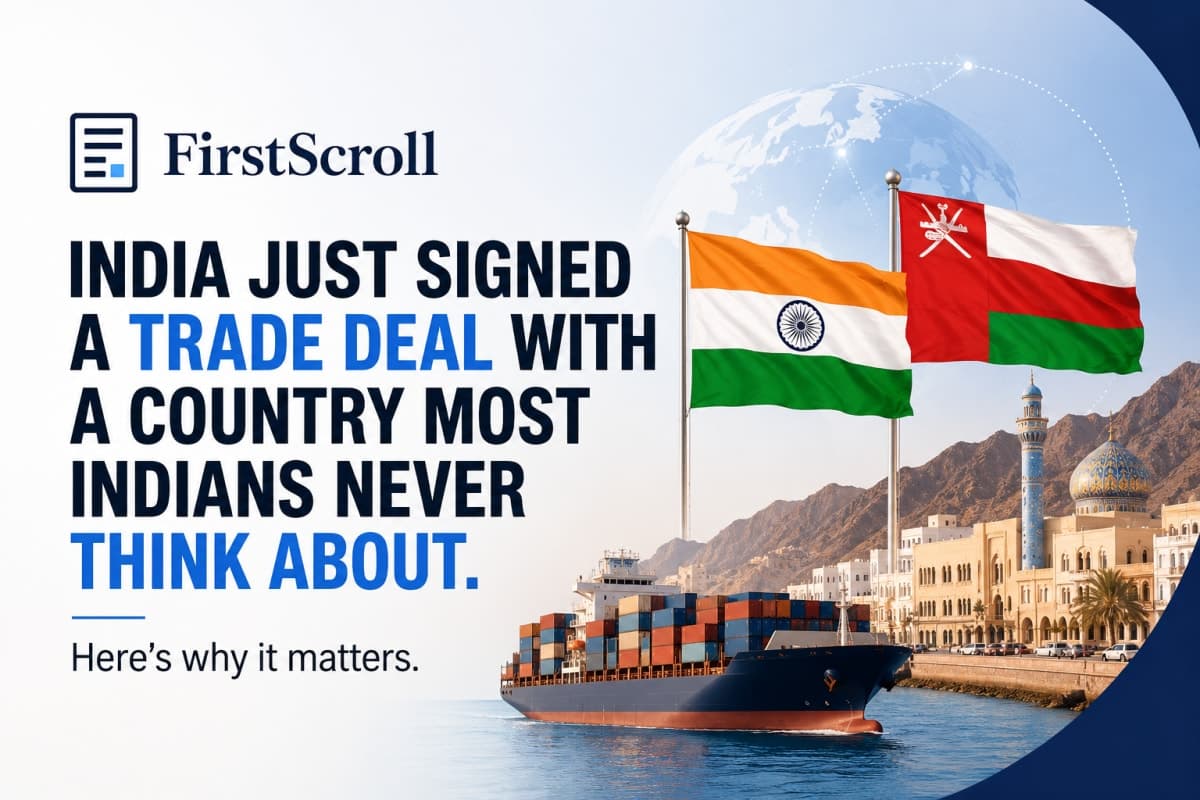
And yet, on June 1, India switched on a trade agreement with exactly this country. It's called the Comprehensive Economic Partnership Agreement, or CEPA, and it was signed in December last year during Prime Minister Modi's visit to Muscat.
So why is India striking deals with a country we barely think about? That's the interesting part.
But first, let's understand what this agreement actually does.
For the uninitiated, when two countries trade, the importing country usually slaps a tax called a customs duty, or tariff, on goods coming in. So if an Indian jeweller wants to sell gold jewellery in Oman, Oman might charge a 5% tariff at its border, which makes that Indian jewellery more expensive, and therefore less competitive, against jewellery from countries Oman taxes less.
A free trade agreement is basically two countries agreeing to drop these border taxes for each other.
Think of it like two neighbouring housing societies that decide to scrap the entry toll for each other's residents. Suddenly, it's cheaper and easier for people from one society to shop, work, and do business in the other. Both sides hope the increased movement makes everyone better off.
Under this deal, the numbers are striking. Oman has agreed to offer zero-duty access on 98.08% of its tariff lines, which covers a remarkable 99.38% of India's exports to Oman. In plain terms, almost everything India sells to Oman will now enter completely tax-free.
And this matters most for a specific kind of Indian business. The labour-intensive ones.
Sectors like gems and jewellery, textiles, leather, footwear, sports goods, plastics, furniture, and engineering products all get full tariff elimination. These are exactly the industries that employ large numbers of ordinary workers. So a small textile exporter in Tirupur or a leather unit in Kanpur now has a slightly easier path into the Omani market. Removal of a 5% tariff, for instance, improves the competitiveness of Indian vehicles there.
In return, India is offering duty concessions on about 77.79% of its tariff lines, covering 94.81% of its imports from Oman by value.
Now, here's where it gets a little more clever, and a little more cautious.
India didn't just throw its doors wide open. For products that are sensitive for India, things like dates, marble, and certain petrochemicals, India used something called a tariff-rate quota. This means a limited quantity can come in at a low or zero duty, but beyond that limit, the normal tariff kicks back in. It's a way of opening the door, but only partway, so domestic producers aren't suddenly flooded.
And India went further to protect its own. It placed 2,789 tariff lines on an exclusion list, shielding sensitive sectors like transport equipment, major chemicals, cereals, fruits, vegetables, spices, coffee, and tea. Translation: India happily dropped tariffs where it helps Indian exporters and consumers, but kept its guard up around farmers and industries that could get hurt by cheap imports.
This is the quiet skill in modern trade deals. It's not about blindly removing all taxes. It's about choosing precisely where to open up and where to stay protected.
But honestly, the goods part of this deal isn't even the most interesting bit.
The real headline is about people.
The agreement includes a big upgrade in what's called professional mobility, or in trade jargon, Mode 4. This is the part of a trade deal that governs how easily a country's professionals can go and work in the other country.
And the improvements here are significant. Oman has agreed to increase the quota for Intra-Corporate Transferees from 20% to 50%. For the uninitiated, an intra-corporate transferee is simply an employee a company moves from its office in one country to its office in another. So an Indian firm with an Oman branch can now send a far larger share of its own people there.
Even better, contractual service suppliers, essentially skilled professionals sent to do specific projects, can now stay for two years instead of the earlier 90 days, with the possibility of another two-year extension. And entry conditions have been eased for skilled professionals in fields like accountancy, taxation, architecture, and medical services.
Why does this matter so much for India?
Because people are arguably India's biggest export. India already has a massive diaspora across the Gulf, sending home tens of billions of dollars in remittances every year. Making it easier for Indian professionals, not just labourers but accountants, architects, and doctors, to work in the Gulf directly strengthens one of India's most reliable economic lifelines.
Which brings us back to the original question. Why Oman, and why now?
The answer is that this isn't really just about Oman. It's about a pattern.
This is the fifth free trade agreement India has implemented in recent years, after deals with Mauritius, Australia, the UAE, and the EFTA bloc of European nations. India has also signed agreements with the UK and New Zealand, and concluded talks with the 27-nation European Union earlier this year.
Do you see what's happening? For decades, India had a reputation for being cautious, even reluctant, about free trade. It worried, often with good reason, that opening its markets would let cheap foreign goods crush its domestic industries. So it stayed guarded.
That India is changing. The country is now signing trade deals at a pace it never has before, methodically, one partner at a time, each deal carefully calibrated with quotas and exclusion lists to protect what's sensitive while opening up where it helps.
Oman, in that sense, is one tile in a much larger mosaic. India is steadily weaving itself into a web of trade relationships across the Gulf, Europe, and the Asia-Pacific. Part of this is opportunity. A fast-growing India wants bigger markets for its exporters and easier passage for its workers. And part of it is insurance. In a world where the old certainties of global trade are wobbling, where a single decision in Washington can upend tariff assumptions overnight, having many trading partners means you're never too dependent on any one of them.
So the next time you see a headline about India signing a trade deal with a country you barely think about, it's worth remembering what it really signals. It isn't just about that one country. It's about an India that spent decades being wary of the world's markets, now quietly and deliberately deciding to open its arms, one carefully negotiated handshake at a time.
The deal with Oman is small. The shift it represents is anything but.
Until next time…