In today's FirstScroll, we talk about the interest rate decision coming this week, and the genuinely difficult corner the RBI has been backed into.
The Story
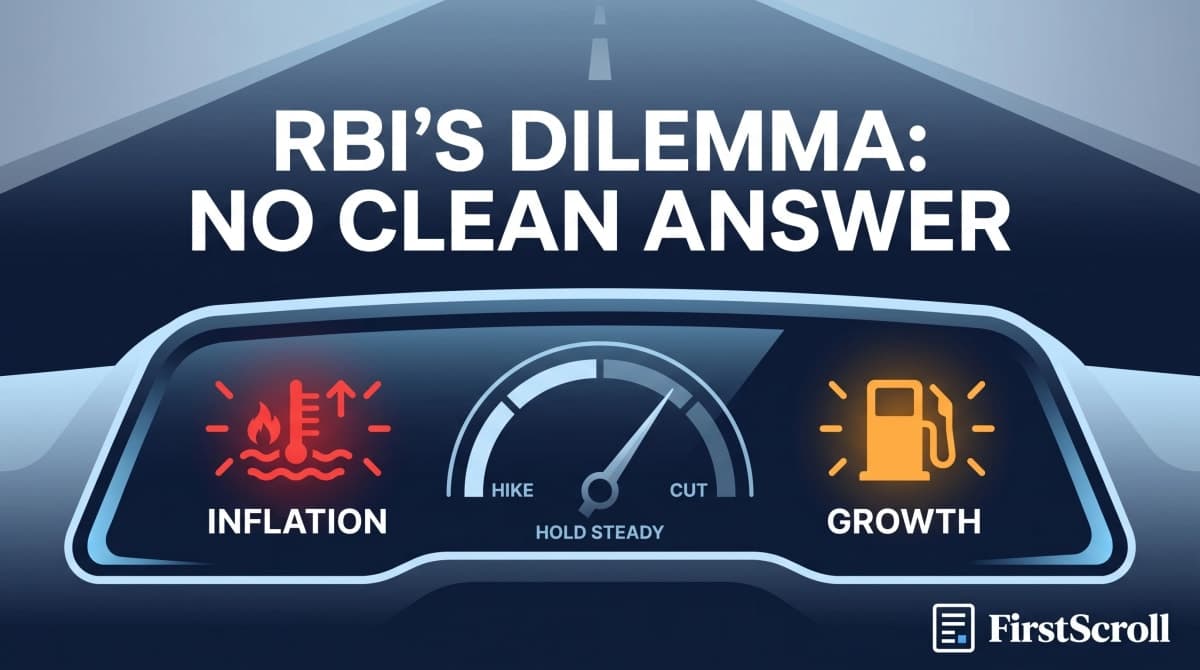
Imagine you're driving a car, and two warning lights flash on your dashboard at the same time.
One says the engine is overheating. The other says you're running low on fuel. The catch is, the two problems demand opposite responses. To cool the engine, you should slow down. But slowing down too much, in heavy traffic, risks getting you stranded.
That, roughly, is the situation the Reserve Bank of India walks into this Friday, June 5, when its rate-setting committee announces its decision.
Let's set the scene.
For the uninitiated, the RBI's most important job is managing the price of money in the economy. It does this through something called the repo rate, which is the interest rate at which the RBI lends to banks. When the repo rate goes up, banks raise the interest rates they charge you on home loans, car loans, and business loans. Borrowing gets costlier, people spend less, and that cools down rising prices. When the repo rate goes down, borrowing gets cheaper, people spend more, and the economy speeds up.
So the repo rate is essentially the RBI's accelerator and brake pedal for the whole economy.
The decision is made by a six-member group called the Monetary Policy Committee, or MPC, chaired by RBI Governor Sanjay Malhotra. They meet over three days, and on Friday at 10 AM, the Governor will tell the country what they've decided.
Right now, the repo rate sits at 5.25%. And almost every economist expects the RBI to leave it exactly there, unchanged, for the third meeting in a row.
Which sounds boring. A non-event. But the reason it's expected to do nothing is the interesting part, because doing nothing is itself a difficult choice when both your warning lights are on.
Here are the two warning lights.
The first is inflation, the overheating engine. You've felt this one yourself if you've filled fuel or bought groceries lately. The West Asia conflict has pushed up crude oil prices, the government has begun raising petrol and diesel rates, and these cost shocks are slowly working their way through the economy. Retail inflation projections are now creeping closer to the 5% mark. And when prices are rising, the textbook response is clear: raise interest rates to cool things down.
The second light is growth, the fuel gauge. India's economic momentum has softened. The RBI itself revised its growth forecast for the year down to 6.9%, and recent data on industrial activity and high-frequency indicators has been on the weaker side. When growth is slowing, the textbook response is the exact opposite: cut interest rates to encourage borrowing and spending, and give the economy a push.
Do you see the trap?
Inflation says raise rates. Growth says cut rates. The RBI cannot do both at once. And so, caught between two opposing pressures, it does the only thing that doesn't actively make either problem worse. It waits. It holds the rate steady and watches.
In central banking, this even has a name. A "neutral" stance. It means the RBI isn't committing to either cutting or hiking next time. It's keeping both hands hovering, ready to move in whichever direction the data eventually demands.
But here's what makes this particular meeting genuinely tricky, and why the Governor's tone on Friday matters more than the rate itself.
A year ago, the RBI had it easy. Inflation was low, growth was strong, and it had room to cut rates comfortably to support the economy. In fact, it did cut, quite aggressively, bringing the rate down over several meetings.
That comfortable world is gone. Today, inflation is rising, growth has been trimmed, the rupee is under pressure at record lows, and hovering over all of it is the West Asia conflict, a variable that neither the RBI nor anyone else can reliably forecast. If oil spikes further, inflation worsens. If it calms, the pressure eases. The RBI is, to a real degree, a hostage to events far outside its control.
This is why economists are watching not the number, but the words.
When the Governor speaks on Friday, markets will be parsing his tone for a signal. Does he sound worried about inflation, hinting that the next move could be a rate hike? Or does he sound more concerned about growth, leaving the door open to a future cut? That single shading of tone can move stock prices, bond yields, and the rupee within seconds, because it tells investors which way the RBI is leaning for the months ahead.
Think of it like a cricket captain setting a field. The bowler hasn't bowled yet, but where the captain places the fielders tells you a lot about what he expects to happen. The repo rate is the same. Holding it steady is the safe field. But the Governor's commentary is where he quietly reveals what he's bracing for.
So what does all this mean for you, practically?
If you have a home loan on a floating rate, a steady repo rate means your EMI doesn't change this week. No relief, but no pain either. The bigger question is the direction. A few months ago, there was hope the RBI would keep cutting rates, which would have lowered your EMI over time. That hope has faded. With inflation now the bigger worry, further rate cuts look less likely, and the small possibility of a future hike has crept onto the table.
If you're a saver with fixed deposits, the flip side applies. When the RBI is in wait-and-watch mode, banks don't rush to slash deposit rates, so your FD returns stay roughly where they are. And if the inflation worry eventually pushes the RBI toward a hike rather than a cut, deposit rates could even edge up. For anyone considering locking money into a very long fixed deposit right now, it may be worth pausing until the rate direction becomes clearer.
But step back from the EMIs and FDs, and there's a bigger story in this Friday's non-decision.
For a stretch of recent years, India's central bank was operating in fair weather. Inflation was tame, the world was relatively calm, and the RBI could focus single-mindedly on nurturing growth. The decisions were, relatively speaking, easy.
That era has quietly ended. The RBI now operates in a world where a war thousands of kilometres away sets the price of petrol in Indore, where a weakening rupee imports inflation through every barrel of oil, and where the old certainties of global trade are wobbling. In this world, the central bank's job is no longer about confidently steering toward one goal. It's about balance, patience, and keeping its options open in the face of forces it can't predict.
Friday's decision will likely be to do nothing. But that "nothing" is not inaction. It's the sound of an institution carefully holding its breath, both warning lights blinking on the dashboard, waiting to see which problem it will have to fight first.
The hard part isn't this decision. It's that there's no longer a clean answer in sight.
Until next time…