
In today's FirstScroll, we talk about why the government is preparing to sell a slice of the country's biggest insurer, and the quiet deadline forcing its hand.
The Story
Think about the last time you were forced to sell something not because you wanted to, but because a rule said you had to.
Maybe it was a deadline to clear out an old flat. Maybe a society rule that said you couldn't keep more than two cars in your parking spot. The point is, when you sell on someone else's timeline rather than your own, you rarely get the best price.
That is roughly the situation the Government of India finds itself in with Life Insurance Corporation.
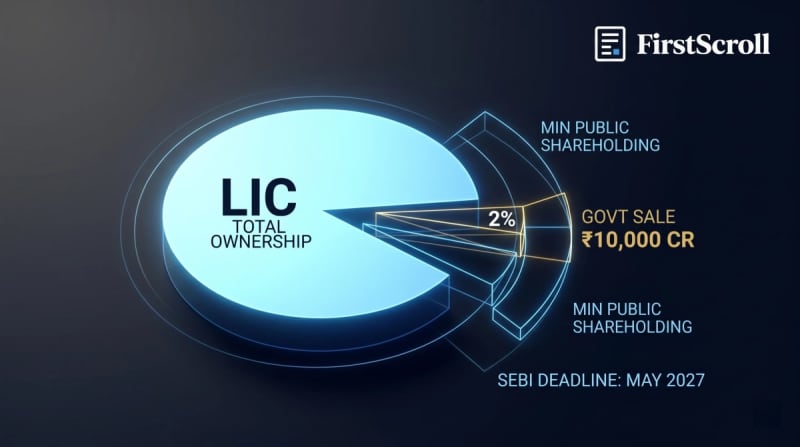
For context, the government is preparing to sell about a 2% stake in LIC sometime in late June or early July, in a deal that could raise up to ₹10,000 crore, or roughly $1 billion. It has lined up Goldman Sachs, Motilal Oswal, BNP Paribas, and IIFL Capital to manage the sale.
On the surface, this looks like a routine bit of disinvestment. The government owns a company, it sells a small piece, it pockets the cash. Happens all the time.
But the more interesting question is: why now? And why only 2%?
The answer takes us back to a rule most people have never heard of.
When LIC listed on the stock market in May 2022, in what was then India's largest ever IPO at ₹21,000 crore, the government sold only a tiny sliver of it. Just 3.5% of the company went to the public. The government held on to the remaining 96.5%.
And that's where the rule comes in.
For the uninitiated, SEBI, the market regulator, has something called the Minimum Public Shareholding norm. The idea is simple. If your company is listed on the stock exchange, a minimum portion of it, usually 25%, must be owned by the general public rather than the promoter. In LIC's case, the promoter is the government.
Why does this rule exist? Think of it like a basic fairness check for the stock market. If a company is publicly listed but 96.5% of it is locked up with a single owner, then the small free-floating portion can be easily pushed around. Prices can swing wildly on tiny trades, and ordinary shareholders are left at the mercy of one dominant promoter. A healthy public float keeps the stock liquid, the price honest, and the company accountable to outside shareholders.
So LIC has to get there. But here's the thing. Going from 3.5% public ownership to 25% is an enormous distance to cover, and dumping that much LIC stock on the market at once would crater the price.
So the regulators gave the government room to breathe. SEBI has set a deadline for LIC to raise its public shareholding to at least 10% by May 16, 2027. A longer runway exists for the full 25%.
And suddenly the 2% makes sense.
The government isn't selling 2% because that's all it wants to sell. It's selling 2% because it has a 2027 deadline creeping up, a colossal stake to offload, and a strong incentive to do it slowly, in small tranches, so it doesn't crash the very stock it's trying to sell. Sell too much too fast, and you flood the market and drive the price down. Sell in small slices over time, and you protect the value of everything you still hold.
It's the difference between dumping a thousand shares of a stock in one click versus selling a little each week. Any retail investor who has tried to exit a large position in an illiquid stock knows this instinct well.
So why is the government in a hurry to sell at all, beyond just ticking a regulatory box?
Because it needs the money.
India runs a fiscal deficit, which is simply the gap between what the government earns and what it spends. To plug that gap, the government has a disinvestment target every year, a plan to raise money by selling stakes in the public sector companies it owns. Selling LIC shares is one of the cleaner ways to hit that target, because LIC is profitable, popular, and there's genuine investor appetite for it.
And the timing is, in some ways, working in the government's favour. LIC recently reported a stronger than expected March quarter, and the stock had rallied nearly 5% before the sale buzz. The company crossed a milestone of over ₹10 lakh crore in debt assets under management. At current prices, each 1% of LIC is worth roughly ₹6,000 crore, which tells you just how enormous this institution is. Its total market value sits at over ₹5 lakh crore.
But here's where it gets interesting, and a little ironic.
The very week these stake sale reports emerged, LIC was busy doing something on the other side of the table. It was buying. LIC raised its stake in Central Bank of India to 6.06%, picking up nearly 2.9% of the public sector lender in a single market purchase.
So at the same moment the government is selling a piece of LIC to raise money, LIC itself is deploying its enormous pile of policyholder money to buy stakes in other companies, often other government-linked companies.
This is the quiet truth about LIC that's worth sitting with. It isn't just an insurer. It's the largest pool of domestic savings in the country, and one of the most powerful investing forces in Indian markets. When foreign investors sell Indian stocks, LIC is frequently among the buyers cushioning the fall. When a government company needs an anchor investor, LIC often shows up. It is, in many ways, the financial backbone the state can lean on.
Which raises a genuinely tricky question. Who is LIC actually working for?
On paper, LIC's job is to serve its policyholders, the crores of ordinary Indians who bought a LIC policy expecting safe, steady returns. But LIC is also majority-owned by the government, which means it can be nudged, gently or otherwise, to buy stakes in struggling state companies, to steady the market in rough times, or to act in the national interest as the government defines it.
Most of the time, these two roles coexist quietly. But they aren't always perfectly aligned. A purchase that helps prop up a government-linked company isn't automatically the best use of a policyholder's premium. And the more the government leans on LIC as a financial tool, the more that tension matters.
The stake sale doesn't resolve this. If anything, it sharpens it. As more of LIC moves into public hands, more outside shareholders will start asking exactly these questions about how their company's money is being put to work, and whether its decisions are being made for returns or for the state.
There's also a smaller, sweeter detail in all of this for existing LIC shareholders. Alongside the stake sale chatter, LIC is processing its first ever 1:1 bonus share issue and has announced a final dividend. A bonus issue simply means existing shareholders get additional shares for free in proportion to what they hold, in this case one extra share for every one held. It doesn't make anyone richer by itself, since the price adjusts accordingly, but it does increase the number of shares floating around, which can help improve liquidity. Useful, when you're a company that needs a lot more shares in public hands by 2027.
So when you read that the government is selling 2% of LIC, it's worth seeing it for what it really is. Not a one-off cash grab, but the first visible step of a long, carefully paced journey the government has no choice but to take. A deadline is ticking. A vast stake has to move. And the trick is to sell enough to satisfy the regulator and the budget, without ever selling so much that it spooks the market.
The real story of LIC was never just about insurance. It's about what happens when the country's largest saver, its most reliable market backstop, and a government revenue source all live inside the same institution, and that institution is slowly being handed over, 2% at a time, to the public.
Until next time…


