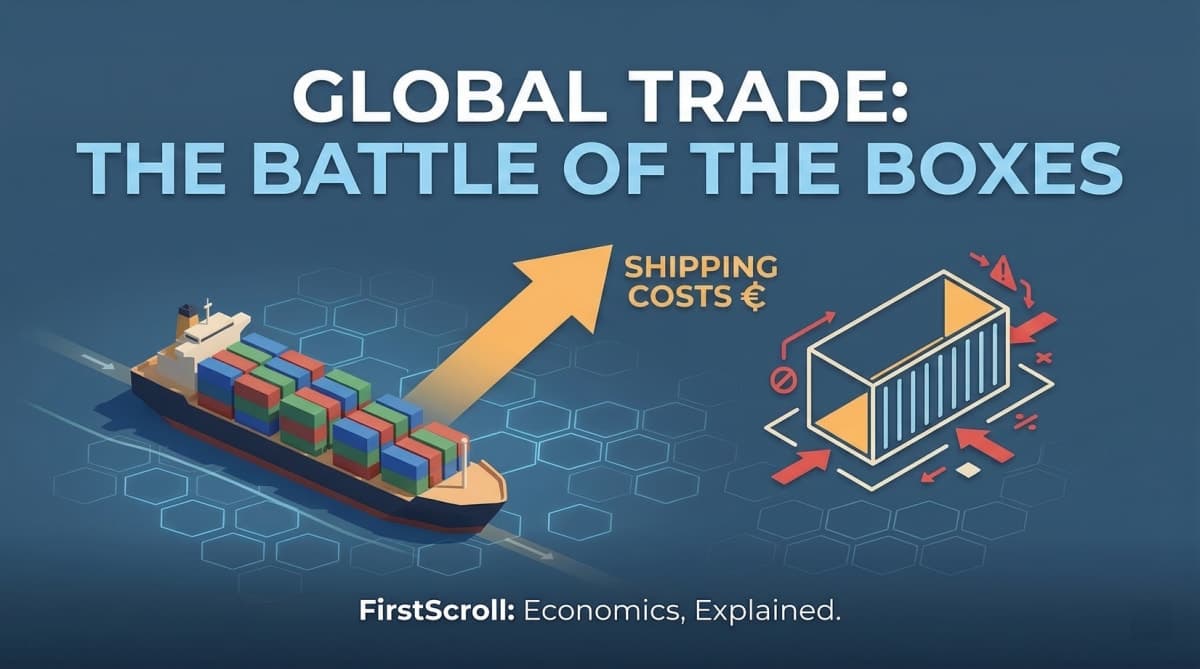
Imagine a simple steel box. It has no engine, no sensors, and no moving parts other than a heavy-duty latch. Yet, if the price to rent this box moves by just a few hundred dollars, the cost of your morning coffee, your next smartphone, and even the sneakers you’re wearing starts to vibrate.
Right now, the world of global trade is watching these steel boxes with bated breath. After a period of relative calm, the cost of moving a 40-foot container from Asia to Europe or the US has seen a series of jagged spikes that have economists breaking out their calculators again.
The Red Sea Ripple
If you’ve glanced at the news lately, you know the Suez Canal the world’s most important shortcut is effectively a "no-go" zone for many major shipping lines. To avoid drone attacks and geopolitical tension, ships are taking the long way around Africa.
This isn’t just a detour; it’s a massive logistical headache. By sailing around the Cape of Good Hope, ships add roughly 10 to 14 days to their journey. When a ship is at sea for two extra weeks, it isn’t just burning more fuel; it’s also "unavailable" to pick up its next load of cargo.
This has created a phantom shortage. Even though we have the same number of ships and containers as before, they are tied up in transit for longer. It’s like a pizza delivery driver taking a route that's twice as long suddenly, the shop needs twice as many drivers to deliver the same number of pizzas.
How the Box Conquered the World
To understand why this matters so much, we have to look back at how things used to work. Before the 1950s, "loading a ship" was a chaotic, manual labor-intensive nightmare. Men would carry sacks of flour, barrels of oil, and crates of electronics individually onto a vessel.
It was slow, expensive, and things got broken or stolen constantly. Then came Malcom McLean, a trucking magnate who had a "eureka" moment: What if we just put the entire truck trailer on the ship?
This led to the "intermodal" container a standardized box that fits perfectly on a truck, a train, and a ship. This simple invention dropped the cost of shipping goods by over 90%. Suddenly, it was cheaper to catch fish in Norway, send it to China to be filleted, and ship it back to Europe than it was to fillet it in Norway. Our entire global economy is built on the assumption that shipping is nearly free.
The "Empty Box" Problem
But here is where the story gets interesting. Shipping isn't just about moving full boxes; it’s about where the empty ones end up.
Think of shipping containers like blood cells in a body. They need to circulate. China is the world's factory, so it constantly needs empty boxes to fill with gadgets and clothes. However, the US and Europe consume more than they produce, meaning empty boxes pile up in ports like Los Angeles or Rotterdam.
When the Red Sea crisis hit, it didn't just delay the "full" boxes coming to you. It delayed the "empty" boxes going back to the factories.
Now, factories in Asia are scrambling. They have the products ready, but they have nothing to put them in. This "equipment imbalance" is what actually drives prices through the roof. When there are ten companies fighting over one empty box, the shipping line simply hands it to the highest bidder.
Why This Really Matters
You might wonder: "If shipping a container goes from $2,000 to $6,000, does that really change the price of my $800 iPhone?"
In isolation, perhaps not. The shipping cost per iPhone might only go up by a dollar or two. But for low-margin goods think furniture, cheap plastic toys, or heavy canned goods the math is brutal. If the shipping cost for a sofa doubles, the retailer has no choice but to pass that on to you.
But here is the real insight: This isn't just about inflation. It’s about reliability.
For the last 30 years, companies have operated on a "Just-in-Time" model. They don't keep big warehouses full of parts; they expect the parts to arrive exactly when they need them. When the "steel box" cycle breaks, the whole assembly line stops. We are seeing a fundamental shift where companies are moving toward "Just-in-Case" building bigger warehouses and moving factories closer to home (a trend called "near-shoring").
The Broader Fallout
For investors, this volatility is a double-edged sword. Shipping companies like Maersk or Hapag-Lloyd often see their profits soar during these crises because they can charge "premium" rates. However, for the broader economy, it’s a headwind.
Central banks are trying to lower interest rates to help the economy grow. But if shipping costs keep pushing prices up, they might be forced to keep rates high for longer to fight inflation.
Consumers will feel it at the checkout counter, not today, but in three to six months when the current "expensive" shipments finally hit the shelves. It’s a slow-motion wave that eventually reaches everyone.
The humble steel box was designed to make the world smaller and more efficient. But as we’re learning today, when that efficiency breaks down, the world suddenly feels very large and very expensive again.
And that’s why a simple metal latch in the middle of the ocean can determine the price of your groceries next Tuesday.