33 crore Indian households cook on LPG. Nearly all of it, 90%, moved through one narrow strait. That strait's now partially shut. And somehow, quietly, that's ended up in your kitchen.
Think about the last time you actually cooked. The burner clicking. That blue flame catching. Dal going low and slow.
That flame runs on LPG. And for the past three weeks, getting that gas into India has become, and I don't think this is an exaggeration, one of the most complicated supply operations the country has ever attempted.
Here's where things stand.
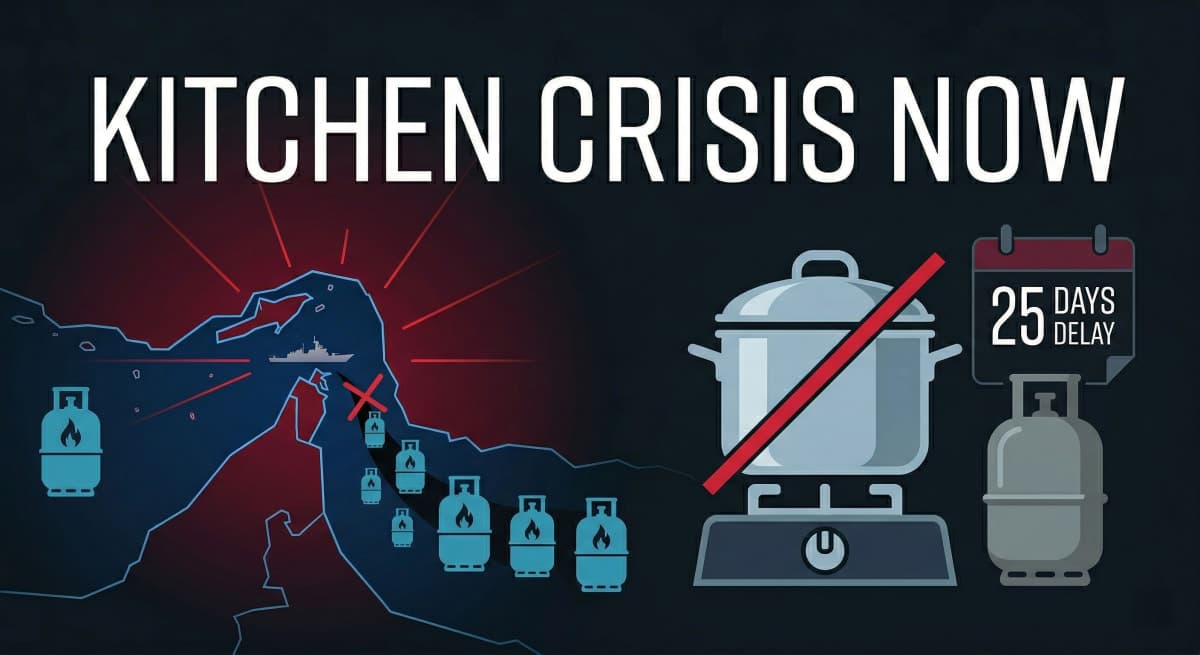
33 crore active LPG connections in India. 90% of imports moved through Hormuz. 25 days is now the minimum gap between cylinder bookings.
The Strait of Hormuz, 33 kilometres of water between Iran and Oman, effectively closed to commercial shipping in the first week of March. The US-Iran conflict that broke out on February 27 brought missile strikes on Gulf energy facilities. QatarEnergy, which supplies most of India's LPG, declared Force Majeure. Insurance premiums on Gulf tankers shot up over 500%. Ships stopped moving.
Overnight, 90% of India's LPG supply pipeline went dark.
And that pipeline feeds 33 crore households, many of them connected to clean cooking fuel for the first time through Pradhan Mantri Ujjwala Yojana. The same scheme held up as one of India's biggest welfare wins now has a single, catastrophic vulnerability sitting right in the middle of it: it runs almost entirely on imported gas from one corner of the world.
The government invoked the Essential Commodities Act. Authorities ran over 12,000 raids, seized 15,000 cylinders. Domestic refineries got orders to max out LPG output, propane and butane normally destined for petrochemical plants got rerouted into the cooking gas pool. That bumped domestic production by 25%.
It wasn't enough.
So what does this actually look like?
Restaurants across Mumbai, Bengaluru, Delhi, and Chennai have cut their menus to the bone. Commercial LPG allocations were slashed 80%. Some places switched to firewood and coal, in 2026. Half of Mumbai's restaurants could temporarily shut if supply doesn't improve.
The Delhi High Court canteen stopped serving hot food entirely. A handwritten sign outside a New Delhi stall: only rice and dal available today.
Urban households now face a mandatory 25-day gap between cylinder bookings, up from 21. Rural areas: 45 days. A cylinder that used to arrive same-day now takes 7 to 14 days. And prices are quietly creeping. A domestic 14.2kg cylinder in Delhi is ₹913 now, ₹60 more than last month. The government approved a ₹30,000 crore package to cushion oil marketing companies, but some of that is still landing on consumers.
Here's the part that makes this more than just a temporary shock.
A tanker from the Middle East takes 5 days to reach an Indian port. From the US? 25 to 30 days. India scrambled to source emergency LPG from the US and West Africa in early March. Those ships are at sea right now. They won't dock until the final week of March, at the earliest.
That three-week lag, between placing the order and the gas actually arriving, is the eye of this storm.
Two Indian tankers, MT Shivalik and MT Nanda Devi, have already delivered 92,712 tonnes. Pine Gas and Jag Vasant crossed Hormuz on March 23 and are en route. 22 India-flagged vessels were stranded in the Gulf; partial clearance is ongoing. US emergency cargoes are at sea, expected late March.
The government is doing everything it reasonably can. Negotiating with Iran for safe passage, rerouting gas from petrochemical plants, rationing, raiding black markets, spending ₹30,000 crore to keep prices from going vertical.
But none of that changes the underlying problem: India spent a decade building 33 crore kitchen connections, pointed them almost entirely at one region of the world, and kept only 18 days of inventory cover in the system.
That was fine. Until it wasn't.
The war in West Asia will end. Ships will sail again. Gas will flow. But India's got maybe 18 months of relative calm before the next disruption, and the question, the one nobody's really answered yet, is what it actually does with that window.
Because the blue flame isn't a convenience for 33 crore households. It's infrastructure. And infrastructure can't afford a single point of failure.