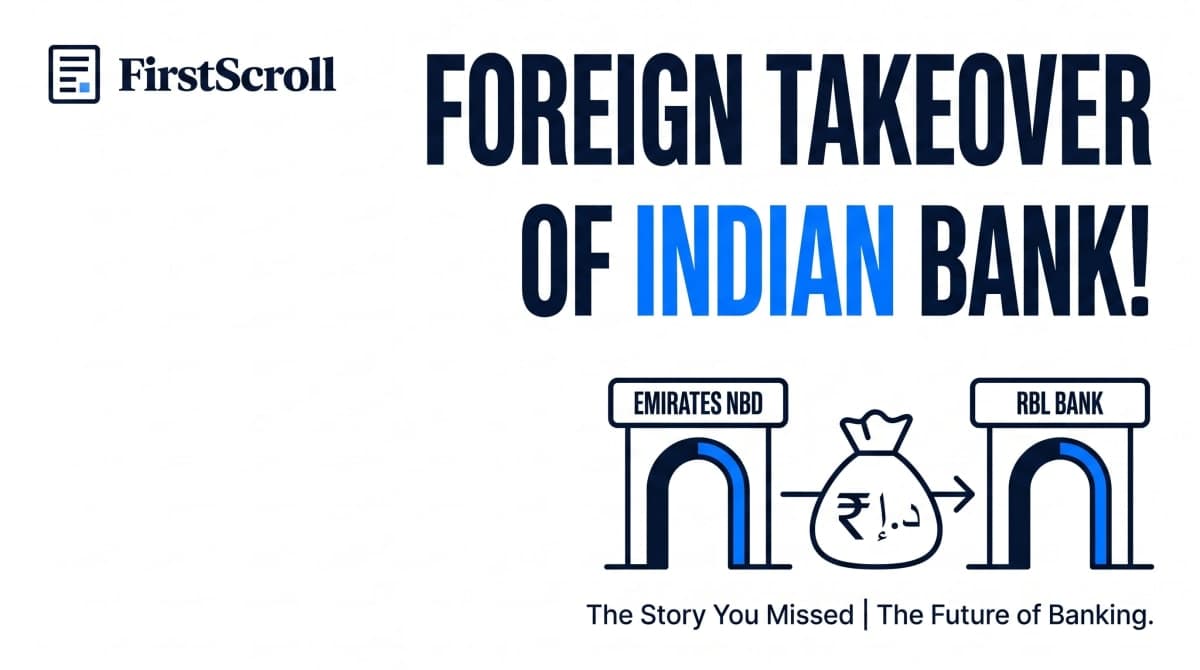
Foreign banks have operated in India for decades. But no foreign bank had ever been allowed to buy outright control of a healthy, listed Indian bank. That just changed.
In today's FirstScroll, we unpack the Emirates NBD takeover of RBL Bank, the largest foreign investment Indian banking has ever seen, and what it signals about where the sector is heading.
The Story
In October 2025, two banks announced a deal that did not get the attention it deserved. Emirates NBD, the largest bank in Dubai and one of the biggest in the Middle East, agreed to invest around $3 billion into RBL Bank, a mid-sized private lender in India.
For months, the deal sat in the long queue of Indian regulatory approvals. Now it has cleared almost all of them. The Reserve Bank of India approved it, the Competition Commission of India cleared it, and on May 15, 2026, the Finance Ministry granted its nod, with RBL Bank confirming the approval in a stock exchange filing.
The size of the deal is roughly $3 billion, or about ₹26,850 crore. But the size is not the most interesting part. The structure is.
Here is what makes this a genuine first.
For the uninitiated, foreign banks have been present in India for a very long time. Citi, HSBC, Standard Chartered, and others have run Indian operations for decades. But they have always operated as branches of their foreign parent, or as wholly owned subsidiaries that they built themselves from scratch. What no foreign bank had ever done was buy outright controlling ownership of an existing, healthy, publicly listed Indian private bank.
That is exactly what Emirates NBD is doing with RBL Bank.
According to the deal structure, Emirates NBD will subscribe to roughly 959 million new equity shares of RBL Bank at ₹280 per share through what is called a preferential allotment. It will also make a mandatory open offer to buy up to a 26% stake from RBL Bank's public shareholders, as required under SEBI's takeover rules. When everything settles, Emirates NBD's stake in RBL Bank is projected to land somewhere between 51% and 74%.
The deal sets several records at once. It is the largest foreign direct investment in Indian banking history. It is the largest preferential share issue by a listed company in India. And it is the first time a foreign bank has been cleared to take majority control of a profitable Indian bank.
So why did the Indian regulators allow something they had never allowed before?
To understand that, you need to understand RBL Bank's position, and India's banking policy.
RBL Bank is a mid-sized private lender. As of late 2025, it operated a network of around 564 branches and served over 15 million customers. It is a real bank with a real franchise. But like many mid-sized Indian private banks, it has wrestled with the central challenge of the sector, which is capital. To grow a loan book, a bank needs capital. To compete on technology, digital products, and branch expansion, it needs more capital. Raising that capital steadily from the public markets is slow and dilutive.
A $3 billion injection solves that problem in one stroke. The capital is expected to significantly strengthen RBL Bank's Tier-1 capital ratio, which is the core measure of a bank's financial cushion, and give it the long-term growth funding to expand digital products, corporate lending, and wealth management.
Think of it like a promising regional restaurant chain that has good food and loyal customers, but cannot afford to open new outlets fast enough. A large, well-funded partner walks in, writes a big cheque, takes a controlling stake, and suddenly the expansion that would have taken a decade can happen in a few years.
For India's policymakers, the calculation has shifted. For years, India was cautious about foreign control of its banks, because banks hold public deposits and are systemically sensitive. But India also wants foreign capital, wants its banking sector well-capitalised, and wants to signal that it is open for serious global investment. Allowing a strong, well-regulated Gulf bank to recapitalise and run a mid-sized Indian lender is a controlled way to do all three.
Once the deal is complete, RBL Bank will be reclassified. It will operate as a foreign bank subsidiary under the RBI's framework, with Emirates NBD as its promoter and parent. The deal also includes a plan to eventually merge Emirates NBD's existing India branch operations, in Mumbai, Chennai, and Gurugram, into RBL Bank, creating a single unified balance sheet.
It is worth noting one regulatory accommodation. The RBI relaxed a governance condition that normally requires at least half the directors at a bank's board meetings to be independent directors. This is a meaningful concession, and it reflects the reality that a promoter-controlled foreign subsidiary has a different governance structure than a widely held bank.
So why does Emirates NBD want this so badly?
The answer is India's growth story. Emirates NBD has identified India as a key market in its broader plan to expand across the Middle East, North Africa, Turkey, and South Asia. India's private banking sector is growing fast, its middle class is expanding, its credit penetration is still low compared to developed economies, and there is a large and active corridor of trade, remittances, and investment between the UAE and India. For a Gulf bank looking for growth, a controlling stake in an Indian bank with 15 million customers is an attractive long-term bet.
So what should you take away from this, whether you are an RBL customer, an investor, or just an observer of Indian banking?
Three things.
One, if you are an RBL Bank customer, the immediate practical impact is small. Your deposits, your accounts, and your loans continue as before. Over time, you may see better technology, new products, and a more aggressively expanding bank, because the whole point of the capital injection is growth. The bank becomes better capitalised, which generally makes it safer, not riskier.
Two, if you are an investor, this deal is a template worth watching. The key question is whether it opens the door to more foreign acquisitions of Indian banks. Several mid-sized Indian private banks face the same capital challenge that RBL did. If the Emirates NBD deal goes through smoothly and is seen as a success, it could become the model for a wave of similar transactions. That would reprice how the market values capital-hungry mid-sized banks.
Three, watch the open offer. Under SEBI rules, Emirates NBD must offer to buy up to 26% from existing public shareholders at ₹280 per share. For current RBL shareholders, that open offer price is the relevant reference point for the value being placed on the bank.
But let's be clear about what this deal is not.
It is not a sign that India is throwing its banking sector open to unrestricted foreign control. The 74% cap on foreign ownership in private banks still stands, and Emirates NBD's final stake will be held within that limit. India has allowed one carefully structured deal, with a well-regulated parent, under heavy regulatory supervision. That is very different from a blanket liberalisation.
And it is not, by itself, a verdict on the broader health of Indian banking. Indian banks remain, on the whole, well-capitalised and profitable. RBL Bank is being acquired not because it is in distress, but because a capital injection accelerates a growth story. This is an opportunity-driven deal, not a rescue.
Step back, and there is a bigger signal here. For decades, the flow of banking ambition was largely one-directional. Global banks set up small branches in India and Indian banks slowly expanded abroad. The Emirates NBD deal marks something new, a foreign bank making a multi-billion-dollar bet to own and run a piece of India's domestic banking system outright.
It is a sign of how the world now sees India's financial sector, not as a difficult, closed market to tiptoe into, but as a growth engine worth buying a controlling stake in. Whether this stays a one-off or becomes a trend will be one of the most important things to watch in Indian banking over the next few years.
Until next time…