In today’s FirstScroll, we unpack the US decision to grant India a 30-day waiver to buy Russian oil. Why it happened, what it really means, and why the word "allow" is doing a lot of heavy lifting in this story.
The Story
On Thursday evening, US Treasury Secretary Scott Bessent posted something on X that set off a political firestorm in India. He announced that the Treasury Department was issuing a temporary 30-day waiver to "allow" Indian refiners to purchase Russian oil.
Read that again. Allow.
A sovereign nation of 1.4 billion people, the world’s third-largest oil consumer, the fifth-largest economy on the planet, was being "allowed" by another country to decide where it buys its energy.
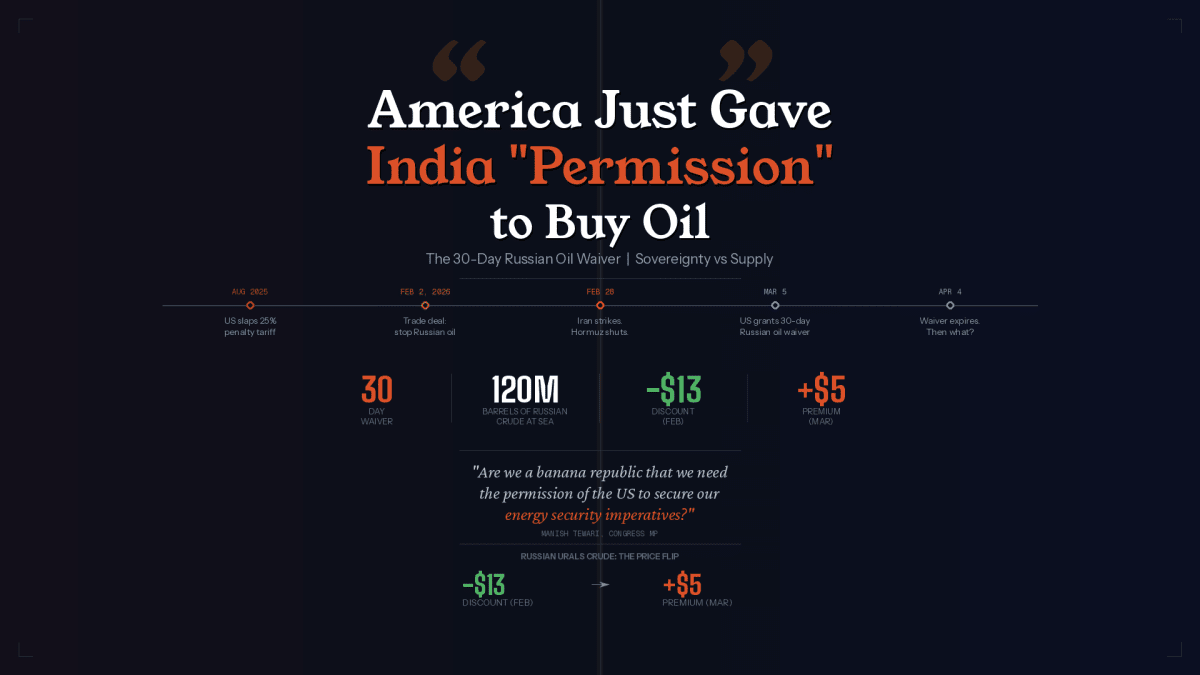
The Indian opposition pounced. Congress MP Manish Tewari asked if India was "a banana republic that we need the permission of the US to secure our energy security imperatives." Rahul Gandhi said what we’re witnessing "is not policy" but "the result of the exploitation of a compromised individual." Shiv Sena UBT’s Priyanka Chaturvedi noted that the government "gives us Instagram reels on strategic autonomy" while the reality is that "it has surrendered India’s interests."
Strong words. But let’s step back and understand how we got here. Because this story didn’t start on Thursday. It started years ago.
How India Became Russia’s Biggest Oil Customer
Before 2022, India barely bought any Russian crude. Russia supplied a tiny fraction of India’s oil imports. Then came the invasion of Ukraine. Western sanctions slammed Russia’s economy, and Moscow started offering crude at steep discounts to anyone willing to buy.
India was willing. Very willing.
Indian refiners jumped at discounted Russian barrels. By 2025, Russia had become India’s single largest crude supplier, accounting for roughly a third of all seaborne oil imports. India was buying around 1.5 to 1.8 million barrels per day of Russian crude at its peak. The savings were massive, keeping domestic fuel prices stable and the import bill in check.
For India, this was pragmatic energy policy. For Washington, it was a problem.
The US Squeeze: Tariffs, Sanctions, and a Trade Deal
The Trump administration wasn’t happy. In August 2025, Washington slapped a 25% "penalty" tariff on Indian imports, explicitly citing India’s continued purchase of Russian crude. This came on top of the existing 25% reciprocal tariff, effectively doubling the trade barrier.
The message was clear: stop buying Russian oil, or face economic consequences.
It worked. Sort of. Under pressure, India began scaling back. Russian crude imports fell 34% year-on-year in the first five weeks of 2026, according to BIMCO shipping data. Russia’s share of India’s oil imports dropped to about 21% in January, down from over 30% at its peak.
Then came the trade deal. On February 2, 2026, Trump announced that India had agreed to stop buying Russian oil entirely and would instead purchase American and "potentially" Venezuelan crude. In exchange, the US would drop the penalty tariffs. India would also commit to buying $500 billion worth of US products over five years.
Here’s the catch: India never officially confirmed the Russian oil commitment. The Ministry of External Affairs carefully stated that "ensuring the energy security of 1.4 billion Indians is the supreme priority" and that India remains "open to exploring the commercial merits of any crude supply options." Classic diplomatic ambiguity.
Then Iran Happened
On February 28, the US and Israel struck Iran. The Strait of Hormuz, which carries half of India’s crude imports, effectively shut down. Brent crude spiked from $73 to $85+. India’s energy lifeline was cut.
And suddenly, those Russian barrels India had been pressured to stop buying became the most logical alternative supply. Russian crude doesn’t transit Hormuz. It comes from Baltic and Arctic ports via entirely different routes.
There were 120 million barrels of Russian crude floating on the water as of March 4, according to CAS data. Some estimates suggest around 30 million barrels could be redirected toward India if refiners moved quickly. These were cargoes already loaded, already at sea, with nowhere to go because the sanctions regime made Indian buyers hesitant.
So the US did what geopolitics always forces you to do eventually: it adapted.
What the Waiver Actually Says
The waiver, issued by the Treasury’s Office of Foreign Assets Control (OFAC), is narrow. It authorises the sale, delivery, and offloading of Russian-origin crude and petroleum products that were loaded on vessels before March 5. The cargoes must be delivered to Indian ports. The buyer must be an Indian entity. And the window expires on April 4.
It does not cover new shipments. It does not relax broader sanctions on Russia. And it explicitly excludes any transactions involving Iran.
Bessent framed it as a "stop-gap measure" to "alleviate pressure caused by Iran’s attempt to take global energy hostage." He added that India is "an essential partner" and that Washington "fully anticipates" New Delhi will ramp up purchases of US oil going forward.
Translation: we’re letting you buy Russian oil for 30 days because our own military action created an energy crisis. But after this, we expect you to buy American.
The Sovereignty Question
This is where the story gets uncomfortable.
The fact that India needed a "waiver" from the United States to buy oil from Russia, something it was doing freely three years ago, tells you how dramatically the power dynamic has shifted. India didn’t ask for this waiver. The US granted it unilaterally, framing it as a favour.
The language matters. When Bessent says "allow," it implies authority over India’s purchasing decisions. When he says "we fully anticipate," it reads like an instruction, not a request.
The opposition’s criticism, while politically motivated, touches a real nerve. Under international law, secondary sanctions (where Country A punishes Country B for trading with Country C) sit in a legally grey area. The Centre for Social and Economic Progress (CSEP) has argued that the US tariffs on India for buying Russian oil potentially violate WTO rules, specifically GATT Article XI on quantitative restrictions.
But legal arguments don’t matter much when one side controls the world’s reserve currency and your largest export market.
Follow the Money
The market reaction tells the real story. Indian refiners didn’t wait. Reliance Industries immediately began seeking Russian crude cargoes. State-owned refiners like Indian Oil, BPCL, HPCL, and MRPL started discussions with traders for prompt delivery.
But here’s the kicker: Russian Urals crude, which was trading at a $13 discount to Brent in February, is now commanding a premium of $4 to $5 above Brent for March deliveries. The discount that made Russian crude attractive in the first place? It’s gone. Sellers know India is desperate, and they’re pricing accordingly.
So India gets to buy Russian oil for 30 days, but at prices that are actually higher than what it would have paid for Middle Eastern crude before the crisis. The savings that justified the whole geopolitical risk of buying Russian oil have evaporated.
What Happens on April 5?
That’s the real question nobody has a clean answer to.
If the Hormuz crisis resolves within four weeks, India goes back to Middle Eastern crude and the Russia chapter quietly closes. If the crisis drags on, India will face a brutal choice: comply with US expectations and pay dramatically more for American and Latin American crude (with 25 to 45-day shipping times and 5x the freight cost), or push back against Washington and risk the trade deal unravelling.
The $500 billion purchase commitment hangs over everything. India currently imports just over $40 billion from the US annually. Hitting that target requires a massive ramp-up in American energy, defence, and technology purchases. Whether that’s economically sensible or just a number designed to keep Washington happy is an open question.
Meanwhile, Russia is ready. Deputy Prime Minister Alexander Novak said on March 4 that Moscow is prepared to increase oil exports to India and China. The infrastructure, the shipping routes, the refinery configurations: they all still favour Russian crude. Unwinding that in 30 days is a fantasy.
The Bottom Line
The 30-day waiver is a band-aid on a structural problem. India imports 88% of its crude and has no good options that don’t involve geopolitical compromise. Buy from Russia, and you anger Washington. Buy from the Middle East, and you’re dependent on a strait that just proved it can shut down overnight. Buy American, and you pay more for oil that takes six weeks to arrive.
The real lesson isn’t about Russia or America or Iran. It’s about energy sovereignty, or the lack of it. As long as India imports nearly 90% of its oil, it will always need someone’s "permission" to keep the lights on. The question is whose.
And that’s a question no 30-day waiver can answer.
• • •
If this story helped you understand the waiver and what it means for India, share it with a colleague on WhatsApp, LinkedIn, or X.
Sources: CNBC, Bloomberg, S&P Global, Euronews, Business Today, The Week, Chatham House, CFR, CSEP, Free Press Journal