In today's FirstScroll, we explain the sudden 1,000-point crash in the Indian stock market and why a holiday for Holi might be the "reset button" investors desperately need.
The Story
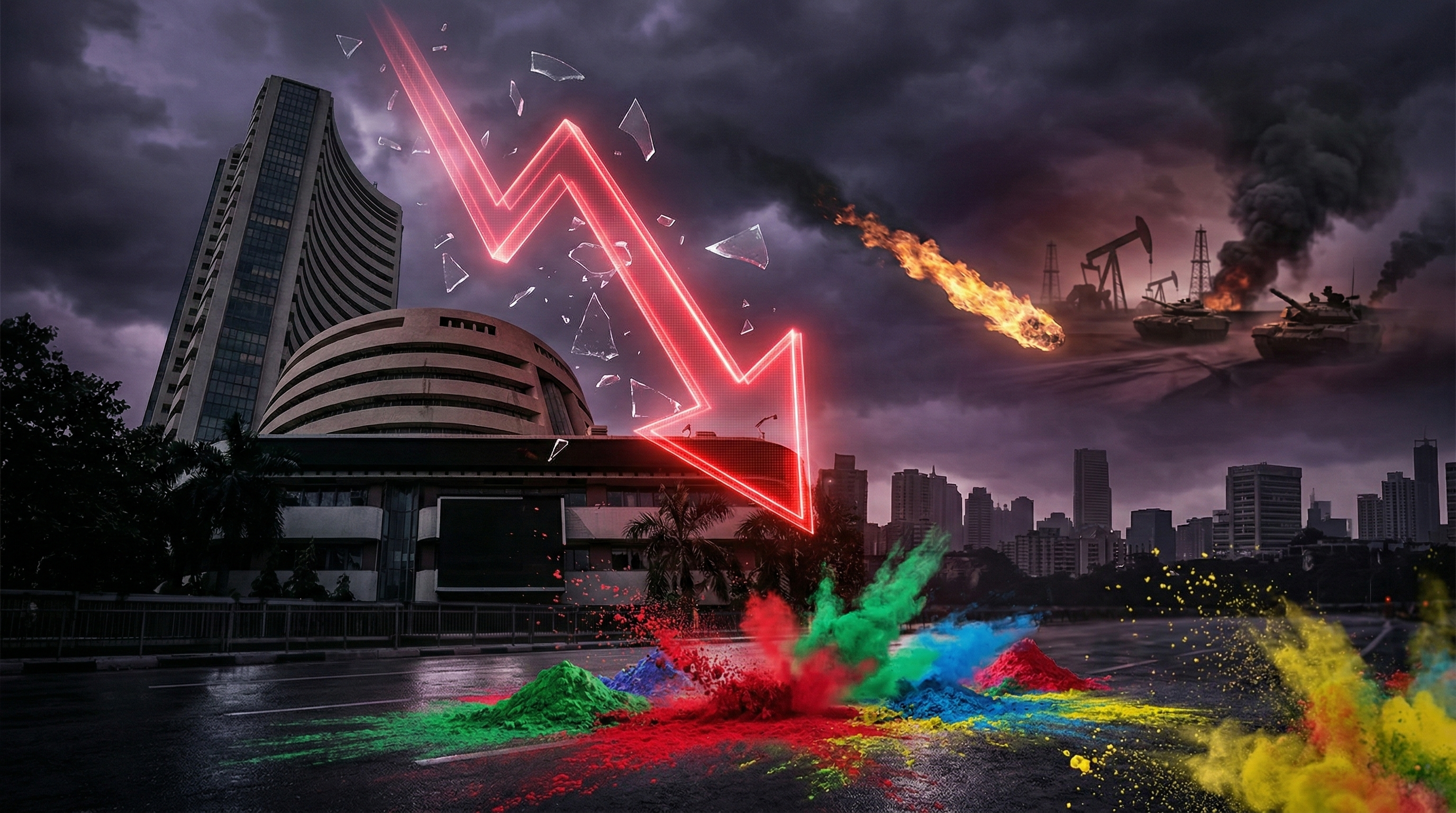
You wake up on a Tuesday morning, ready to check your portfolio, only to realize the markets are... silent. No blinking green or red tickers, no frantic news alerts about midcap meltdowns. For a moment, it feels like the world has stopped. Then you remember: it’s Holi. The exchanges are closed. But while you’re reaching for the organic gulal, your money is likely still nursing a massive hangover from Monday’s brutal selloff.
Every time the Indian markets face a "Black Monday," history tells us a very specific story. In 2008, it was the global subprime crisis. In 2020, it was the first whiff of a global lockdown. On March 2, 2026, the story was a bit more modern a toxic cocktail of Middle East tensions, spiking oil prices, and a sudden "risk-off" mood that saw the Sensex tank by over 1,000 points in a single session.
For years, the Indian market felt like an unstoppable train. We grew used to "buying the dip" and watching Nifty hit new highs every other week. It felt normal. But yesterday, the train hit a massive patch of turbulence. The Nifty 50 tumbled 1.24% to close at 24,865, while the Sensex dropped nearly 1.3% to settle at 80,238.
But wait, how did we get here?
See, the stock market is a bit like a high-strung toddler. It reacts to everything, and right now, it’s throwing a tantrum over the Middle East. With tensions escalating, global investors are worried about the "Oil Shock" a situation where supply disruptions lead to higher petrol and diesel prices. For a country like India, which imports nearly 80% of its oil, a jump in crude prices is like a sudden tax hike on the entire economy.
Now, think about it this way.
When you see a "Risk-Off" sentiment (that’s finance-speak for "everyone is scared"), big institutional investors behave like people in a crowded theater who see a puff of smoke. They don't wait to see if there's an actual fire; they just run for the exit. Yesterday, Foreign Institutional Investors (FIIs) the big global funds were the ones leading the charge to the exit, selling off banking and IT stocks like there was no tomorrow.
Which brings us to the uncomfortable question is your SIP in trouble?
Here’s the thing. While the large-cap stocks (the big, blue-chip companies) took a hit, the real pain was felt in the "broader market." The Nifty Midcap and Smallcap indices tumbled more than 1.5% each. For the uninitiated, midcap and smallcap stocks are companies that aren't quite giants yet. They offer higher growth but are much more volatile. When the market panics, these are usually the first ones to get hammered because they are less "liquid" (meaning it’s harder to find a buyer when everyone is selling).
But here’s the catch.
While the indices were deep in the red, the "Metal" space actually showed some resilience. Why? Because when geopolitical tensions rise, commodities like gold and certain metals often act as a "safe haven." People park their money there when they don't trust paper stocks. It’s the financial equivalent of hiding your cash under the mattress except the mattress is made of 24-karat gold.
So where does that leave us?
On one hand, the 1,000-point drop is a wake-up call. It reminds us that "up only" isn't a law of nature. The market was looking expensive (or "frothy"), and a correction was arguably overdue. On the other hand, India’s domestic story remains strong. The RBI just launched a new Consumer Confidence Survey to gauge how much we’re spending, and early signs suggest "Bharat" is still buying, even if "Dalal Street" is crying.
The "So What?" for you is simple. A market holiday like today is actually a blessing. It prevents "panic-selling" the act of selling your stocks in a hurry just because you see them falling, only to regret it when they bounce back. When markets reopen on Wednesday, March 4, the initial reaction will depend heavily on how global markets behaved while we were playing with colors.
If you’re a long-term investor, this is just a blip. If you’re a trader, it’s a reminder to keep your stop-losses tight.
Until then…
Sometimes, the best thing you can do for your portfolio is to put down the phone and pick up a plate of gujiya.
If this story helped you understand why the markets crashed, share it with a friend on WhatsApp, LinkedIn, or X.