Okay so imagine this.
You're at a friend's wedding. A few guests in the corner are getting loud, saying they're going to start their own party. A better party. No drama, no gatekeeping, no one person controlling the aux.
Everyone nods. People are excited. Someone even designs a flyer.
Then the wedding ends. And the "new party" is still... being planned.
That's basically the BRICS currency situation right now.
FIRST, WHAT IS BRICS
BRICS started as a finance term, not a political group. In the early 2000s, an economist at Goldman Sachs grouped together Brazil, Russia, India, China, and South Africa because they were all fast-growing economies that would matter a lot in the future. He called them BRICS.
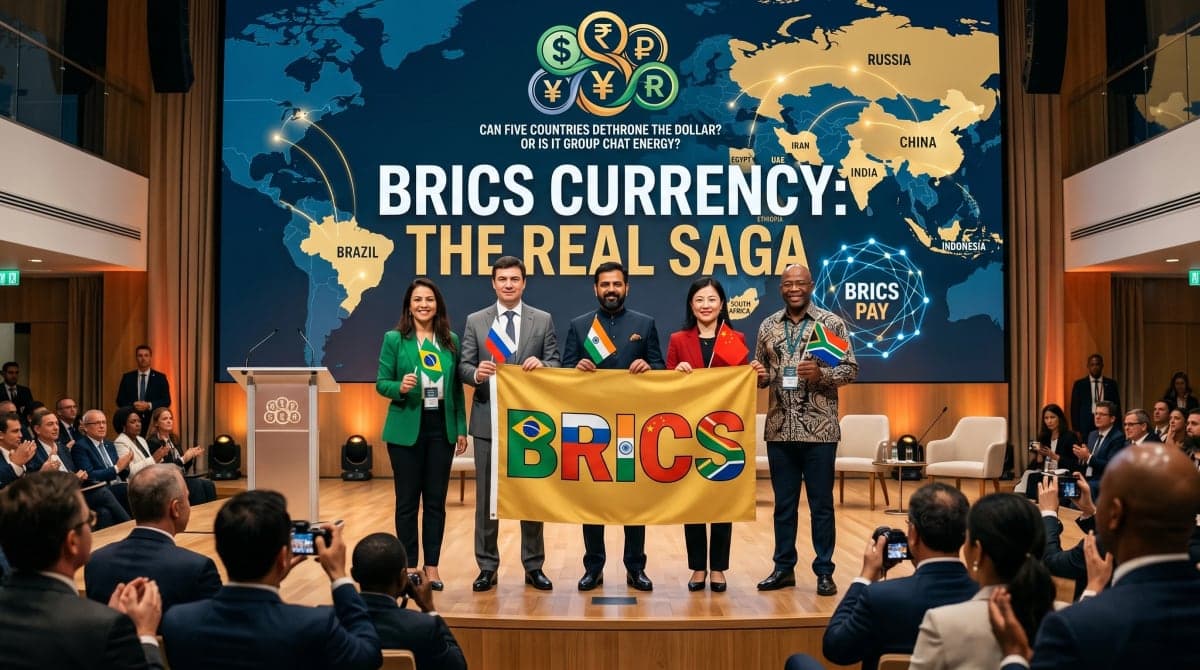
Then the countries actually started meeting. And talking. And in 2024 and 2025, more countries joined the club UAE, Egypt, Indonesia, Ethiopia, Iran. It's now sometimes called BRICS-10.
Together, BRICS countries now represent about 46% of the world's population and 37% of global GDP. That's genuinely massive. These are not small players.
And they all share one common frustration: the US dollar runs the world, and they're tired of it.
WHY DOES THE DOLLAR RUN THE WORLD
Quick history lesson, and we promise to keep it fun.
After World War 2, most of the world's economies were destroyed. America was not. So in 1944, all the major countries met at a hotel in Bretton Woods, New Hampshire, and basically agreed okay, the US dollar will be the world's currency. Everything gets priced in dollars. Everyone holds dollars.
That deal has technically never been undone.
Today, the dollar is used in 89% of all global currency transactions. When India buys oil from Saudi Arabia, it pays in dollars. When Vietnam buys machinery from Germany, it's settled in dollars. When a company in Nigeria takes a loan from an international bank, that loan is in dollars.
As of late 2025, the dollar makes up about 57% of all foreign exchange reserves held by the world's central banks. The euro is second at around 20%. The Chinese yuan? Just under 2%. That's it.
The dollar is not just dominant. It's so dominant that every other currency barely registers.
SO WHY ARE BRICS COUNTRIES UPSET
Because this dominance gives America an absurd amount of power.
When America is unhappy with a country, it can cut them off from the dollar system. That means they can't trade easily with the rest of the world. Can't access international loans. Can't even process basic bank transactions through SWIFT, the global payments network that runs on dollars.
Russia found this out the hard way after the Ukraine invasion. America hit Russia with sanctions that cut it off from SWIFT. Overnight, Russia's ability to trade with the world collapsed.
Iran has been living under dollar-based sanctions for decades.
Even India got a taste when it was threatened with sanctions for buying Russian oil. The thing that gave America the power to threaten India? The dollar.
So BRICS countries have been saying, loudly and increasingly, that they want an alternative. A system where America doesn't control the on and off switch.
ENTER THE BRICS CURRENCY IDEA
The conversation started getting serious around 2023. Russia pushed hardest for a common BRICS currency. The idea was: what if all BRICS countries traded with each other using one shared currency instead of the dollar?
There was even a fun moment at the 2024 BRICS Summit in Kazan, Russia, where they handed Vladimir Putin a symbolic "BRICS banknote." It had all the member flags on it. People went wild. Headlines everywhere saying a new world currency was coming.
Except that note was just a souvenir. A concept. Like a mood board for a currency that doesn't exist.
The idea on the table was something called "The Unit" a digital trade currency that would be backed partly by gold and partly by the currencies of member countries. On paper, it sounds smart. In practice, making it real is... complicated.
HERE IS WHY IT IS SO HARD
Building a shared currency between countries is genuinely one of the hardest things in economics. We know because Europe tried it. It took them literally decades and it still has problems.
Think about it. India's economy grew at 7% last year. Russia's inflation was sky-high because of war. China's growth is slowing down. Brazil is dealing with its own fiscal drama. South Africa has an unemployment rate above 30%.
These economies are all very different. They respond differently to every global event. When oil prices go up, Russia benefits and India suffers. When China's economy slows, India's exports might actually get a boost. They're not in sync.
A shared currency requires a shared monetary policy. Meaning one interest rate. One inflation target. For countries this different, that's almost impossible. If you raise interest rates to fight inflation in one country, you might trigger a recession in another.
And there are political problems too. China and India have a long border dispute. They fought a war in 1962 and have had military standoffs as recently as 2020. Asking them to share a currency is a bit like asking your two relatives who don't speak to each other to share a bank account.
SO WHAT IS ACTUALLY HAPPENING
Here is the real, verified, non-hype version of what BRICS is actually doing right now.
They are not launching a single shared currency. That has been made very clear. At the July 2025 BRICS Summit in Rio de Janeiro, leaders explicitly did NOT announce a common currency. India's External Affairs Minister S. Jaishankar said in 2025 that India has no policy to replace the dollar and is not pushing for de-dollarisation.
What they ARE building is something called BRICS Pay. It's a payments platform that links up all the different national payment systems of member countries. India's UPI. Brazil's Pix. Russia's SPFS. China's CIPS. The goal is to let people trade directly with each other using their own currencies, without converting to dollars first.
So instead of India paying Russia in dollars for oil, India could potentially just pay in rupees, and Russia converts to rubles on their end. Cut out the middleman. Cut out the dollar.
BRICS Pay has a full operational target of 2030. The RBI has also proposed linking all the digital currencies of BRICS countries at the September 2026 New Delhi summit that India is hosting.
AND THE YUAN ANGLE
China has its own ambitions here that are slightly separate from the group effort.
China wants the yuan to become a global reserve currency. It has been pushing oil-producing countries in the Middle East to accept yuan for oil payments. Saudi Arabia is reportedly in talks. Russia now accepts yuan. Iran trades in yuan.
This is called the "petroyuan" and it's a real thing that is slowly growing.
But here is the catch: the yuan is a controlled currency. China's government actively manages its value. It has capital controls, meaning you can't freely move money in and out of China. For a currency to become a true global reserve currency, it needs to be freely usable and trustworthy. The yuan is not there yet.
Its share of global reserves is only 1.93% as of late 2025, barely moving despite all the noise.
WHAT IS ACTUALLY CHANGING QUIETLY
Even if the grand BRICS currency idea never happens, something real is shifting under the surface.
The dollar's share of global reserves has dropped from 71% in 1999 to about 57% today. It's slow, but it's consistent. Countries are diversifying. They are buying gold, euros, and a mix of other currencies.
Central banks bought more than 1,000 tonnes of gold per year from 2022 to 2024 the longest sustained gold-buying streak in modern history. BRICS central banks combined now hold over 6,000 tonnes of gold. This is countries quietly hedging against a world where the dollar matters a little less.
More and more trade within BRICS countries is now happening in local currencies instead of dollars. India and Russia settled oil payments in rupees during 2024 and 2025, though it got messy because Russia ended up with a pile of rupees it couldn't easily spend. These are real experiments, with real problems, that will eventually get solved.
TRUMP ACCIDENTALLY HELPED BRICS
Here's an ironic twist.
Trump's whole tariff strategy was meant to reassert American power. But what it actually did was make more countries want to find alternatives to the dollar system faster.
When America used financial sanctions and tariffs as weapons, it reminded every country watching including the ones that are America's friends that dependence on the dollar means dependence on American policy decisions. That's a risk.
Countries like India and Brazil, who are not anti-America, are still quietly building alternative rails. Not to destroy the dollar. Just to have options.
SO WILL THE BRICS CURRENCY HAPPEN
Honest answer: not as a single shared currency, not anytime soon, and maybe never in the way the headlines describe.
But the BRICS Pay system connecting national payment networks could actually happen and could meaningfully reduce dollar usage in trade between member countries. That's significant.
What is definitely happening is a slow, multi-decade shift towards a less dollar-dominated world. Not a world without the dollar. Just one where the dollar has more competition.
Think of it like this: WhatsApp didn't kill SMS overnight. But look at how many people you text using SMS today.
THE ONE THING TO REMEMBER
The dollar's power is not just about economics. It's about trust. Decades of stable, predictable, liquid financial markets. No capital controls. No government randomly deciding the dollar is worth something different tomorrow.
For any currency to replace the dollar, it needs that trust. And trust takes generations to build.
BRICS countries are angry enough to try. But they are not aligned enough to succeed quickly.
For now: the dollar is not dying. But it is slowly, quietly, sharing the stage.
Found this useful? Share it with someone who thinks money stuff is boring. Prove them wrong.