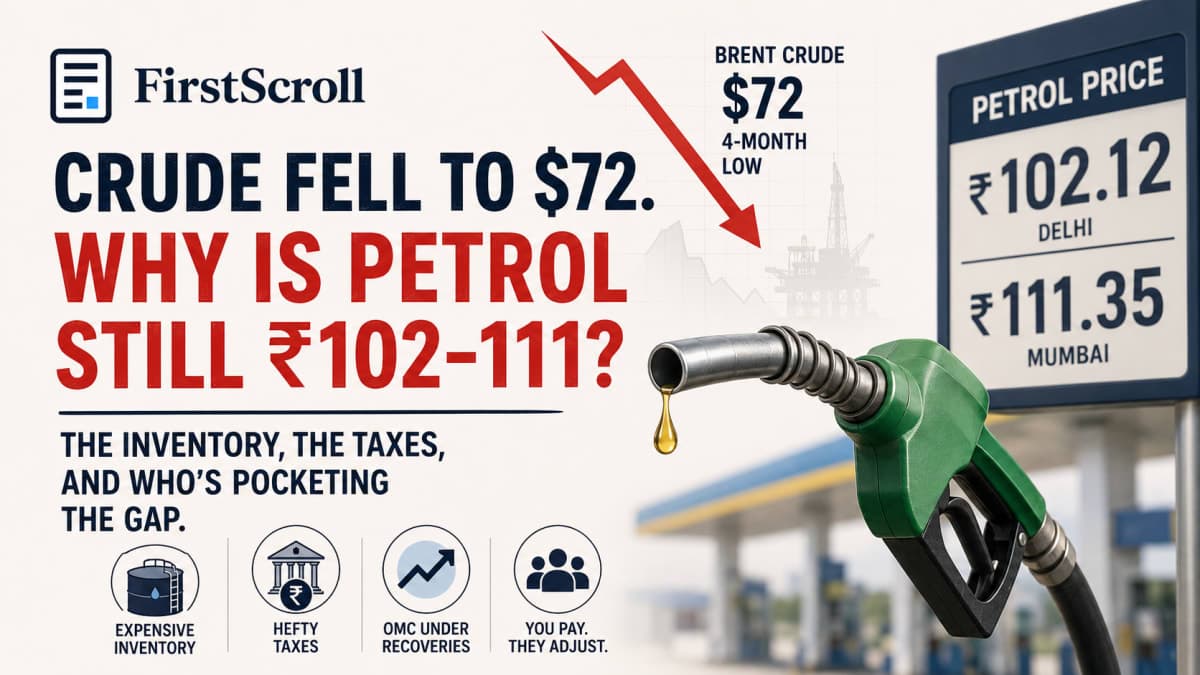
In today's FirstScroll, we break down why your petrol bill hasn't budged even though crude oil just hit a four-month low.
With that out of the way, let's dive into today's story.
The Story
Think back to late May. The West Asia conflict was at its peak, tankers were dodging the Strait of Hormuz, and every news channel had a graphic of crude prices climbing like a fever chart.
At your neighbourhood petrol pump, the fever showed up too. Prices went up four times in ten days, and everyone nodded grimly. War means expensive oil, expensive oil means expensive petrol. Fair enough.
Fast forward to today. The conflict has cooled, tankers are sailing through Hormuz again, and Brent crude has crashed to about $72 a barrel, its lowest level in more than four months. June was, in fact, crude's biggest monthly decline since 2020.
And your petrol bill? Exactly where it was in May. Delhi is still paying ₹102.12 a litre for petrol. Mumbai is still above ₹111.
So here's the question: if crude has fallen this hard, who's pocketing the difference, and when do you get your share?
You see, the petrol price you pay isn't really the price of oil. It's a stack. At the bottom sits the cost of crude, imported in dollars. On top of that come refining costs, freight, dealer commissions, and the margins of the oil marketing companies, the OMCs like Indian Oil, BPCL and HPCL that own the pumps. And crowning the whole thing are central excise duty and state VAT, which together make up a hefty chunk of every litre. We've broken down the full stack in [our guide to how petrol prices are set in India](INTERNAL: how petrol prices are set in india tax breakup).
So even a big move in crude only shifts the bottom layer of the stack. But that still doesn't explain zero movement. For that, you need to understand the layer nobody talks about: inventory.
Petroleum minister Hardeep Singh Puri spelled it out this week. Fuel retailers are still working through stocks of expensive crude bought during the peak of the West Asia crisis. A barrel loaded onto a tanker in the Gulf takes weeks to reach an Indian refinery, more time to become petrol, and more still to reach your pump. The fuel you buy today was priced by the crisis, not by this week's chart.
Now, walk through each player's incentive and the freeze starts making sense.
Start with the OMCs. As crude spiked during the crisis, into a 52-week range that stretches from under $59 to over $126, the OMCs sat on a price freeze for 76 straight days. Only on May 15 did they finally start passing costs on, and even then, four revisions in under two weeks added up to just ₹7.50 a litre, reportedly the first retail hikes in four years.
Think about what that freeze cost them. Crude nearly doubling, pump prices frozen, means they absorbed heavy losses on every litre sold, a phenomenon we've covered before as [under-recoveries](INTERNAL: omc under recoveries explained). Now that crude has crashed, holding prices steady is how they repair their books.
Then there's the government. Petrol and diesel sit outside GST, so fuel taxes are one of the most reliable revenue machines both the Centre and the states have. And the tax lever moves quietly, in both directions. This March, the Centre cut central excise duty on petrol by ₹10 a litre, and your pump price didn't fall by a single paisa. The relief went to the OMCs' books, not your bill. The same wedge works in reverse: when crude crashes, taxes can rise to capture the windfall while the price you see stays exactly the same.
And you, the consumer? You're at the end of the queue. In this system, you're effectively the lender of last resort to the OMCs: you overpay when crude is cheap so that you can underpay when crude is expensive.
But here's the twist. This smoothing logic only feels fair if it works in both directions, and the record suggests it doesn't move at the same speed both ways. When crude rises, pump prices adjust within weeks, inventory or no inventory. When crude falls, the "old expensive stock" argument can stretch for months. Economists have a name for this: rockets and feathers. Prices go up like a rocket and come down like a feather.
There's also a supply-side wrinkle that could keep crude soft for a while. OPEC+ has approved another production increase of 188,000 barrels a day for next month, and Saudi Arabia has cut its selling price for Asian buyers. India, meanwhile, imported a record volume of crude in June. Cheap oil, in other words, may not be a blip. Which makes the case for a pump price cut harder to postpone with every passing week.
Now to be clear, the OMCs' inventory argument isn't fiction. They genuinely did buy costly crude during the crisis, the rupee's level against the dollar genuinely does move their costs, and a fragile ceasefire in West Asia could send Brent right back up. Nobody wants to cut prices on Monday and hike them on Friday.
But zoom out, and this episode tells you something about how fuel pricing in India actually works. On paper, petrol and diesel prices were deregulated years ago, meant to move daily with the market. In practice, this year they froze for 76 days, jumped four times in ten days, and froze again, at whatever level suited the system's bookkeeping.
So the real question isn't whether crude at $72 will eventually reach your pump. It's who decides when, and whether the feather ever falls as fast as the rocket rose. That's something only time, and perhaps an election calendar, will tell.
Until then…
If this story helped you make sense of your unchanged fuel bill, share it with a friend on WhatsApp, LinkedIn or X. You might also enjoy our story on how a company allegedly misplaced ₹15 lakh crore.