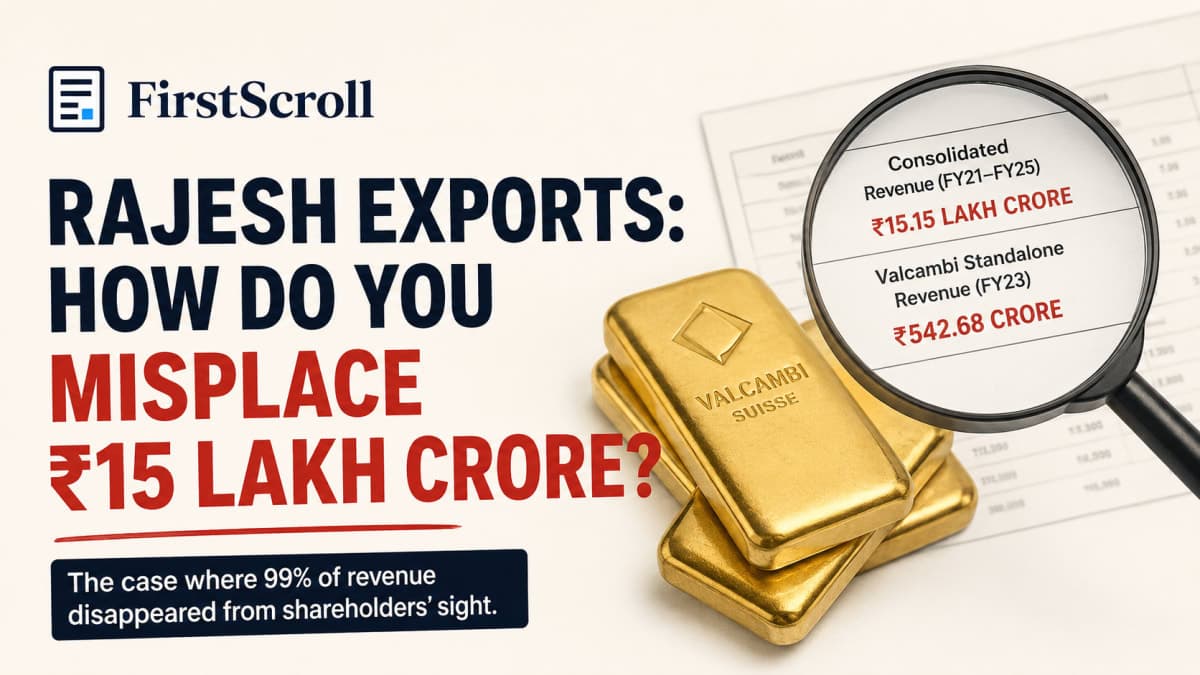
In today's FirstScroll, we break down the Rajesh Exports saga and explain how a listed company's revenue can be 99% invisible to its own shareholders.
With that out of the way, let's dive into today's story.
The Story
In 2015, a jeweller from Bengaluru pulled off one of the most audacious deals in Indian business. Rajesh Exports bought Valcambi, a legendary Swiss gold refinery sitting in the small town of Balerna, right on the Italian border.
Overnight, a company that made jewellery in Bangalore became the owner of one of the world's largest gold refineries. And its reported revenues exploded, routinely placing it among India's largest listed companies, in the same league as the Tatas and Ambanis of the world.
There was just one oddity. For a company reporting lakhs of crores in revenue, almost nobody could tell you what the stock had done for them lately.
Then, in March 2024, a single shareholder filed a complaint with SEBI about trade receivables that had been outstanding for over two years. Money the company said customers owed it, sitting unpaid, for years. SEBI started pulling the thread.
What it found became a 109-page interim order this June, alleging that roughly ₹15.15 lakh crore of revenue reported between FY21 and FY25, nearly everything the company claimed to have earned in five years, was prima facie misrepresented. And this week, the auditors' watchdog NFRA confirmed it has begun its own probe into who signed off on those books.
So here's the question: how does a listed company allegedly misstate 99% of its revenue, for five straight years, without anyone noticing?
The answer lies in a distinction most investors skip past: standalone versus consolidated financials.
You see, a standalone statement shows what the listed company itself earned. A consolidated statement adds up the listed company plus everything it owns: subsidiaries, and subsidiaries of subsidiaries, wherever they sit in the world. When you read that a company "made ₹2.8 lakh crore," you're almost always reading the consolidated number.
Now here's the catch. If 97 to 99% of that consolidated revenue comes from subsidiaries, as SEBI says it did at Rajesh Exports, then the consolidated number is only as trustworthy as the subsidiary accounts feeding it. And those subsidiary accounts sat far from Indian investors' eyes.
The structure, as SEBI describes it, looked like a ladder. The listed Indian parent at the top. A Singapore entity below it. Then a Swiss holding company called Global Gold Refineries, or GGR. And at the very bottom, Valcambi, the actual refinery melting actual gold.
The revenue lived in the middle of the ladder. GGR, the holding company, reported consolidated revenue of about ₹2.93 lakh crore for 2023. But Valcambi, the only entity actually operating a refinery, reported audited standalone revenue of just ₹542.68 crore that year.
Read that again. The holding company claimed revenue over 500 times larger than the refinery it was holding. And unlike Valcambi, which is audited by KPMG, GGR's consolidated numbers weren't independently audited at all.
Why would anyone inflate revenue on this scale? The incentives aren't mysterious. A company ranked among India's largest by turnover commands prestige, index inclusion, institutional ownership, and eligibility for government incentives. LIC alone held nearly 11% of the stock. Big revenue, even if the market never quite believed it, kept the story alive.
And SEBI's order goes beyond the revenue gap. It flags derivative trades worth ₹11,487 crore recorded as company sales and purchases that a counterparty reportedly denied ever transacting, ₹339 crore allegedly moved to the promoter's personal accounts without board approval, and a ₹1,035 crore investment in an African gold mine that forensic auditors could not verify exists.
Now to be clear, the company has a defence, and it's not absurd on its face. Rajesh Exports argues that Valcambi, as a refiner, books only its processing fee, the small charge for melting someone else's gold, while GGR accounts for the gross value of the gold flowing through. Chairman Rajesh Mehta has flatly denied the allegations, calling the order untrue, and Valcambi itself has distanced its operations from the proceedings entirely.
But here's where SEBI remained unconvinced. If the refinery never takes ownership of the gold, how does the holding company above it get to book that gold's full market value as its own revenue? At the interim stage, the regulator found no documentation to support the explanation, and the order is now with the courts of process: a fresh forensic audit, a market ban on the promoter, and the NFRA circling the statutory auditors.
The market, for its part, delivered its verdict long ago. On the day of SEBI's order, the entire company was valued at about ₹3,210 crore. That's roughly 1% of the annual revenue it claimed to generate. Investors were being asked to believe in a ₹2.8 lakh crore business priced like a mid-sized textile firm, and the stock has since fallen 47% this year alone.
Zoom out, and the uncomfortable lesson isn't about one jeweller. It's that a consolidated P&L can look pristine while the entities generating it stay invisible, and that neither a famous auditor at the bottom of the ladder nor an LIC stake on the register guarantees anyone actually checked the middle. Whether SEBI's final order confirms the alleged hole, or the company's processing-fee defence survives scrutiny, is something only time will tell.
Until then…
If this story helped you make sense of the Rajesh Exports case, share it with a friend on WhatsApp, LinkedIn or X.