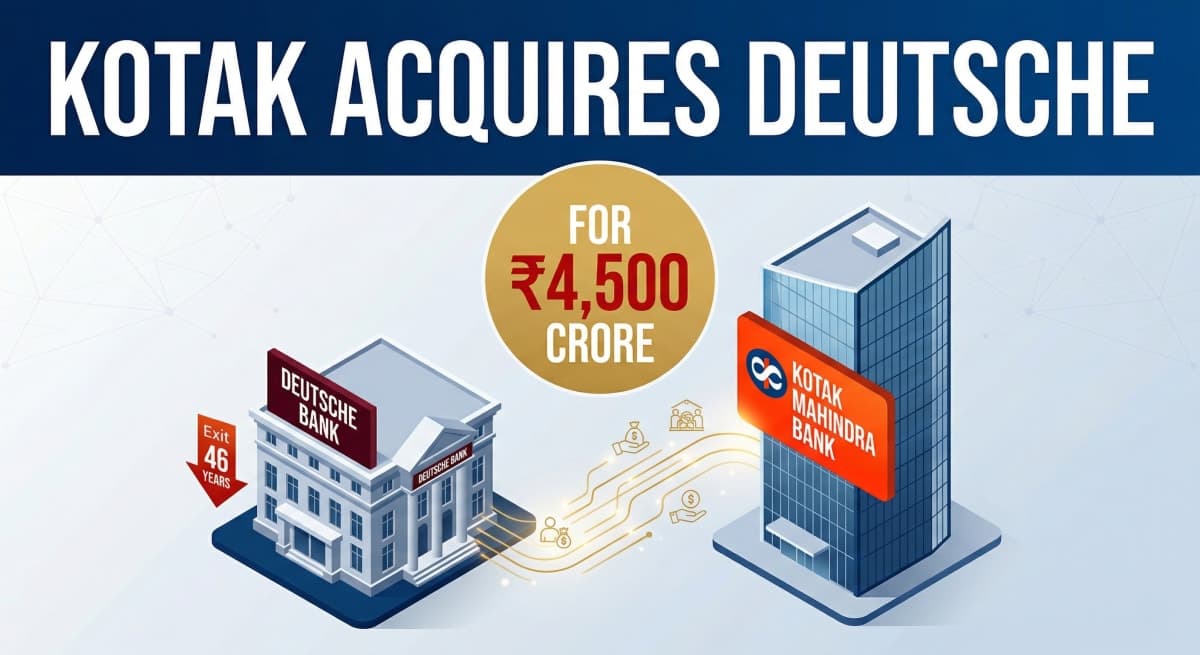
Deutsche Bank entered India in 1980. It served the country's wealthiest urban clients for nearly five decades. And this week, it decided enough is enough and handed the keys to Kotak Mahindra. Here's what that tells you about who wins in Indian banking right now.
There is a very specific type of bank account that most people don't have but many people aspire to.
It's not your standard savings account with ₹10,000 minimum balance. It's a wealth management account the kind where a dedicated relationship manager calls you by your first name, where your money is invested across assets you didn't know existed, and where the branch looks less like a bank and more like a five-star hotel lobby.
Deutsche Bank in India built its entire retail business around that client. For 46 years, 17 branches across India's biggest cities, it quietly served the upper crust high-net-worth individuals, senior corporate executives, NRIs with large investable wealth.
And this week, it decided to stop.

The deal, reported first by the Economic Times on March 23, sees Kotak Mahindra Bank emerge as the preferred bidder beating Federal Bank in what was a competitive process. The final announcement is expected as early as next week. RBI approval and a 6 to 12 month integration period will follow.
But before we get to what Kotak gains, it's worth asking: why is Deutsche Bank leaving?
The answer is not India-specific. Deutsche Bank CEO Christian Sewing has spent the last three years dismantling the bank's global retail footprint. The logic is simple retail banking is expensive to run, requires enormous local infrastructure, and competes with entrenched local players who know the market far better. Deutsche's real strengths are in investment banking, corporate finance, and institutional services. India's retail franchise was profitable it reported ₹2,455 crore in revenue for FY25 but it was an outlier.
India was the only country outside Europe where Deutsche Bank still ran a full retail banking franchise. Think about that for a second. Frankfurt, London, Paris yes. And then Mumbai. That inconsistency was always going to get corrected eventually. It just took this long.
This is not the first time a global bank has made this exit from India. It is, in fact, becoming a pattern.
2018 - Deutsche Bank first explored selling its India retail unit. Held talks with IndusInd Bank. Deal didn't happen.
2022 - Axis Bank buys Citibank's India consumer business for ₹11,600 crore credit cards, retail banking, wealth management.
2025 - Kotak buys Standard Chartered's India personal loan book its first acquisition of this kind.
2026 - Kotak acquires Deutsche Bank's full India retail franchise loans, deposits, wealth, MSMEs. ₹4,500 crore.
The trend is unmistakable. Global banks enter India, build a niche, find the economics don't justify staying, and sell to an Indian private bank that's hungry for scale. India's banking consolidation isn't happening through mergers of equals it's happening through foreign banks quietly handing over their best clients to domestic players.
So what does Kotak actually get here?

For Kotak, this is what bankers call a "bolt-on" a relatively small acquisition that slots neatly into an existing strategy without requiring a fundamental change in direction. Kotak's private banking arm already manages wealth for India's ultra-rich. Adding Deutsche's ₹7,000 crore in wealth assets is not a pivot. It's a deepening.
And the price is fair. Kotak is paying ₹4,500 crore for a portfolio with a net asset value of ₹4,300 crore a slight premium that reflects the quality of the book and the relationships that come with it.
For Deutsche Bank's existing customers in India and there aren't that many, given the deliberately niche positioning the near-term impact is minimal. Accounts, cards, and loans continue under existing terms through the transition period. The relationship manager may eventually change. The coffee in the lobby probably won't.
The bigger story here isn't really about Kotak or Deutsche. It's about what this pattern of deals says about Indian banking in 2026.
India's private banks Kotak, Axis, HDFC are getting more aggressive and better capitalised. Global banks are recalibrating. And the HNI client, once considered the exclusive domain of foreign institutions with global networks and Swiss-style discretion, is increasingly comfortable banking with a homegrown name.
That shift is quiet. But it's real.
Until next time…