Imagine you planned your year around earning ₹7 lakh. Then, in the span of 11 days, someone told you to expect ₹6.5 lakh. And then, before you had even had time to adjust, they called again and said, actually, make that ₹5.9 lakh. That's essentially what's happening to India's economy right now, according to Goldman Sachs. And the culprit is thousands of kilometres away, in a narrow stretch of water most people have never thought twice about.
The Story
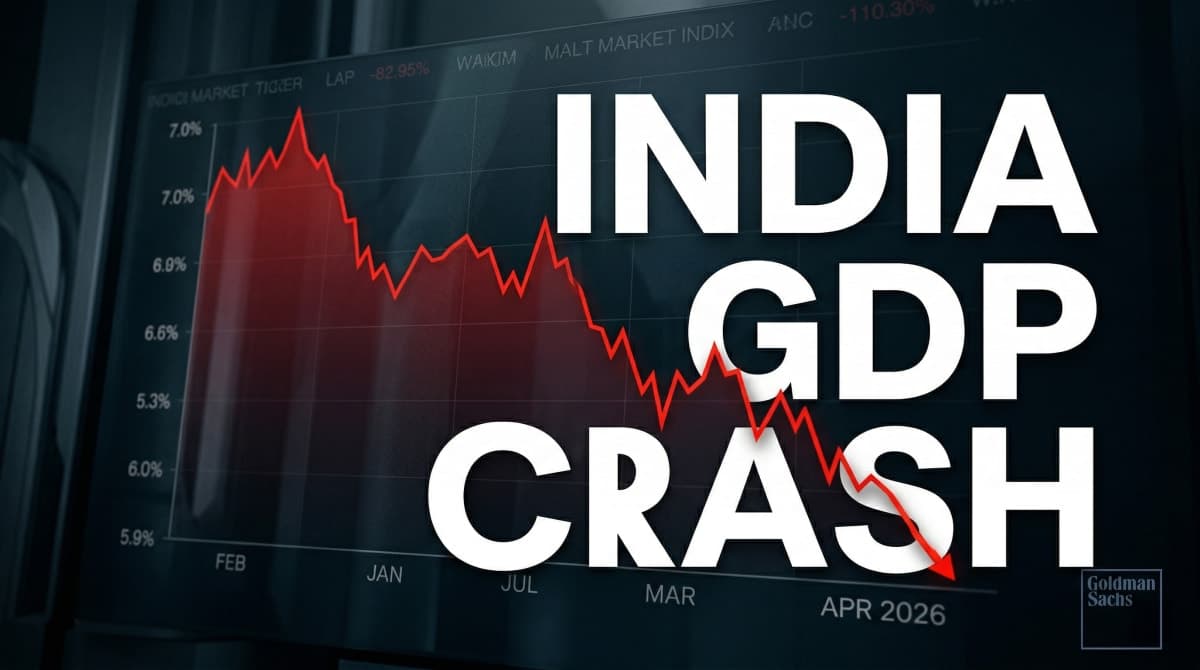
A war changes everything. When the US-Iran conflict broke out in late February 2026, the world's financial modellers scrambled to reprice their assumptions. Goldman Sachs, one of Wall Street's most closely watched investment banks, had India growing at 7% this year. Then came March 13, and that became 6.5%. Then came March 24, and now it's 5.9%. Two cuts in eleven days. That's not a tweak. That's a rethink.
So what changed? The short answer: oil. The longer answer: a chokepoint called the Strait of Hormuz.
Scroll Note: Strait of Hormuz - A narrow waterway between Iran and Oman, roughly 33 kilometres wide at its narrowest point. About 20% of the world's oil supply passes through it every day. When it's disrupted, global energy markets feel it almost instantly.
Goldman's analysts noted that this is a "qualitatively different" kind of oil shock for India, one that hits both import costs and currency stability at the same time. Most oil shocks hit your wallet through petrol prices. This one is doing that, but it's also hammering the rupee, widening India's trade deficit, and threatening to pull the RBI into a corner it really doesn't want to be in.
Here's where it gets interesting. Goldman now expects the Strait of Hormuz to remain near-shut until mid-April, with Brent crude averaging $105 per barrel in March and climbing to $115 in April, before potentially falling back to $80 by the fourth quarter if flows normalise. That "if" is doing a lot of heavy lifting.
For India, the timing couldn't be trickier. India imports about 85% of its crude oil, making it highly sensitive to sustained high energy prices. Every dollar that Brent rises is a dollar more India has to pay, in foreign currency, to keep its lights on, its trucks moving, and its factories running.
Scroll Note: Current Account Deficit (CAD) - When a country imports more than it exports, the gap is called the current account deficit. A wider CAD means more foreign currency flowing out, which puts pressure on the local currency and can unsettle financial markets.
And that deficit is widening fast. Goldman now warns that India's current account deficit could reach 2% of GDP in 2026, up from 1.3% in the October-to-December quarter of 2025. A jump of that size, in that short a time, signals real stress on India's external finances.
But the piece of the report that's really getting people's attention is the inflation forecast and what Goldman thinks the RBI will have to do about it.
Goldman now expects India's inflation to average 4.6% in 2026, up from their earlier estimate of 3.9%. While that technically stays within the RBI's tolerance band of 2 to 6%, the bank now forecasts a 50 basis point hike in the policy repo rate, driven not just by rising prices, but by the need to defend a weakening rupee.
Scroll Note: Repo Rate - The interest rate at which the RBI lends money to commercial banks. When the RBI raises it, borrowing becomes more expensive across the economy, for businesses, home loans, and personal credit alike. It's one of the RBI's main tools to control inflation.
Think about what that means in practice. The Indian rupee has already fallen roughly 4% against the US dollar so far in 2026, after declining about 4.7% in 2025. A weaker rupee means everything imported, crude oil, edible oil, electronics, fertilisers, costs more in rupee terms. That cost gets passed on. To your grocery bill. To your fuel pump. Gradually, to almost everything.
Now, zoom out for a second. The RBI cut rates aggressively through 2025 to support growth. A 50 bps hike would mark a sharp reversal of that stance. Goldman notes that markets are already pricing in even more aggressive tightening, implying three to four 25 bps hikes over the coming year. The MPC meets on April 6 to 8. That meeting just became the most watched policy event of the year.
There's also a wrinkle that makes this oil shock different from the ones India has navigated before. Unlike past oil shocks where higher prices boosted Middle Eastern economies and led to increased remittances and exports for India, the current conflict is hurting those economies, resulting in a simultaneous hit to India's import costs, export demand, and remittance inflows. All three levers are moving in the wrong direction at once.
The good news, and there is some, is that India isn't walking into this without armour. Goldman's Chief India Economist Santanu Sengupta noted that India enters this shock with strong buffers, including over $700 billion in foreign exchange reserves. That's a significant cushion. But cushions, as anyone who's sat on one long enough knows, eventually compress.
What to watch next: the RBI's April MPC meeting, how long the Strait of Hormuz disruption lasts, and whether the government steps in with excise duty cuts or subsidy tweaks to keep retail fuel prices from becoming a political and inflationary flashpoint. The 7% growth story isn't dead. But right now, it's on hold.
Until next time, keep scrolling. 📜