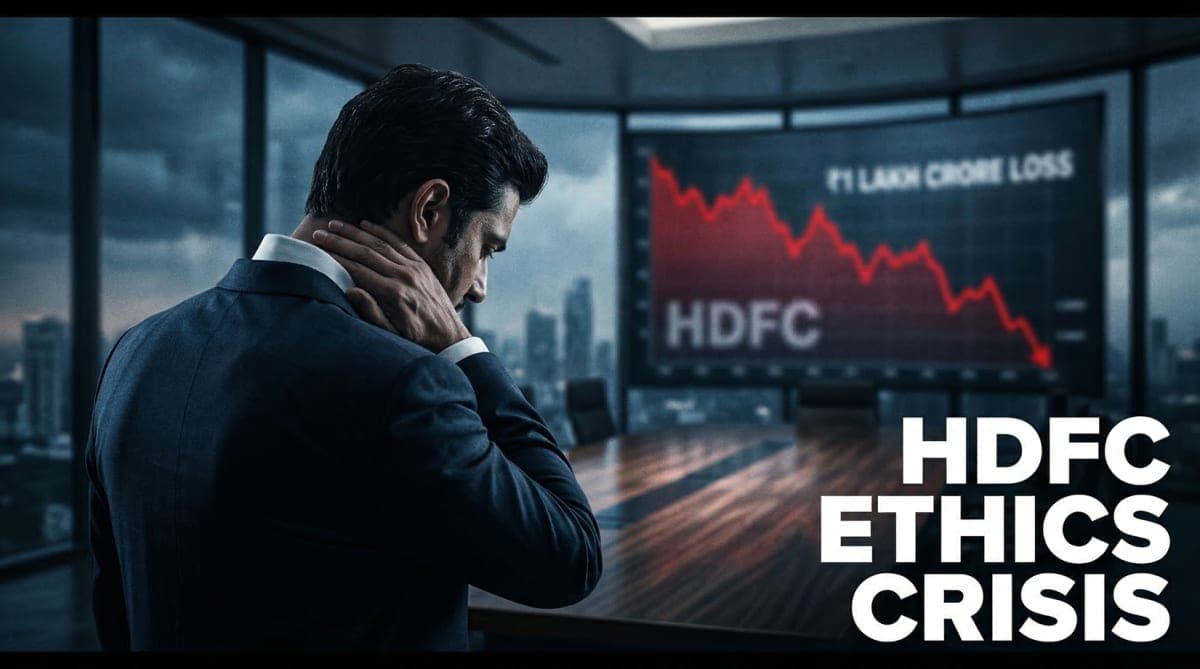
Eight words in a resignation letter wiped out ₹1 lakh crore from India's largest private bank overnight. And the most unsettling part? No one not the board, not the CEO, not the RBI knows what those eight words refer to.
There's a good chance your salary hits an HDFC Bank account every month. Or your home loan runs through them. Or your mutual fund SIP goes via HDFC AMC. With over 12 crore customers, HDFC Bank is not just a bank it's infrastructure.
So when its chairman quietly walks out citing "ethics," you probably want to know what exactly happened.
Here's the thing: nobody does.
From Atanu Chakraborty's resignation letter - March 17, 2026
"Certain happenings and practices within the bank, that I have observed over last two years, are not in congruence with my personal values and ethics. This is the basis of my aforementioned decision."
That's it. No specifics. No names. No details. One carefully worded sentence from a former IAS officer a man who spent decades in the Ministry of Finance and ran India's Department of Economic Affairs. Someone who does not choose words carelessly.
And those eight words "not in congruence with my personal values and ethics" were enough to trigger one of the sharpest single-day falls HDFC Bank has ever seen.

Now here is where it gets strange.
On the morning of March 19, HDFC Bank called an emergency investor call. Six of its 12 board members showed up including the newly appointed interim chairman Keki Mistry and CEO Sashidhar Jagdishan. Their message was consistent: there are no governance issues, no power struggles, no operational problems. Everything is fine.
The RBI also stepped in unusually quickly to call HDFC Bank a "Domestic Systemically Important Bank with sound financials, a professionally run board, and a competent management." That kind of statement from the regulator doesn't happen every day. It's essentially the RBI saying: please don't panic.
But here's the part that's hard to square. When the board asked Chakraborty directly during a meeting whether his resignation involved a governance issue, he said no. He also did not provide any evidence or details of the alleged unethical practices to the board. The CEO admitted the board was "baffled." Sources say the underlying issue may have been a personal relationship breakdown between Chakraborty and the bank's senior management.
So we're left with this: the chairman saw something over the last two years that troubled him enough to resign mid-term his tenure was extended until May 2027. He called it an ethics issue. Then he refused to say what it was. And the bank insists there's nothing to see here.
Both things could be true. It could genuinely be a personal falling-out dressed up in formal language. That happens in boardrooms more often than people admit.
But it could also be something more. And that uncertainty is precisely why markets reacted the way they did.
What's the actual damage? Analysts at Emkay noted that exits from HDFC Bank's senior leadership have been accelerating since the 2023 merger with HDFC Ltd. A ₹40-lakh-crore balance sheet, 12 crore customers, and a leadership pipeline that's looking thinner than it should that's not a comfortable combination.
By the time markets closed on Thursday, the share had recovered somewhat to ₹799. The RBI had spoken. The board had spoken. The interim chairman had spoken.
The only person who hasn't elaborated is Chakraborty himself.
And until he does or until something more specific surfaces the most important sentence in Indian banking this week remains exactly as cryptic as it was on March 17.
Until next time…