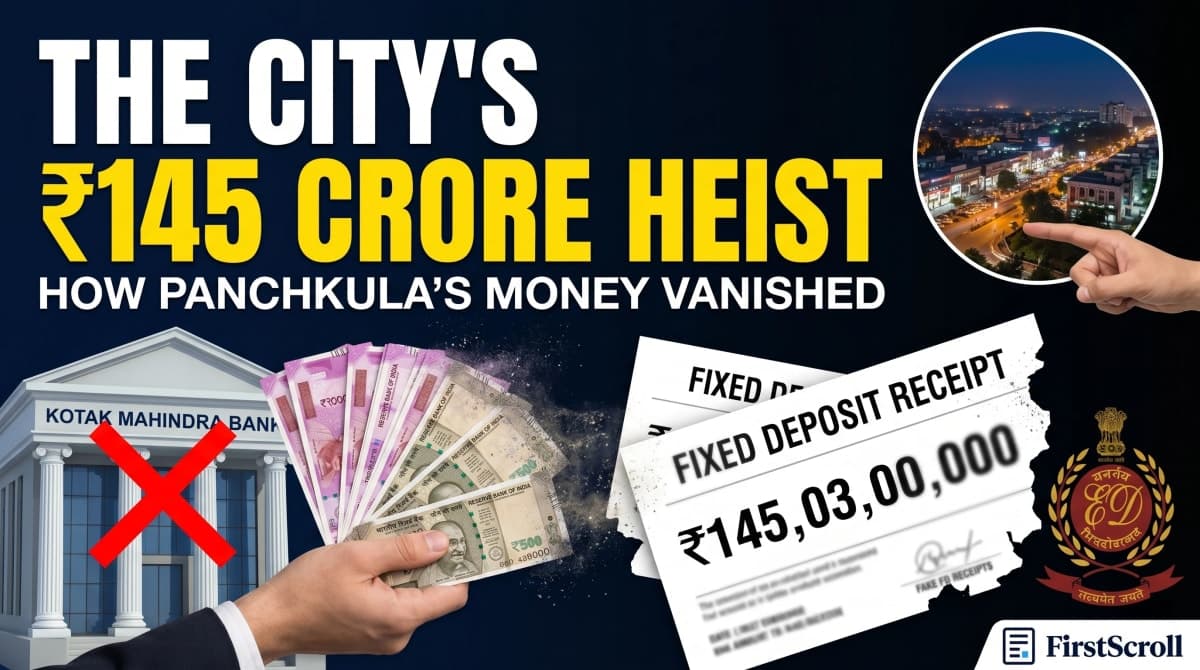
On the morning of March 25, 2026, a few officials from the Panchkula Municipal Corporation walked into a Kotak Mahindra Bank branch in Sector 11. They had a routine task. One of their fixed deposits had matured. They wanted to transfer the money out.
The conversation at the counter went something like this.
"Hi, we'd like to redeem this FD."
"Sure. One moment."
Long silence. Confused looking up of records. More silence. Concerned phone calls.
"Madam, we don't actually have this FD on our books."
"What do you mean? Here's the receipt. We've been holding it for years."
"The receipt is fake."
That's how India's most jaw-dropping municipal heist of 2026 was uncovered. Not by a forensic auditor. Not by a whistleblower. Not by an investigation. By a regular maturity request that didn't match anything in the bank's actual records.
What followed has to be one of the wildest financial crime stories of the year. A complete civic body had been led to believe it was sitting on 16 fixed deposits worth ₹145.03 crore for years. Not a single one of them was real.
Buckle up. This story has bank insiders, fake email IDs, forged FD receipts, real estate builders, and one rogue accountant who held the keys to a city's treasury.
Let's break it down.
So how does ₹145 crore just disappear?
Here's the part that should genuinely terrify you.
Municipal corporations across India hold thousands of crores in fixed deposits with banks. Property tax, GST share, government grants, water charges. All of it sits in bank FDs earning interest while the city plans roads, drains, parks, and schools.
The Panchkula Municipal Corporation believed it had ₹145.03 crore parked safely across 16 such FDs at Kotak Mahindra Bank's Sector 11 branch. According to the Enforcement Directorate's official press release of April 23, 2026, the projected maturity value of those FDs was ₹158.02 crore.
In reality, every single one of those FD receipts was a forgery.
The bank had no record of these deposits. The MC had no idea the money was gone. Both sides operated for years, perfectly happy, looking at completely different sets of books.
Try wrapping your head around that for a minute.
Imagine your bank statement says you have ₹50 lakh in your savings account. You see the balance every time you log in. Every email confirms it. Every relationship manager tells you "yes ma'am, you have ₹50 lakh with us." Then one day you go to withdraw it and the bank says "haan ji, your balance is ₹0. We don't know what statement you've been looking at."
That's basically what happened. But to a city. With ₹145 crore.
How did they actually pull it off?
This is where the detective story gets really interesting.
According to the ED's investigation under PMLA, the fraud needed three types of people working together:
One: A senior bank official with the authority to approve transactions Two: A customer relationship manager who could process those transactions Three: A municipal accountant with the seal and signature authority
Find these three people, get them to cooperate, and you have a working pipeline to drain a civic body. That's exactly what happened in Panchkula.
The cast of characters:
Pushpinder Singh: Former Deputy Vice President, Kotak Mahindra Bank Dileep Kumar Raghav: Former Customer Relationship Manager, Kotak Mahindra Bank Vikas Kaushik: Former Senior Accounts Officer, Municipal Corporation Panchkula
Together, these three did something straight out of a heist film. Here's the play-by-play.
Step 1: They opened two new bank accounts in the name of "Municipal Corporation Panchkula" using forged authorisation documents. To the bank's systems, these looked like legitimate corporation accounts. To the corporation, these accounts didn't exist.
Step 2: They created forged "fund migration letters" that supposedly came from the MC, asking for money to be moved from the genuine accounts to the new fake ones.
Step 3: The bank insiders processed these "instructions" using unauthorised email IDs. The actual MC officials had no idea any of this was happening because the emails were going from fake addresses, not the corporation's real ones.
Step 4: Once the money landed in the fake accounts, it was transferred onward to a network of private financiers: Rajat Dahra, Swati Tomar, Kapil Kumar, Vinod Kumar.
Step 5: These financiers then routed the money back to Pushpinder Singh and his wife Preeti Thakur. So the bank insider who started the chain was also receiving the money at the end of it.
Step 6: Some of the money was forwarded to real estate firms as high-interest loans, where it disappeared into property and construction projects.
Through this entire process, the MC kept getting "FD advice notes" showing it owned 16 healthy FDs worth ₹145 crore. All forged. The MC's records said everything was fine. The bank's records said the money was elsewhere. Neither side was checking against the other.
This went on for years. Yes, you read that right.
Wait, how did it go undetected for so long?
This is the question every Indian taxpayer should be asking. And the answer is uncomfortable.
Most municipal corporations in India do not run real-time digital reconciliation with their bank accounts. The MC sees what the bank tells it via printed statements and FD advice notes. The bank processes whatever it has on file.
There's no automated cross-check. No dashboard. No verification system that compares what the MC thinks it has with what the bank actually shows.
According to investigators, this is exactly why frauds like this can run undetected for years. As long as the forged documents look professional and the maturity isn't called yet, nobody notices anything is wrong.
The fraud was finally uncovered when the Panchkula MC tried to withdraw the maturity proceeds of one specific deposit, around ₹58-59.5 crore, as confirmed by Municipal Commissioner Vinay Kumar. The funds didn't show up in their account even though their records said the maturity had been processed.
That single failed withdrawal blew the whole thing wide open.
If that FD hadn't matured when it did, the fraud might still be running today.
Where did the ₹145 crore go?
This part is even more fascinating.
The ED's investigation tracked the money through multiple layers of "layering," which is fancy money-laundering speak for moving cash through several bank accounts to make it impossible to trace.
The official destination chain, as per the ED:
₹70 crore allegedly went to Rajat Dahra alone, one of the private financiers in the chain. Between 2020 and 2025, this single individual received money in two bank accounts before transferring it onward to several other accounts now under investigation.
The remaining money was split across Swati Tomar, Kapil Kumar, and Vinod Kumar. From there, it landed back with the original bank insider Pushpinder Singh and his wife.
A significant chunk eventually went to real estate firms. ED searches on April 22, 2026 covered the premises of a real estate firm called Sanat Realtors and an individual named Sunny Garg.
So the public's money, meant to fix Panchkula's roads and drains, ended up financing private real estate deals. The taxpayers paid. The builders profited. The bank insiders pocketed commissions. The accountant got his cut.
Roads stay broken. Drainage stays clogged. Parks stay un-built. Because ₹145 crore that was supposed to fund all of that was busy enriching a network of insiders.
Six arrests and counting
Investigations are now running on parallel tracks.
The Haryana State Vigilance and Anti-Corruption Bureau registered the first FIR in March 2026 under the Bhartiya Nyaya Sanhita 2023 and the Prevention of Corruption Act, 1988. This is the criminal track, focused on the corruption and conspiracy charges.
The Enforcement Directorate then opened a parallel money laundering case under PMLA 2002. This track follows the money trail and aims to attach the assets bought with the stolen funds.
Six people have been arrested so far:
Dileep Kumar Raghav (former CRM, Kotak)
Pushpinder Singh (former DVP, Kotak)
Rajat Dahra (private financier)
Three others linked to the conspiracy
The ED has seized "incriminating documents" including sale-purchase agreements from raids across 12 premises in Chandigarh, Panchkula, Zirakpur, Dera Bassi, and Rajpura (Patiala) in Punjab, as per the ED's official statement of April 23, 2026.
Kotak Mahindra Bank, in its own statement, has said it is examining the matter following directions from the MC and is fully cooperating with law enforcement agencies.
What it means for you
If you have an FD anywhere. Don't assume your FD is real just because you have a receipt or a passbook entry. Periodically log into your bank's official portal and verify your deposits exist. Cross-check the bank's statement against your own records. Sounds tedious. The Panchkula MC would tell you it's worth it.
If your housing society, school, or office holds large FDs. Push for digital reconciliation. Demand a system where the bank's data flows directly into the institution's accounting software, not via printed statements that one accountant can fake. Most modern banks now offer corporate net banking with real-time verification. Use it.
If you're an investor in Kotak Mahindra Bank. Watch this case carefully. The Reserve Bank of India has been increasingly aggressive about penalising banks for governance failures and lapses in internal controls. Any major regulatory action against the bank would impact valuations.
If you pay taxes anywhere in India. Understand this: municipal corporations across India hold thousands of crores in similar deposits, with similar oversight gaps. Panchkula isn't a one-off. It's a sample case of a system-wide vulnerability. The next ₹145 crore fraud is probably already running. Quietly. Somewhere. We just haven't found it yet.
If you work in finance or banking. Internal control isn't just compliance theatre. It's the only thing standing between your institution and a headline. Real-time monitoring, multi-signatory verification for large transactions, mandatory cross-checks between client books and bank books. None of these are exotic. All of them are missing in too many places.
The bigger picture
Here's the part that should haunt every Indian who pays taxes.
Panchkula Municipal Corporation isn't a small village panchayat. It's a fully functional civic body in one of Haryana's wealthiest urban districts. It has accountants. It has audit committees. It has financial reporting protocols. And still, ₹145 crore went missing for years without anyone noticing.
If it can happen in Panchkula, it can happen anywhere.
The fundamental problem is that India's municipal corporations were never designed for the world of digital banking. The systems are still based on paper FDs, printed bank statements, and physical signatures. In 2026. In a country that runs UPI and aadhaar-linked everything else.
The fix is technically easy. Mandate real-time digital reconciliation between civic body accounts and bank systems. No civic body holding more than ₹100 crore in FDs should be able to run on paper records. Every transaction above a threshold should require multi-signatory, multi-channel verification. The technology exists. The political will to implement it doesn't.
Until that changes, frauds like Panchkula will keep happening. We'll just keep reading about them as one-off shocks instead of recognising them as the structural failures they are.
The Panchkula MC's officials walked into a bank branch one morning expecting a routine transfer.
What they got was the worst kind of education.
The kind that costs the public ₹145 crore.
The kind that should never have been needed in the first place.