In today's FirstScroll, we open up one of India's coolest homegrown brands. boAt earphones are in millions of ears, the brand is everywhere, the founder is a Shark Tank star. Yet on a revenue of over ₹3,000 crore, it barely scrapes together ₹60 crore in profit. How can a brand this huge make money this thin? Let's unpack it.
The Story
You probably own a pair. Or three.
boAt is the brand that put affordable, stylish earphones and smartwatches into the hands of an entire generation of young Indians. Loud branding, cricketer endorsements, Aman Gupta charming everyone on Shark Tank India. In less than a decade, it went from nothing to India's number one audio brand for five years straight, selling crores of devices. By every measure of fame, boAt is a massive success.
So here's the part that doesn't add up.
In FY25, boAt's parent company made revenue of around ₹3,100 crore. Sounds huge. But its actual profit? Just about ₹61 crore. And that was a celebration, because the two years before that, it actually lost money, ₹80 crore and ₹129 crore in losses.
Do the quick math. ₹61 crore profit on ₹3,100 crore of sales is a net margin of about 2%. For every ₹100 worth of earphones boAt sells, it keeps around ₹2.
A massive, famous, market-leading brand, surviving on wafer-thin scraps. Why?
To understand it, you have to see what boAt actually is, versus what you think it is.
The uncomfortable truth: boAt doesn't really make earphones.
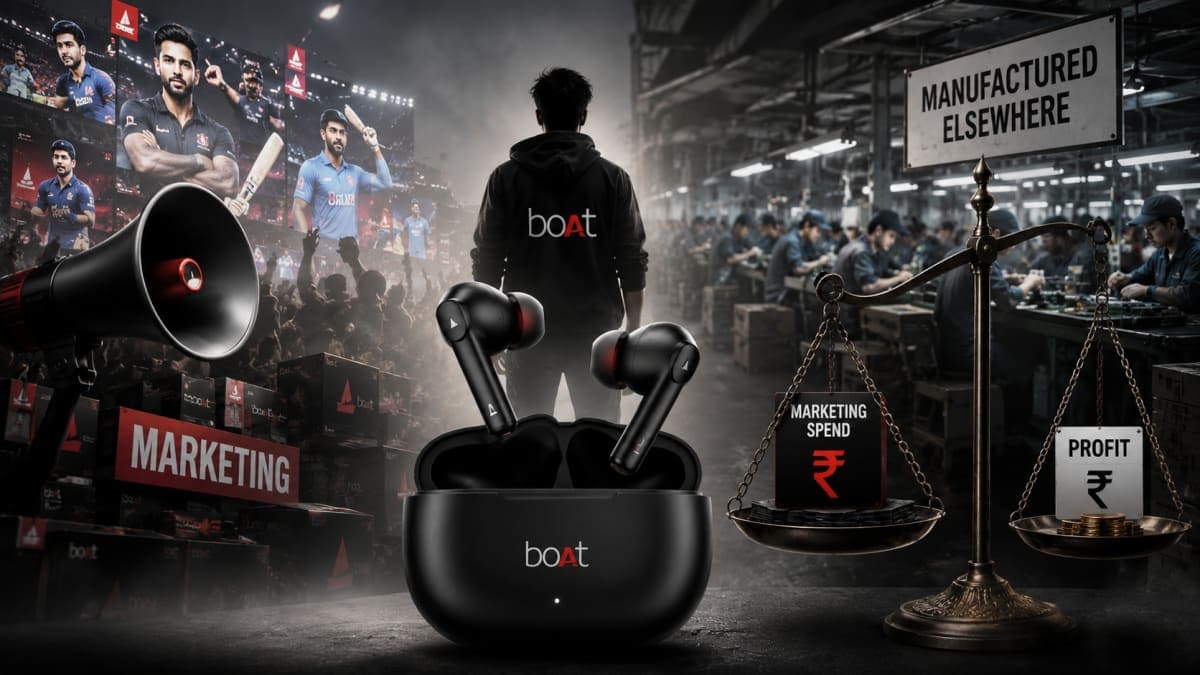
This surprises people. boAt is not a factory. It doesn't have giant plants stamping out earbuds. It's primarily a branding and design company. It designs the products, slaps on that cool boAt logo, markets them brilliantly, and gets them manufactured by other companies, largely in China, then sells them in India.
This "asset-light" model is great for growing fast, you don't burn crores building factories. But it has a hidden cost. When someone else makes your product, they take a chunk of the profit. boAt buys the finished earbuds at a price, and can only mark it up so much before it gets too expensive for its budget-conscious buyers. The fat margins from manufacturing go to the factory, not to boAt.
So right away, boAt is working with a thin slice. But that's only half the problem.
The killer: it sells a commodity in a knife-fight market.
Here's the brutal reality of budget electronics. One ₹1,500 pair of earbuds is not that different from another ₹1,500 pair. Customers don't have deep loyalty, they buy on price, looks, and whatever's discounted today.
That means boAt is trapped in a vicious price war. On one side, global giants like Sony, JBL, and Samsung sit above it. On the other, a swarm of cheaper rivals like Noise, boult, and a flood of new brands attack from below, constantly undercutting on price. To stay the cheapest cool option, boAt can't raise prices much. Its pricing power is basically zero.
And in a market like that, the only way to keep selling is to shout the loudest. Which leads to boAt's single biggest money drain.
The marketing treadmill.
To stay top-of-mind in a sea of identical earbuds, boAt spends enormous amounts on advertising, celebrity deals, cricket sponsorships, influencer campaigns. In FY25 alone, it spent a staggering ₹390 crore on advertising and promotion, nearly 13% of its entire revenue.
Read that next to the profit again. boAt spent ₹390 crore on ads to earn ₹61 crore in profit. Marketing costs it more than six times what it actually keeps.
This is the treadmill. boAt has to keep spending big on marketing, because the moment it stops shouting, a cheaper rival grabs its customers. But all that spending eats almost everything it earns. It's running flat out just to stay in the same place.
So now the full picture clicks. Thin margins because it doesn't manufacture. No pricing power because earbuds are a commodity. And huge ad bills because it's in a brutal brawl for attention. Squeeze those three together, and a ₹3,100 crore brand is left holding just ₹61 crore.
It gets trickier: its growth engine stalled.
There's one more wrinkle. For a while, boAt's exciting growth came from smartwatches (wearables). That category was booming, and boAt rode the wave.
Then the wave crashed. boAt's wearables business collapsed by nearly 58%, from ₹783 crore to just ₹330 crore in two years, as the smartwatch craze cooled and competition exploded. Meanwhile its core audio business grew only about 10% over the same period. So overall revenue actually went slightly backwards, drifting down over three years.
A brand that grew fivefold in five years suddenly found its momentum gone. Growth stalled, exactly when it's trying to go public.
So how did it even get back to profit? And is it doomed?
Let's be fair, because boAt did engineer a real turnaround, just not a glamorous one.
It didn't suddenly start earning more per sale. Instead, it got disciplined on costs. It slashed its capital spending and cut warranty costs through better quality control, while reducing debt and interest costs sharply. In other words, it stopped the bleeding by spending smarter, not by selling more profitably. That discipline is what flipped those ₹100+ crore losses into a small profit. Genuinely good management, but it's a defensive win, not an explosion of profitability.
And this is exactly why its planned IPO has people raising eyebrows. boAt was once valued at around ₹10,000 crore. But that for a company earning ₹61 crore means investors would be paying a price more than 160 times its annual profit, sky-high for a business with flat revenue and razor-thin margins. Some analysts argue its fair value is closer to ₹3,000 to 4,000 crore. The brand is loved; the maths is hard.
So, how does boAt sell crores of earphones and still struggle to make real profit?
Because fame and profit are two completely different things. boAt nailed the brand, the design, the vibe, the cultural moment. But underneath the cool logo, it's stuck in the toughest kind of business: selling a commodity it doesn't manufacture, with no pricing power, in a market where the only way to stay visible is to spend a fortune on ads.
It's a brilliant brand sitting on brutal economics. And that's the real lesson here. Selling a lot is the easy part. Keeping a meaningful slice of what you sell, when you don't control the product and can't control the price, is the part that quietly decides whether a famous company is actually a great business.
boAt won India's ears. The harder battle is winning real, fat profits. And that one is still very much on.
Until next time...