In today's FirstScroll, we tell the story of how a mutual fund app built by ex-Flipkart engineers dethroned the king of Indian stock trading, and why "biggest" and "most profitable" turned out to be two very different crowns.
The Story
For years, if you asked anyone in India "which trading app should I use?", the answer was automatic: Zerodha.
Zerodha basically invented discount broking in India back in 2010. It made trading cheap, killed the fat commissions that old brokers charged, and built a cult following of serious traders. For over a decade, it sat at the top like it owned the place. Because, well, it kind of did.
And then, almost without anyone noticing, it got dethroned.
By September 2023, a company most people still thought of as "that mutual fund app" had quietly pulled ahead. Groww ended September 2023 with 6.63 million active clients versus Zerodha's 6.48 million, ending Zerodha's long reign at the top.
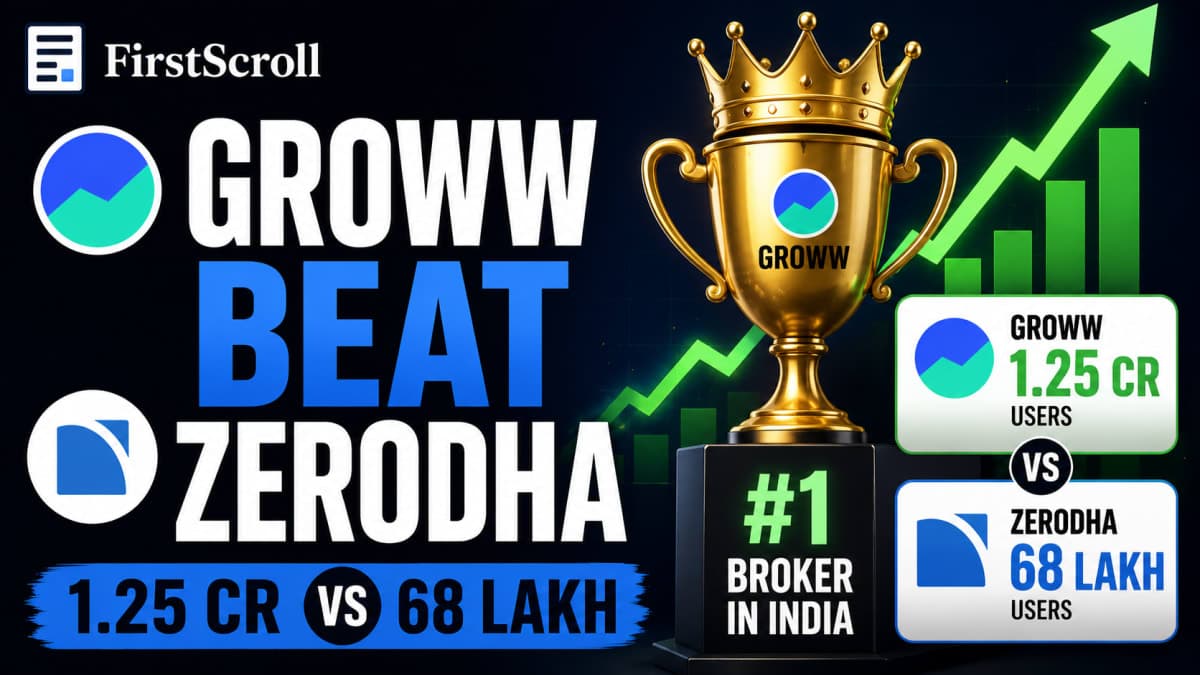
And it didn't stop there. The gap became a canyon. By early 2026, Groww had around 1.25 crore active clients with a 27.66% market share, while Zerodha had slipped to about 68 lakh and 15.21%. That's not a narrow lead anymore. Groww now has nearly double the users of the company that built this entire industry.
So how did a newcomer pull off one of the fastest takeovers in Indian fintech? And here's the twist that makes this story actually interesting: even after losing the crown, Zerodha was still making more money than Groww. We'll get to that.
First, let's understand how Groww won.
Move 1: It treated investing like ordering food, not flying a plane.
Here's the thing about Zerodha's platform, Kite. It's powerful. Pro traders love it. Advanced charts, fast execution, deep tools. But for a 22-year-old opening their first ever investment account, it can feel like being handed a fighter jet cockpit when all you wanted was to buy ₹500 of an index fund.
Groww went the opposite way. Founded in 2016 by four ex-Flipkart employees, Lalit Keshre, Harsh Jain, Neeraj Singh, and Ishan Bansal, it started life as a simple mutual fund app and obsessed over one thing: making investing dead simple. Clean design. Three taps to invest. No jargon. It felt less like a brokerage and more like a regular consumer app.
And that was the masterstroke. Because the wave of new investors flooding into the market post-pandemic weren't pro traders. They were first-timers. Students, young professionals, people in smaller towns who'd never bought a stock in their life. To them, "simple" wasn't a downgrade. It was the entire point
Move 2: The mutual fund trojan horse.
This is the sneaky-genius part. Most people came to Groww not to trade stocks, but to start a SIP in a mutual fund, the safe, beginner-friendly thing everyone's CA uncle recommends.
But once you're already on the app, already KYC-verified, already comfortable, taking the next step into buying actual stocks is frictionless. Groww basically used mutual funds as the front door, and then opened a second door to broking right next to it. It still remains the most used app for mutual fund investments in India. The funnel was beautiful.
Move 3: Growth without burning cash on ads.
You'd assume capturing crores of users meant insane marketing spends. Nope. Around 83% of Groww's users were acquired organically, meaning word of mouth, app store discovery, and reputation did the heavy lifting. Friends told friends. The simplicity sold itself.
Put it together and the scoreboard was brutal. Between FY21 and the September 2023 takeover, Zerodha's user base roughly doubled while Groww's exploded by around 750%. One company was growing steadily. The other was going vertical.
So Groww won the user war. Game over, right?
Not quite. Because here's the catch that confuses everyone.
Being the biggest didn't make Groww the richest.
Even in the year Groww grabbed the crown, Zerodha was still by far the most profitable brokerage in the country, posting a net profit of ₹2,907 crore in FY23. And even in FY25, as we covered earlier, Zerodha made around ₹4,237 crore in profit, while Groww's FY25 net profit was about ₹1,824 crore on revenue of roughly ₹3,900 crore.
Sit with that. Groww has nearly double the users, but Zerodha makes well over double the profit. How?
Because Zerodha's smaller user base is packed with the people who actually generate money for a broker: active, high-frequency traders who hammer the buy and sell buttons in futures and options, paying ₹20 a pop, again and again. Remember, brokers don't really earn from the patient SIP investor. They earn from the hyperactive trader.
Groww won the volume game by attracting millions of beginners and long-term investors. Zerodha held the value game by keeping the serious traders. More users, but quieter ones. Fewer users, but louder, costlier-to-serve ones who pay the bills.
It's the classic split in any consumer business: the company with the most customers isn't always the one making the most money per customer.
But Groww wasn't done. It went and did the thing Zerodha famously refuses to do.
The IPO that crowned the takeover.
Zerodha is proudly bootstrapped. No outside investors, no listing, family-owned, by choice. Groww went the complete opposite direction. After re-domiciling from the US back to India in late 2024 specifically to list here, it made a strong stock market debut on November 12, 2025, listing at ₹114, a 14% premium over its ₹100 issue price.
And the financial glow-up was real. Groww had swung from an ₹805 crore loss in FY24 to a ₹1,824 crore profit in FY25, with eye-watering margins of around 59% and a return on net worth near 37%. That FY24 loss, by the way, was mostly a one-time tax hit from moving its headquarters back to India, not a broken business.
The market loved it, but not blindly. The listing valued Groww richly at around a 30 to 34 times price-to-earnings multiple, far above traditional brokers like Angel One at roughly 20 times.
Translation: investors are paying a premium today, betting Groww's beginner army keeps growing and eventually starts trading more, and paying more.
So, how did Groww quietly overtake Zerodha?
Not by beating Zerodha at its own game. It refused to play that game at all. Instead of fighting for hardcore traders, it went after the millions of Indians who found the stock market intimidating, and made it feel as easy as a food delivery app. It used mutual funds as the doorway, simplicity as the weapon, and word of mouth as the engine.
The result is a fascinating split-screen in Indian finance. Groww is the king of reach, the app in the most hands. Zerodha is the king of profit, the platform in the most serious hands. One won the crowd. The other kept the cash.
And the really interesting question for the next few years? Whether Groww can convert its enormous army of casual investors into the kind of active traders that made Zerodha so rich, without losing the simplicity that got them in the door in the first place.
Because in this business, having the most users is only half the battle. The other half is getting them to actually trade.
Until next time...