In today's FirstScroll, we trace one of the greatest glow-ups in business history. Netflix started as a tiny company posting DVDs in red envelopes, was once laughed out of the room by the biggest video chain on Earth, and is now a streaming colossus worth hundreds of billions. The secret to its survival is a strategy so brutal that most companies are too scared to even try it.
The Story
In the year 2000, two founders walked into the office of Blockbuster, the giant that ruled movie rentals, with those iconic blue-and-yellow stores in every neighbourhood.
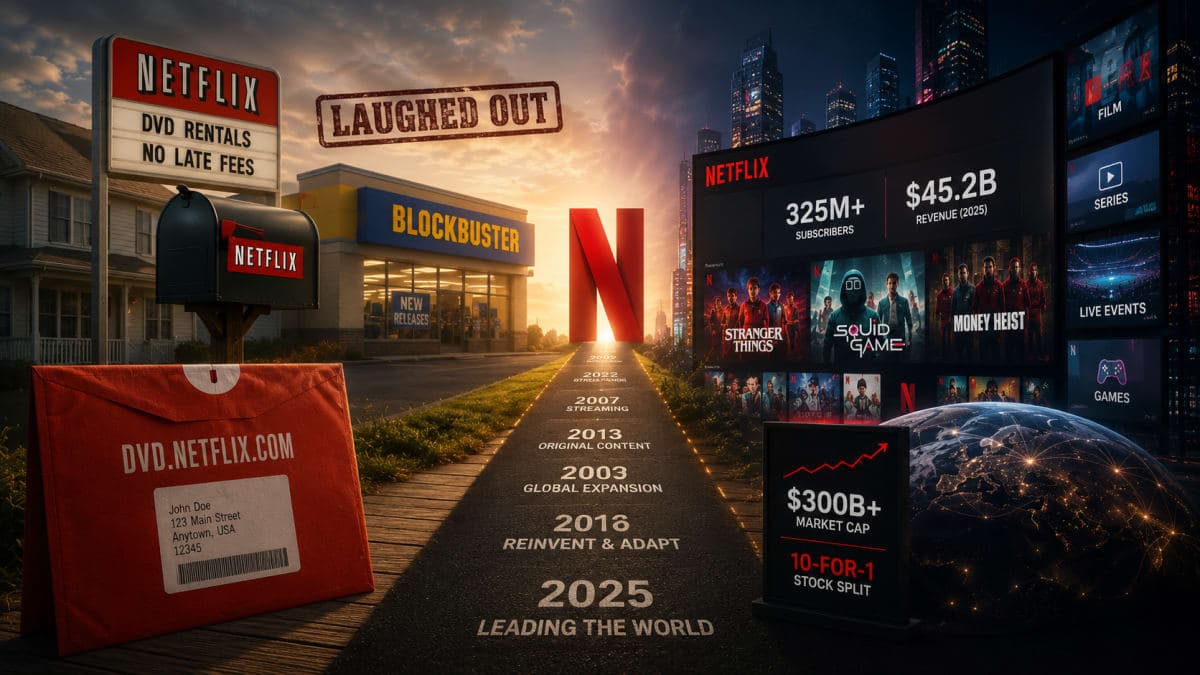
Their tiny startup, Netflix, was bleeding money mailing DVDs to people's homes. So they made an offer: buy us for $50 million, and we'll run your online arm. Blockbuster's executives, sitting on a multi-billion-dollar empire, basically laughed them out of the room.
You know how this ends. Today, Blockbuster is a punchline with one store left in the entire world. And Netflix? It closed 2025 with $45.2 billion in revenue and 325 million subscribers, the most of any streaming service on Earth, worth hundreds of billions of dollars.
So how did the company that got laughed at end up eating the entire industry? The answer is a single, ruthless habit that Netflix repeated again and again.
The superpower: killing your own golden goose.
Most successful companies have one big fear: messing up the thing that makes them money. So they protect it, defend it, and milk it for as long as possible. That's exactly the instinct that killed Blockbuster, it clung to its physical stores and late fees until the world moved on.
Netflix did the opposite. Its entire history is built on one terrifying move: deliberately destroying its own successful business before a competitor could. Founders call this "cannibalizing yourself". Netflix turned it into an art form. Let's watch it happen, three times.
Kill #1: Burning down the DVD business it was built on.
By the mid-2000s, Netflix's DVD-by-mail service was finally working beautifully. Red envelopes, no late fees, people loved it. The easy move would have been to relax and enjoy the cash.
Instead, in 2007, Netflix looked at the future, faster internet, and bet against itself. It launched streaming, the very thing that would eventually make its own beloved DVD service obsolete. It chose to blow up its own golden goose because it knew that if it didn't, someone else would.
That single decision is what destroyed Blockbuster and the entire DVD-rental world. Netflix didn't get disrupted. It disrupted itself first.
Kill #2: From renting Hollywood's stuff to making its own.
Streaming had a new problem. Netflix was just a middleman, paying Hollywood studios to show their movies and shows. And those studios could yank their content away or jack up prices anytime, especially once they realised Netflix was becoming a threat. Netflix didn't own anything. It was renting its entire library.
So in 2013, it made another bold leap. It started making its own shows. The first big swing, House of Cards, proved a streaming service could create prestige, award-winning content just like a real Hollywood studio.
This changed everything. Now Netflix owned its hits. Nobody could take them away. And shows like Stranger Things, Money Heist, and Squid Game became global obsessions that only existed on Netflix, giving people a reason to subscribe that no rival could copy. It went from a shop renting other people's products to a factory making its own.
By 2016, it flipped the switch on going global, launching in 130 countries in a single day. The DVD mailer was now a worldwide entertainment machine.
For a while, it looked unstoppable. And then, it nearly all came crashing down.
The near-death moment: 2022.
In early 2022, the unthinkable happened. For the first time in over a decade, Netflix lost subscribers, around 200,000 in one quarter, then nearly a million more in the next. Wall Street panicked. The story flipped overnight from "unstoppable giant" to "streaming is finished". The stock crashed from $350 to below $170 in a single day, wiping out a fortune.
The narrative was simple and confident: streaming had run out of new people to sign up. Netflix was done growing.
That narrative was dead wrong. And how Netflix responded is the masterclass.
Kill #3: Breaking its own sacred rules.
Cornered, Netflix did something shocking, it tore up two of its most sacred, decade-old promises.
Promise one it broke: "we will never show ads." For its entire life, Netflix had proudly been ad-free. In 2022, facing the crisis, it launched a cheaper, ad-supported plan. A complete U-turn. And it worked spectacularly, that cheap ad tier now pulls in around half of new sign-ups and opened up an entirely new advertising business.
Promise two it broke: looking the other way on password sharing. For years, Netflix happily let you share your password with friends and family. In 2022, it cracked down hard, forcing freeloaders to get their own accounts. People predicted a revolt. Instead, millions of those borrowers quietly converted into paying subscribers.
The turnaround was staggering. The company everyone declared dead in 2022 came roaring back to $45.2 billion in revenue, 325 million subscribers, and a fat 29.5% operating margin by 2025. It then split its stock 10-for-1 in late 2025, a classic sign of a stock that has climbed so high the company wants to make it look more affordable. Over the last decade, the stock delivered a jaw-dropping roughly 900% return.
And true to form, it's already cannibalizing again, pushing aggressively into live events, sports, and even video games, planning its next self-disruption before anyone forces it.
So, how did Netflix go from mailing DVDs to a streaming empire worth hundreds of billions?
By mastering the single hardest discipline in business: the willingness to destroy its own success on purpose. Three times, Netflix took the thing that was making it money, DVDs, then licensed content, then its ad-free no-password-sharing model, and deliberately broke it, because it understood that comfort is what kills companies.
Blockbuster protected its golden goose and died with it. Netflix kept killing its own golden geese, and each time, hatched a bigger one.
The lesson is almost uncomfortable. The companies that last aren't the ones that defend what made them successful. They're the ones brave enough to torch it, and build the next thing, before the world does it for them.
Until next time...