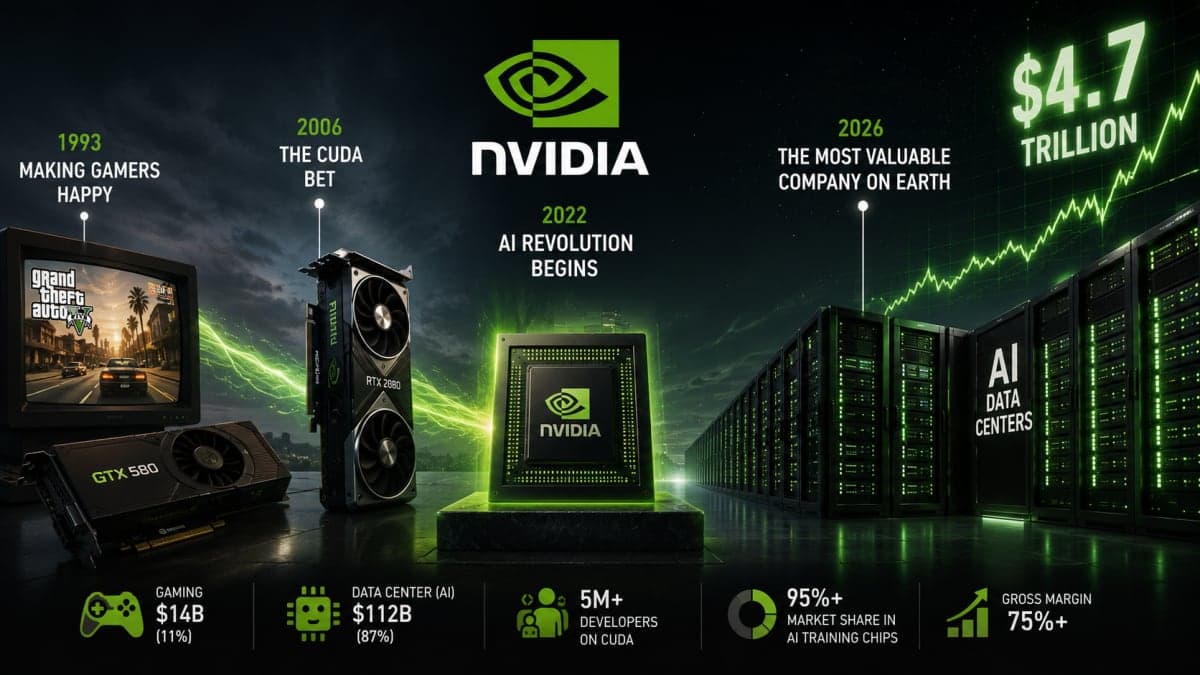
In today's FirstScroll, we trace the most explosive rise in business history. Nvidia spent 30 years making chips so gamers could enjoy prettier explosions. Then, almost by accident, it discovered those same chips were the secret fuel for artificial intelligence. And that discovery turned it into a $4.7 trillion giant, bigger than Apple, bigger than anyone. Here's how it happened.
The Story
If you were a PC gamer anytime in the last two decades, you knew Nvidia.
It made the graphics card, the GPU, the expensive component you saved up for so your games would run smoothly and look gorgeous. For most of its life, that's what Nvidia was: a company that made gamers happy. A respected, successful, but fairly normal tech company.
Today, Nvidia is the most valuable company on the planet, worth around $4.7 trillion. That's bigger than Apple. Bigger than Microsoft. A number so large it's hard to even picture.
So how did a "gaming graphics company" become the single most important company of the AI age? The answer is one of the luckiest, smartest accidents in tech history. And to get it, you first have to understand what makes its chips special.
The accidental superpower hiding in a gaming chip.
Here's the key idea, and it's simpler than it sounds.
Your computer's main brain is the CPU. Think of it as one brilliant genius doing tasks one at a time, very fast. Great for most things.
A GPU, Nvidia's specialty, works completely differently. Instead of one genius, imagine an army of thousands of ordinary workers, all doing simple sums at the same time. This is called "parallel processing", doing tons of little calculations simultaneously.
Why did gaming need this? Because drawing a game's graphics means calculating the colour of millions of pixels on your screen, all at once, many times a second. An army of small workers is perfect for that. So Nvidia spent decades perfecting chips that could do massive amounts of simple math in parallel, purely to make games look good.
And here's the beautiful accident. It turns out that the math behind artificial intelligence works exactly the same way. Training an AI model means doing billions of simple calculations, all at the same time. The very thing Nvidia built for video game explosions was, by sheer coincidence, the perfect tool for building AI.
Nvidia had spent 30 years accidentally building the ideal AI engine. But luck alone didn't make it a $4.7 trillion company. One brilliant decision did.
The bet nobody understood: CUDA.
Back in 2006, long before anyone cared about AI, Nvidia did something that looked pointless at the time. It built a software platform called CUDA, which let programmers use Nvidia's gaming GPUs for any kind of heavy math, not just graphics.
For years, this looked like a waste of money. A "niche developer play", as one analysis called it, that Nvidia poured resources into for nearly a decade with little payoff. Investors didn't get it. Why build tools for scientists and researchers when your customers are gamers?
But that long, patient bet quietly built something priceless: an entire generation of researchers, scientists, and AI developers who learned to build their work on top of Nvidia's chips using CUDA. Over 5 million developers now build on it. It became the default language of serious computing.
Then 2022 happened. ChatGPT exploded, the AI gold rush began, and the entire world suddenly needed to build AI. And to build AI, you needed two things: chips that do massive parallel math, and the software to program them. Nvidia was the only company that had spent 16 years perfecting both. Everyone else was starting from scratch.
The gold rush had arrived, and Nvidia was the only one selling shovels.
The numbers that show the transformation.
What happened next is staggering. As the whole tech world raced to build AI data centres, they all came knocking on the same door, Nvidia's. And the company's revenue didn't just grow, it erupted.
In fiscal 2026, Nvidia booked around $215.9 billion in total sales, and its market value rocketed to roughly $5 trillion, crowning it the most valuable company on Earth. To grasp the speed: the stock went from a $300 billion company in early 2022 to trillions in about four years, the fastest large-scale wealth creation in stock market history.
But the most telling stat is where the money now comes from. Remember, this was a gaming company. Today, gaming is almost a side note. Its data centre (AI) business brings in around $112 billion, about 87% of revenue, while gaming is just $14 billion, around 11%. The thing that built Nvidia, gaming, is now the small leftover slice. AI is the whole company.
Why nobody can easily catch up.
Now you might think, if selling AI chips is this profitable, surely rivals will pile in and steal the prize? They're trying. But Nvidia has built a fortress that's shockingly hard to breach.
It controls over 95% of the AI training chip market. And its real protection isn't just the chips, it's CUDA, that software platform. Because millions of developers and nearly every AI tool in the world are built to run on CUDA first, switching to a rival's chip means rewriting tons of work and retraining your people. That's expensive and painful, so most simply don't. This "lock-in" is what analysts call the strongest tech moat since Microsoft Windows.
That dominance shows up in its profits. Nvidia earns gross margins of around 75% or more on its AI chips, meaning for every ₹100 of chips it sells, it keeps roughly ₹75 as gross profit. For a hardware company, that's almost unheard of. It can charge a fortune because, right now, there's nowhere else to go.
The catch, because even kings have weak spots.
Let's stay balanced, because this empire isn't risk-free. Three storm clouds loom.
One, its customers are building their own chips. The giants buying Nvidia's chips, Google, Amazon, Microsoft, Meta, are all developing their own AI chips to reduce their dependence and Nvidia's eye-watering prices. If even one shifts away meaningfully, it stings.
Two, customer concentration. A handful of giant cloud companies make up a huge share of Nvidia's sales. If their AI spending slows even slightly, Nvidia feels it hard.
Three, geopolitics. US restrictions on selling advanced chips to China have already cut off a multi-billion-dollar market, and Nvidia is currently planning with zero China data centre revenue assumed. The world's AI king is caught in the middle of a US-China tech war.
So, how did Nvidia go from a gaming chip maker to the most valuable company on Earth?
By spending 30 years perfecting a very specific skill, doing enormous amounts of simple math in parallel, for one purpose: video games. Then making a patient, decade-long bet on software (CUDA) that let those same chips do anything. So when the AI revolution arrived and the whole world suddenly needed exactly that capability, Nvidia was the only company that had been quietly preparing for it for two decades.
It's the ultimate story of luck meeting preparation. Nvidia got lucky that gaming math and AI math were secretly the same thing. But it got rich because it was the only one smart and patient enough to build the tools to take advantage of it, years before anyone knew they'd be needed.
The gamers, it turned out, were just the warm-up act. The real game was one Nvidia had been quietly winning all along.
Until next time...