In today's FirstScroll, we unpack the most expensive free gift in business history. In 2016, one company handed out free internet to a billion people, burned through billions of dollars doing it, and somehow came out owning the entire industry. It looked like financial suicide. It was actually a masterplan.
The Story
Rewind to 2016. Using the internet in India was a luxury sport.
You'd buy a tiny 1GB data pack for ₹250 to ₹300, guard it like gold, and panic every time a video auto-played. Calls cost money by the minute. Roaming charges punished you for travelling. Only about 300 million Indians were online, out of a population of over 1.3 billion. The rest of the country was simply priced out of the internet.
The telecom companies, Airtel, Vodafone, Idea and others, were comfortable. They made fat money charging Indians per call and per megabyte. Nobody wanted to rock the boat.
Then, on 5 September 2016, Mukesh Ambani rocked the boat with a wrecking ball.
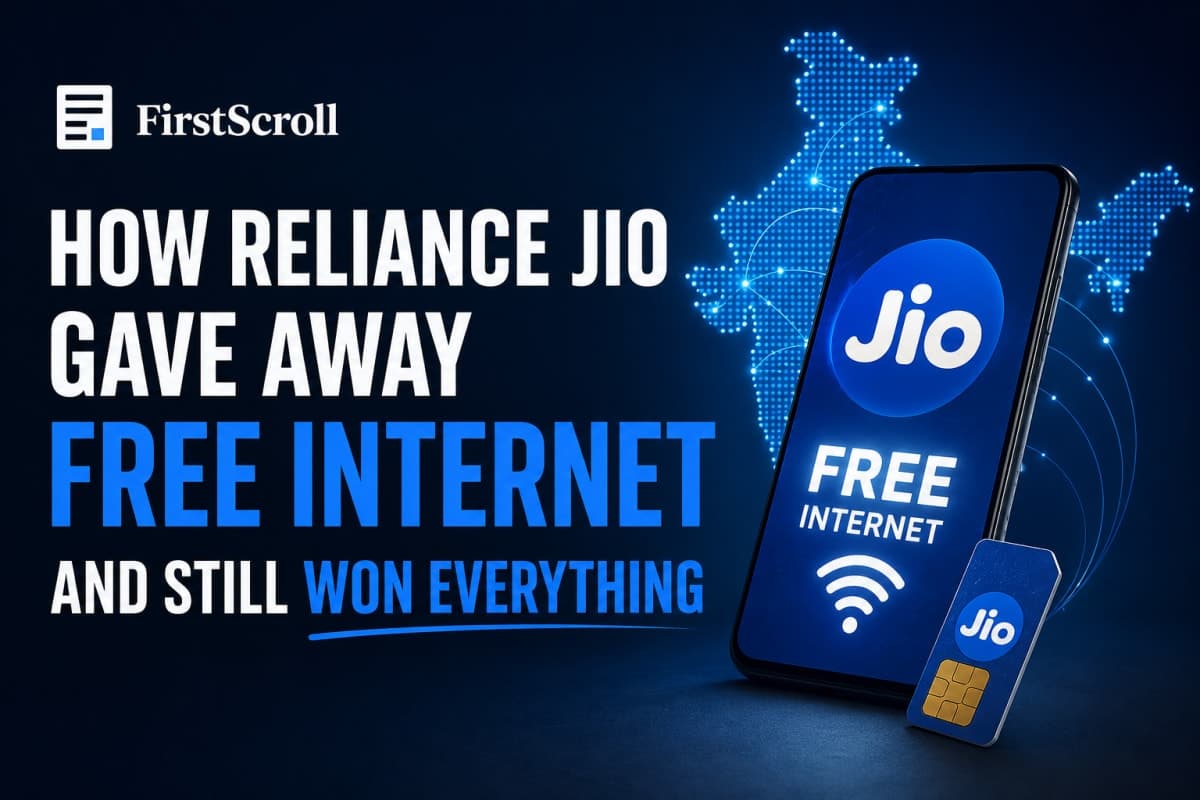
Reliance Jio launched with an offer that sounded fake. Free unlimited 4G data. Free voice calls, for life. Free SMS. Zero roaming charges. All of it, free until early 2017.
Not a discount. Not a weekend offer. Months of completely free internet for anyone who wanted a SIM.
People lost their minds. Queues snaked outside stores. And the subscribers came in numbers the world had never seen. Jio hit 50 million users in just 83 days, and crossed 100 million in about six months, the fastest any telecom company on Earth had ever reached that mark.
Now here's the obvious question. Giving away a service for free to 100 million people costs an absolute fortune. This is the kind of thing that bankrupts companies. So how on earth was this a smart move?
To understand the genius, you have to see what Jio was really doing while everyone else saw a free giveaway.
It wasn't a giveaway. It was a demolition.
The free offer wasn't really about being generous. It was a weapon, aimed straight at the competition.
See, the older telecom companies made most of their money from voice calls running on old 2G networks. That was their golden goose. Jio walked in and made calls free forever, which is like setting fire to your rival's main source of income while your own business doesn't even depend on it.
And the rivals couldn't fight back, because of a brutal trap. To match Jio, they'd have to slash their prices too, which meant torching their own profits. But they were already drowning in debt from expensive spectrum auctions, and they'd been lazy, sticking with old 2G and 3G networks instead of building modern 4G. Jio, by contrast, had built a shiny all-new 4G-only network from scratch, with over 250,000 towers and a massive fibre-optic backbone, funded by the deep pockets of Reliance.
So Jio could afford to bleed. The others couldn't. And that difference decided everything.
The bloodbath.
What followed was carnage. As the whole industry was forced to drop prices to survive Jio, the average revenue each telecom earned per user crashed about 40% in two years. For weaker players, that was fatal.
The dominoes fell fast. Reliance Communications went bankrupt. Tata Docomo, Telenor, Aircel, and MTS shut down or sold out. And the once-mighty Vodafone and Idea, two giants on their own, were so battered they had to merge in 2018 just to survive, and even then kept losing users every quarter.
A market that once had a dozen players collapsed into basically three: Jio, Airtel, and a wounded Vodafone Idea. The chaos was exactly what Jio wanted. It had turned a crowded, messy market into one it could dominate.
So the "crazy" free giveaway makes sense now. Jio spent billions buying something more valuable than short-term profit. It bought the market itself.
But getting the users was only half the plan. Now came the part where free turns into a money-printing machine.
Step two: hook them, then gently start charging.
Once Indians had tasted fast, unlimited internet, there was no going back. People who'd never streamed video were now watching YouTube for hours. Data usage exploded from under 1GB a month to, today, over 25GB per user. The internet went from a luxury to oxygen.
And once you're addicted to oxygen, you'll happily pay a small amount for it.
So Jio started charging, but kept prices dramatically lower than the old days, around 1GB per day for the price people used to pay for a fraction of that. Cheap enough that nobody left. Multiply a small monthly bill across hundreds of millions of locked-in users, and you get a river of cash. Today Jio has over 500 million subscribers, making it India's biggest telecom by far, with around 40% of the market.
This was Ambani's real bet, summed up in his favourite phrase: "data is the new oil." Give away the pipes for free, get the whole country hooked on the flow, then own the flow forever.
Step three: the part most people miss.
Here's where Jio goes from clever to genius. The internet connection was never the final product. It was the doorway.
Once Jio owned the data pipe into half a billion pockets, it started selling everything through that pipe. JioCinema for streaming. JioMart for shopping. JioFiber for home broadband. Payments. Cloud services. A whole ecosystem riding on the network it had built.
Think about it. Every other telecom just sold you data and stopped there. Jio used data as the front door, and then sold you the entire house behind it. That's why investors value Jio Platforms in the range of $120 to 154 billion ahead of a possible mega-IPO, not as a phone company, but as a digital empire.
And the wildest part? It built all this while wiping out its operational debt by 2021, funded mostly by Reliance and global investors rather than crippling loans. The same debt trap that killed its rivals, Jio simply sidestepped.
So, how did Reliance Jio give away free internet and still win everything?
Because the free internet was never the business. It was the bait. Jio used a giant free offer to do three things at once: flood the market with users no rival could afford to chase, bankrupt or cripple almost every competitor in the process, and get an entire nation permanently hooked on cheap data. Then it quietly switched on the meter and built a digital empire on top.
It's one of the boldest business moves in modern history, a company that lost money on purpose, for years, to win a prize bigger than any single year's profit: control of how a billion people connect, shop, watch, and pay.
The free gift, it turned out, was never really for us. It was for Jio.
Until next time...