In today's FirstScroll, we decode the strangest business in Indian finance: an app that gives away its main feature for free, barely runs ads, and still earns more profit than most companies on the stock exchange. So... where's the money coming from?
The Story
You know how free-to-play games work, right?
Downloading the game costs nothing. Playing costs nothing. 95% of players never spend a rupee. But a small group of players, the ones hooked on the game, keep buying skins, battle passes, and power-ups. And those few players make the game company billions.
Now hold that thought. Because Zerodha is basically that, but for the stock market.
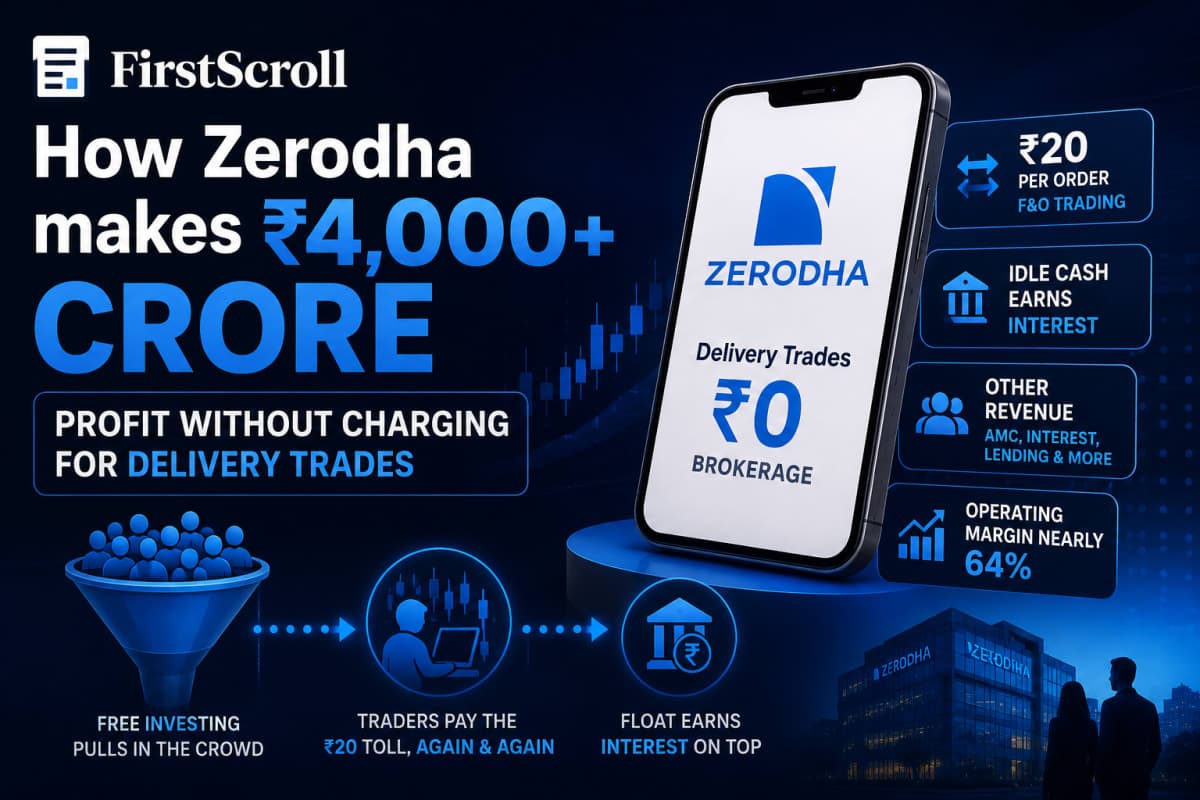
Here's the setup. When you buy shares on Zerodha and just hold them, what the market calls a "delivery trade", you pay zero brokerage. Nothing. Buy ₹500 of a stock or ₹5 lakh, Zerodha's cut is ₹0. And yet, this company made ₹4,237 crore in profit in FY25.
To put that in perspective: that's more profit than most companies listed on the stock exchange. From an app. That doesn't charge for its main thing. Built by two brothers in 2010 with zero outside funding, still 100% family-owned. No investors. No IPO. No ads with cricketers.
So what's the trick?
The lazy answer is "they have millions of users, so small fees add up". Partly true. But the real machine is smarter than that. Because in Zerodha's world, the free users were never the customers. They're the funnel. Let's open the hood.
Engine 1: The ₹20 in-app purchase.
Holding shares is free. But the moment you start trading, buying and selling the same day, or playing futures and options (F&O), Zerodha charges a flat ₹20 per order.
₹20. Your momos cost more.
But here's the thing about F&O traders: they don't place one order. They place 20, 50, sometimes 100+ orders a day. Every single tap means another ₹20. Multiply that across lakhs of traders, every market day, all year, and that "chai money" becomes the single biggest revenue line in the company.
These are the whales. And here's the uncomfortable irony: the patient investor doing the financially smart thing rides free. The hyperactive options trader, who per SEBI's own studies usually loses money, is the one paying for everyone's free ride.
Engine 2: Money that earns money while everyone sleeps.
At any moment, lakhs of users have idle cash just sitting in their Zerodha accounts. Money waiting for "the dip". Money from shares they just sold. Yours might be sitting there right now.
Individually? Pocket change. Collectively? A mountain. And parked mountains of cash earn interest, for Zerodha. On top of that, the company's own savings have piled up to over ₹22,600 crore in cash and bank balances, which itself generates serious interest every year.
Read that again. Zerodha's past profits now earn more by existing than many companies earn by working.
Engine 3: The small stuff that isn't small.
₹300 a year as account maintenance. Feels like nothing, but across ~72 lakh active users, it stacks up. Interest when traders borrow money to take bigger bets. A mutual fund business. A lending arm whose loan book tripled in a year. Lots of side quests, all adding XP.
And the cheat code: spending almost nothing.
This is the half everyone misses. Earning money is one thing. Keeping it is Zerodha's actual superpower.
Total ad spend in FY25? ₹47 crore. That's it. For a company with ~₹8,900 crore revenue, that's basically a rounding error. Startups burn more than that on one IPL season. No celebrity ads. No cashback wars. Growth came from word of mouth and Varsity, their free stock-market education platform that quietly turns curious beginners into account holders.
No branches. No salespeople calling you at lunch. Just software doing the work of thousands of people. Result: operating margins of nearly 64%. For context, Apple, the company famous for fat margins, runs at around 30%.
So that's the machine. Free investing pulls in the crowd. Traders pay the ₹20 toll, again and again. Idle cash earns interest. And ruthless cost control means nearly half of every revenue rupee drops straight into profit.
Beautiful, right? Except in FY25, the machine glitched.
Revenue fell 11% to ₹8,868 crore. Profit dropped 23%. What happened? SEBI, worried that retail traders were getting wrecked in options, tightened the F&O rules. Fewer weekly expiries, bigger lot sizes, stricter margins. Trading cooled off. Founder Nithin Kamath himself flagged that brokerage revenue crashed about 40% in the June quarter.
Sit with that for a second. The regulator squeezed one engine, and a quarter of the profit vanished.
That's the most honest confession the numbers could make: "free brokerage" was never free. It was sponsored by the most speculative corner of the market. When the speculation slowed, so did Zerodha.
To be fair, Zerodha saw this coming. Kamath has been publicly warning about the F&O addiction for years, and the company is now building steadier engines: margin funding, loans against shares, mutual funds, insurance. Stuff that doesn't live and die by options volumes. And with ₹22,000+ crore in the bank and zero debt, no financial company in India has more breathing room to figure it out.
So, how does Zerodha make ₹4,000+ crore without charging you for buying stocks?
Same way your favourite game makes billions without charging you to play. You don't need to charge everyone. You charge the right people, the right amount, at the right frequency, and spend almost nothing while doing it. Investors ride free. Traders fund the ride. The float earns interest on top.
It might be the most elegant business model in Indian finance. Just remember, as FY25 proved, even elegant machines can have a single point of failure.
Until next time...