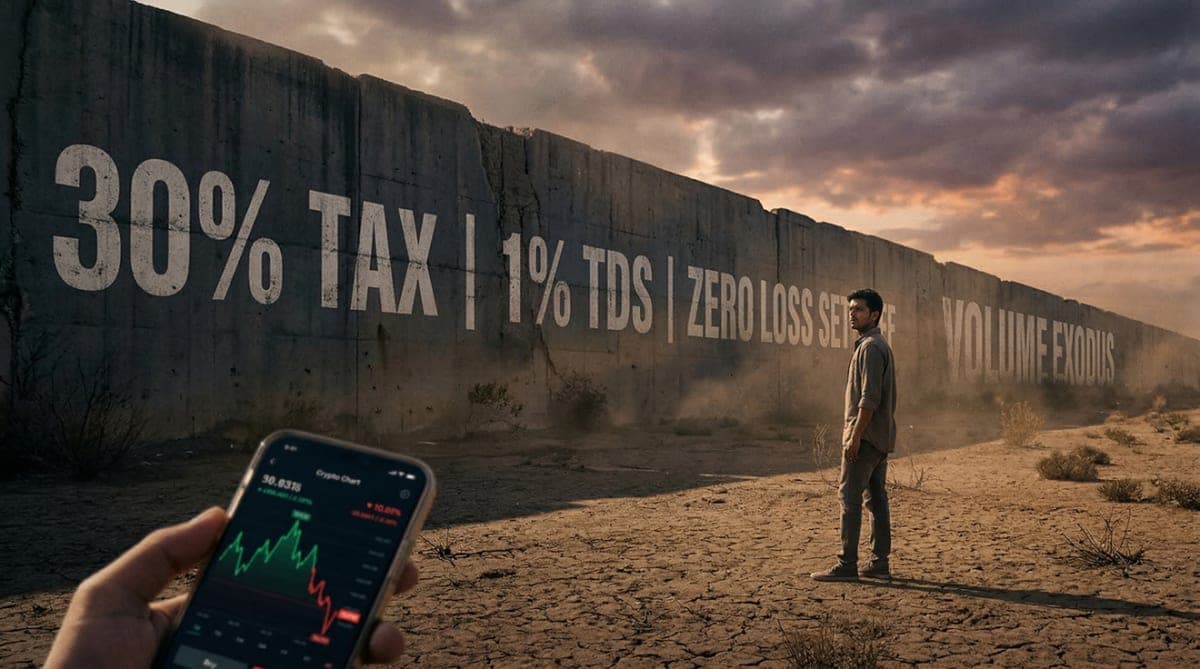
In today’s FirstScroll, we break down India’s crypto tax regime: the 30% flat tax, the 1% TDS, the zero loss set-off rule, and why 72% of Indian trading volume has already fled offshore. The world’s largest crypto population is being regulated out of its own country.
• • •
The Story
Let’s start with a simple example.
You buy Bitcoin for ₹10 lakh. It drops. You sell for ₹8 lakh. You’ve lost ₹2 lakh. Then you buy Ethereum for ₹5 lakh. It goes up. You sell for ₹8 lakh. You’ve made ₹3 lakh.
Net result across both trades: you’re up ₹1 lakh. In any rational tax system, you’d pay tax on that ₹1 lakh.
In India, you pay 30% tax on the ₹3 lakh Ethereum profit (₹90,000 in tax) and get absolutely zero benefit from the ₹2 lakh Bitcoin loss. Your net gain was ₹1 lakh. Your tax bill is ₹90,000. Your effective tax rate? 90%.
Welcome to India’s crypto tax regime. The world’s harshest.
The Three-Headed Monster
India’s Virtual Digital Asset (VDA) taxation, introduced in Budget 2022 by Finance Minister Nirmala Sitharaman, stands on three pillars. Each one is painful individually. Together, they’re devastating.
1. 30% flat tax on all crypto gains. No slab benefits. Whether you earn ₹5 lakh a year or ₹5 crore, crypto profits are taxed at a flat 30%. Add 4% health and education cess, and the effective rate is 31.2% at minimum. If your total income exceeds ₹50 lakh, surcharges push it even higher. No distinction between short-term and long-term. Hold for 10 days or 10 months, same rate.
2. 1% TDS on every transaction. Every time you sell crypto on an Indian exchange, 1% of the entire sale value (not just the profit) is deducted at source. Sell ₹1 lakh worth of Bitcoin, and ₹1,000 is immediately locked away as TDS, regardless of whether you made money or lost it. You can claim it back when filing your ITR, but until then, your capital is frozen.
3. Zero loss set-off. This is the killer. You cannot offset crypto losses against crypto gains. You cannot offset them against any other income. You cannot carry them forward. According to research cited by Nadcab, roughly 50% of Indian crypto investors are paying capital gains tax despite suffering net losses, collectively losing around ₹180 crore due to this rule alone.
What This Looks Like in Practice
Say you’re an active trader making three ₹1 lakh trades in a day. That’s ₹3 lakh in total consideration. TDS locks away ₹3,000 immediately, even if your net profit is zero. Do this daily, and the TDS bleed becomes serious.
Now layer on the no-loss-offset rule. As MEXC’s India guide explains, if you make ₹4 lakh on one trade and lose ₹4 lakh on another, your net profit is zero. But your tax bill is ₹1,20,000 (30% of the ₹4 lakh gain). This creates scenarios where traders owe more in taxes than their actual net profits, pushing some into debt.
And starting July 2025, GST also applies to exchange platform fees (at 18%), adding yet another layer on top of the 30% income tax and 1% TDS.
The total friction on an active Indian crypto trader is unlike anything in any other asset class, anywhere in the world.
The Exodus
So what happened? Exactly what you’d expect. Traders left.
According to data compiled by AInvest, over 72% of India’s crypto trading volume has migrated offshore since the tax regime kicked in. A separate industry estimate puts it at 90% when you include the full impact of TDS on domestic exchanges.
The destinations? Dubai, Singapore, Mauritius. International exchanges like Binance, MEXC, and Bybit don’t auto-deduct 1% TDS. They don’t freeze your capital on losing trades. They let you trade freely. The catch is that you’re technically still liable for Indian tax, but enforcement on offshore platforms is patchy at best.
A CoinSwitch survey found that 66% of Indian crypto investors perceive the regime as unfair, and 59% have reduced participation because of the tax environment.
The irony? The government collects almost nothing. Between 2022 and 2025, total onshore crypto tax collections were just ₹437 crore. That’s a rounding error for a country with 150 million crypto users. The punitive tax didn’t generate revenue. It just pushed the revenue offshore.
Budget 2026: The Hope That Died
Before the February 2026 Budget, the crypto industry mounted its biggest lobbying push ever. WazirX, CoinDCX, CoinSwitch, ZebPay, and every major exchange sent detailed proposals to the Finance Ministry. The asks were specific: cut TDS from 1% to 0.01%, allow loss set-off within crypto, introduce long-term capital gains treatment for holdings over 36 months.
EY India published a report showing that rationalisation could add ₹10,000 to ₹15,000 crore in annual tax revenue through higher compliance. CoinDCX’s Sumit Gupta called it "the last realistic window before mass exodus." WazirX’s Nischal Shetty said cutting TDS to 0.1% and allowing loss set-off would bring volume back "onshore overnight."
Finance Minister Sitharaman did not mention crypto once in her entire Budget speech. Not a single word. The 30% tax stayed. The 1% TDS stayed. The zero loss set-off stayed. The only change? A new penalty framework: ₹200 per day for non-filing and ₹50,000 for inaccurate reporting, effective April 1, 2026.
The silence, as the industry noted, was the loudest message they’d ever received.
How India Compares
India’s regime is an outlier globally. Not in a good way.
In the US, crypto is taxed as property: short-term gains at your income slab rate, long-term (over 1 year) at a lower capital gains rate. Losses can be offset. In Singapore, there’s zero tax on crypto capital gains for individuals. In the UAE (Dubai), same: zero capital gains tax. In Portugal, long-term holders pay nothing. Even the UK, which taxes crypto at up to 24%, allows loss set-offs and carry-forward.
India stands alone in combining a high flat rate (30%), universal TDS (1% on gross), zero loss recognition, and no distinction between short and long-term. No major economy comes close.
The Enforcement Tightening
If you think going offshore means you’re invisible, the government is working to change that. Starting January 2026, the FIU introduced AI-assisted liveness tests for KYC, geo-tagging of onboarding locations, and enhanced AML monitoring. India is adopting the OECD’s Crypto-Asset Reporting Framework (CARF) by April 2027, enabling automatic data sharing on crypto holdings with over 100 countries.
The Income Tax Department has already identified undisclosed virtual digital assets worth ₹888 crore and issued over 44,000 notices to non-compliant taxpayers. Starting 2026, AI-driven enforcement systems will automatically cross-check TDS deductions against declared income.
So the noose is tightening on offshore traders too. The government isn’t making it easier to trade. It’s making it harder to hide.
The Bottom Line
India has 150 million crypto users, the largest crypto population on earth. It has some of the sharpest blockchain developers, the most active trading communities, and genuine potential to be a global hub for Web3 innovation.
Instead, it has a tax regime that forces 72% of volume offshore, collects negligible revenue, punishes traders for losses they didn’t choose, and treats crypto worse than gambling, lottery winnings, or horse racing (all of which, incidentally, also carry 30% tax but at least allow certain deductions).
The government’s logic is clear: they don’t want to encourage crypto. They see it as speculative, risky, and potentially destabilising to the rupee and the Digital Rupee (CBDC) project. So they’ve built a tax wall so high that most retail participants simply go around it.
But here’s the problem with tax walls. People don’t stop trading. They stop trading onshore. The activity continues. The tax revenue doesn’t.
India isn’t killing crypto. It’s just exporting it.
• • •
If this story made you rethink India’s crypto tax approach, share it with a friend who’s been stung by the 30% trap.
Sources: CoinDCX, Koinly, Yahoo Finance, MEXC, Nadcab, AInvest, Tapbit, CoinDesk, CAClubIndia, TaxGST.in