In today's FirstScroll, we break down America's new 10% duty on Indian goods and explain why New Delhi is quietly celebrating a tax on its own exports.
With that out of the way, let's dive into today's story.
The Story
Imagine your landlord announces a rent hike. You brace for 12.5%. He settles for 10%, and exempts half your house from the increase entirely.
Do you celebrate, or do you complain that rent still went up?
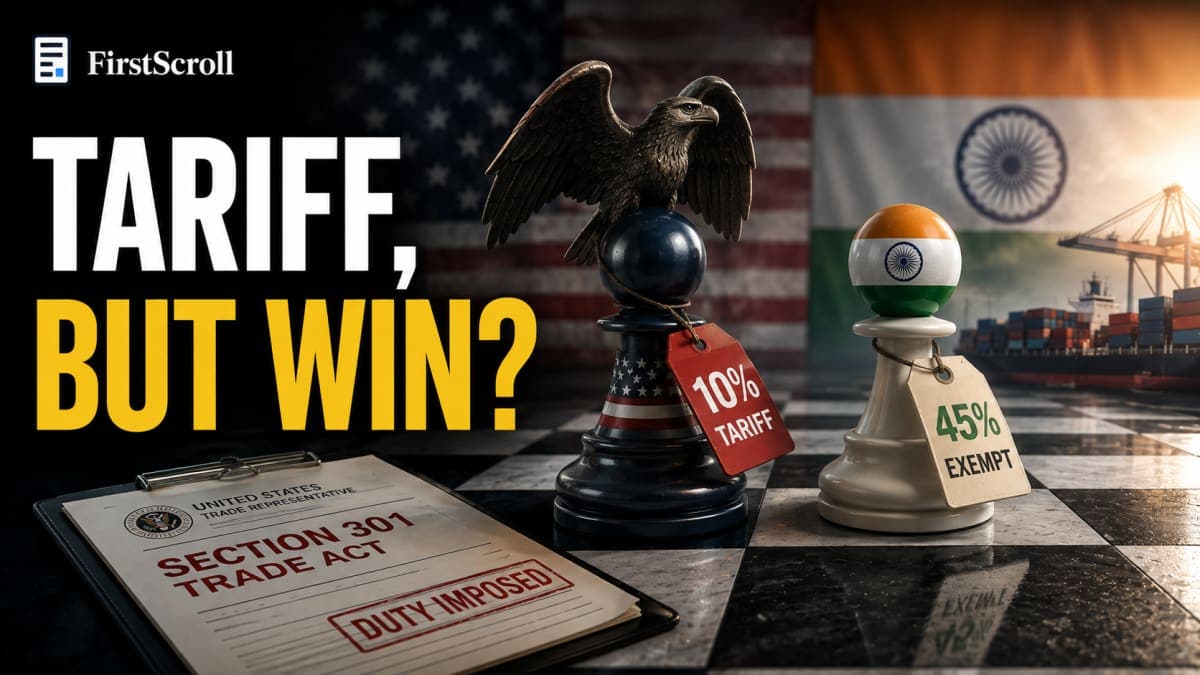
That, in one building, is India's newest trade dilemma. The United States has imposed a fresh set of duties on imports under something called Section 301 of its Trade Act. Indian goods now face a 10% levy when they enter the American market. A tax on Indian exports, imposed by India's largest export destination, in the middle of a year already crowded with economic shocks.
And yet, the mood in New Delhi is closer to relief than outrage.
So the question is, how does a fresh 10% American tariff on your goods count as good news?
To answer that, you need to know what Section 301 actually is. It's a provision of American trade law that lets the US government investigate and punish trade practices it considers unfair, without waiting for the World Trade Organization to agree. Think of it as a unilateral penalty clause: Washington is the complainant, the judge, and the customs officer, all at once.
When the US first proposed these duties, India was bracketed among countries facing a 12.5% levy. That was the opening bid. What followed was the part of trade policy nobody televises: months of negotiation over tariff tiers, product lists and exemptions.
The final order tells you how those talks went. The US Trade Representative cut India's proposed rate from 12.5% to 10%, placing India in the lower tariff tier. And crucially, the Centre says 45% of India's exports to the US remain entirely outside the new duty. Nearly half of everything India ships to America pays nothing extra at all.
This is where incentives explain everything. Washington wants leverage and revenue without pushing strategic partners toward China. New Delhi wants market access protected for its most vulnerable, labour-heavy export sectors. And Indian exporters just want predictability, because a known 10% can be priced into a contract, while an unknown threat cannot.
Seen through that lens, the deal makes sense. Trade negotiators don't measure outcomes against a world with no tariffs. That world stopped existing years ago. They measure outcomes against what everyone else got, and against what was threatened. On both counts, India landed on the better side of the table.
But there's a twist here. "45% of exports are exempt" is a sentence doing a lot of quiet work, because it means the other 55% are not. Somewhere inside that 55% sit real factories with real payrolls, now 10% less competitive on American shelves than they were last quarter. A tariff tier is an average. Nobody exports an average. The relief is national; the pain is sectoral, and it will show up in specific industries' order books over the next two quarters.
And there's a second catch. Section 301 duties aren't a treaty. They're an executive action, which means they can be revised, expanded, or weaponised again whenever Washington's mood or maths changes. India hasn't bought certainty. It has bought a better seat in an ongoing game.
Now to be clear, that seat matters. In a year when Indian industry has been actively diversifying export markets beyond the US toward Europe, Latin America and Africa, landing in the lowest tariff tier keeps the largest single market workable while the diversification compounds.
So was it a win? It was the trade policy version of losing less than everyone expected, which, in 2026, is what winning looks like.
Whether the exempted 45% stays exempt is something only time will tell.
Until then…
If this story helped you make sense of the new US tariffs, share it with a friend on WhatsApp, LinkedIn or X.