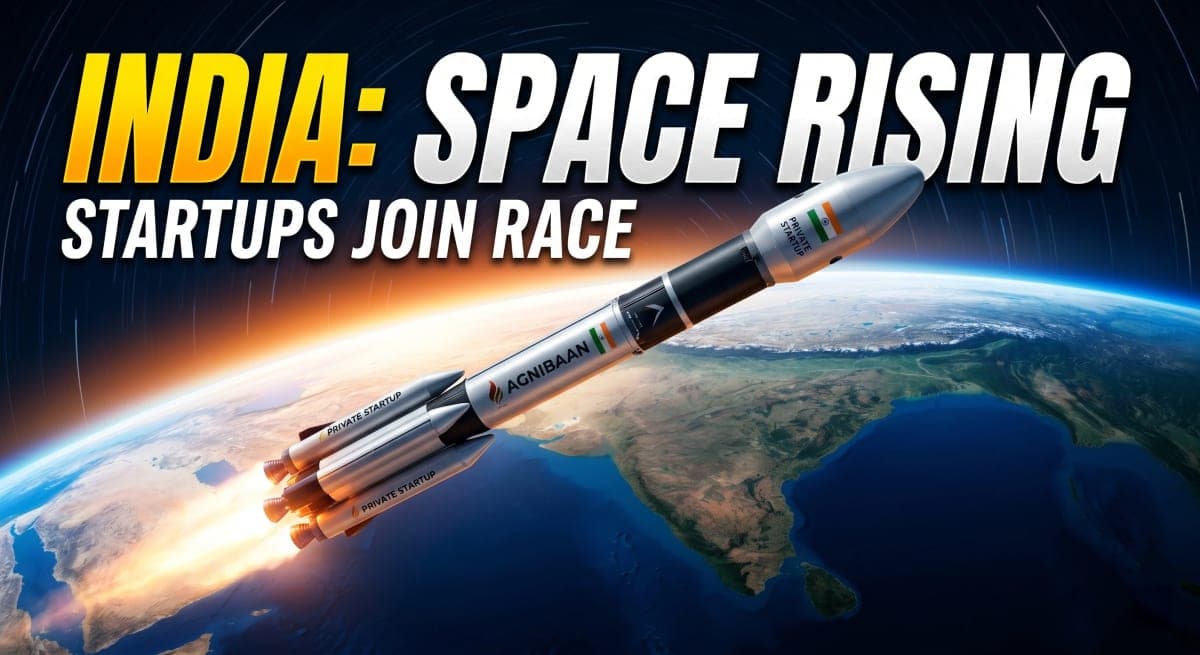
For most of India's history, space was a government thing.
ISRO did it. Quietly. Brilliantly. On a budget that would make NASA blush. They sent a mission to Mars for less than it cost to make the Hollywood film Gravity. They landed on the Moon's south pole when no one else had. They built a reputation for doing extraordinary things with ordinary resources.
But ISRO was always the only player. Space in India meant ISRO. Full stop.
That's changing fast.
Today, India has over 300 private space startups. Young engineers, ex-ISRO scientists, IIT graduates building rockets in garages, launching satellites from Sriharikota, and raising hundreds of millions of dollars from investors around the world.
India's space economy, currently worth around $9 billion, is projected to hit $44 billion by 2033. That's a nearly 5x jump in under a decade.
So what changed? Who's building this? And is space actually a business?
Let's find out.
First: Why Was Space Always a Government Thing?
To understand why private space is such a big deal, you need to understand why it didn't exist before.
Space is expensive. Extraordinarily expensive. A single rocket launch can cost hundreds of crores. Building a satellite takes years of engineering and billions in investment. For most of the 20th century, only governments had that kind of money and patience.
But there's another reason India's private sector stayed out: ISRO kept the door closed.
Not intentionally. ISRO was built to serve India's national interest weather forecasting, navigation, defence, rural communication. It wasn't set up as a platform for private companies. Its facilities, data, and infrastructure were largely off-limits to outsiders.
A quick lesson: Imagine if the government owned all the roads, all the airports, and all the ports but only government trucks were allowed to use them. Private businesses couldn't ship anything, no matter how good their product. That was essentially the situation for Indian space companies until a few years ago.
Then, in 2020, everything changed.
The Policy That Unlocked Private Space
In 2020, the government opened India's space sector to private players for the first time. A new body called IN-SPACe the Indian National Space Promotion and Authorisation Centre was created as a single window for private companies to get approvals, access ISRO's infrastructure, and participate in the space economy.
Before IN-SPACe, a private company wanting to launch a satellite had to navigate multiple government agencies, wait months for approvals, and often got nowhere. After IN-SPACe, the same company could go to one body, get a response in a reasonable timeframe, and actually get things done.
Then came the Indian Space Policy 2023 a landmark document that formally defined the roles of everyone in the ecosystem. ISRO would focus on research and cutting-edge science. A commercial arm called NSIL would handle business. And private companies would be free to build, launch, and operate.
The results were almost immediate.
The number of space startups in India jumped from barely one in 2022 to nearly 200 by 2024. Funding surged. And the companies that had been quietly building in the background suddenly had a real runway.
Meet the Companies Actually Building This
Let's talk about who's doing the work because these aren't hypothetical companies. They've already launched things into space.
Skyroot Aerospace is the most-funded private space startup in India, having raised nearly $100 million. It was founded by two former ISRO scientists Pawan Kumar Chandana and Naga Bharath Daka who left stable government jobs to build rockets in a startup. Their rocket series is called Vikram, named after the legendary Indian space scientist Dr. Vikram Sarabhai. In November 2022, Skyroot launched Vikram-S India's first privately built rocket to reach space. It was a sub-orbital flight, meaning it went up and came back down without going into orbit. But it was a proof of concept. Nobody had done it before in India. In 2026, Skyroot is preparing for Vikram-I's first orbital flight the real deal.
Agnikul Cosmos came out of IIT Madras and built something that had never existed before: the world's first rocket engine made entirely by 3D printing. Their engine, called Agnilet, is a single piece of metal no assembly, no welding, no joints. It's a manufacturing breakthrough that could make rockets cheaper and faster to build. In June 2024, they launched their Agnibaan rocket from India's first-ever private launchpad at Sriharikota. A private company, owning its own launchpad, launching its own rocket in India. Five years ago, that sentence would have sounded like science fiction.
Pixxel is doing something completely different. It's not building rockets it's building hyperspectral satellites. Here's what that means in plain English: normal cameras, including the ones on satellites, see what your eye sees red, green, blue. A hyperspectral camera sees hundreds of wavelengths of light invisible to the human eye. It can look at a farm and tell you which crops are diseased. It can look at a forest and detect illegal mining. It can look at a coastline and spot oil spills. Pixxel, backed by Google's parent company Alphabet, has already launched two demonstration satellites. In 2025, it won a government contract to build India's first commercial Earth observation satellite constellation.
Digantara is tackling a problem most people don't know exists: space junk. There are over 30,000 pieces of debris orbiting Earth dead satellites, rocket parts, fragments from collisions. Every one of them is a risk to active satellites. Digantara is building a space surveillance network to track this debris in real time, helping satellite operators avoid collisions. It's not glamorous. But as more satellites go up, it becomes critical infrastructure.
So Is Space Actually a Business?
This is the most important question and the most honest one to ask.
Building rockets and satellites is cool. But cool doesn't pay salaries. So how do these companies actually make money?
A lesson on the space business model:
The space economy is not just about launching rockets. In fact, launch is just the delivery mechanism. The real money is in what you do once you're up there.
Think of it like the internet. The cables that carry data are important but the businesses that run on top of the internet (Google, Netflix, Amazon) are worth far more than the cable companies. Similarly, the real value in space is in data and services.
Pixxel's hyperspectral satellites, for example, will sell data subscriptions to agricultural companies, mining firms, governments, insurance companies, and climate researchers. The satellite goes up once. But the data it generates can be sold again and again, for years.
Skyroot and Agnikul make money by charging customers to put their satellites into orbit. Small satellites are a booming market companies, universities, and governments around the world want to launch small satellites but don't want to build their own rockets. India, with its low-cost engineering talent and ISRO's proven track record, is well-positioned to become a global hub for small satellite launches.
Digantara sells space situational awareness data as a subscription. The more congested space gets, the more valuable this becomes.
This is why serious investors are putting real money into Indian space startups. It's not charity. It's a bet that the data and services generated from space will be worth enormous amounts of money and that Indian companies can capture a piece of that global market.
The $44 Billion Target Is It Realistic?
Let's be honest about the numbers.
India's space economy today is worth around $9 billion. The government wants to grow it to $44 billion by 2033 a 5x jump in under a decade. That would take India's share of the global space market from 2% today to around 8%.
Is that achievable? It depends on a few things.
The government needs to keep buying. Private space companies need customers to survive. Right now, a large chunk of their revenue comes from government contracts ISRO, defence agencies, and public sector units buying satellites and launch services. If government procurement is predictable and consistent, it gives startups the stability to grow. If it's bureaucratic and slow, it kills momentum.
Global competition is fierce. SpaceX exists. It's not a fair fight. Elon Musk's company has driven down the cost of launching things into space by an order of magnitude. Indian startups can't compete with SpaceX on scale not yet, maybe not ever. What they can compete on is specialisation, cost efficiency, and serving markets and customer sizes that SpaceX doesn't prioritise.
Deep tech takes time. The government recognised this when it changed the rules in early 2026 doubling the window during which space startups are treated as startups (and get associated tax and regulatory benefits) to 20 years. Space companies don't become profitable in 3 years. They need patient capital and patient policy. The rule change signals that the government understands this.
Why This Matters for India
Here's the bigger picture that's easy to miss in all the technical detail.
India's space programme was always strategic. It wasn't about national pride it was about practical problems. ISRO's satellites give India weather forecasts, GPS navigation, disaster warnings, and secure communications. Space isn't a luxury for India. It's infrastructure.
As private companies take over more of the commercial work, ISRO can focus on the frontier human spaceflight, deep space exploration, the Chandrayaan missions, the upcoming Gaganyaan programme that will send Indian astronauts to space.
And as Indian startups become globally competitive, they create high-quality engineering jobs, build indigenous technology that reduces dependence on foreign systems, and position India as a serious player in the 21st century's most strategic industry.
The chairman of IN-SPACe put it simply in a recent interview: a $44 billion space economy means $44 billion worth of demand. India has to create that demand from government, from private industry, from agriculture, from mining, from every sector that can benefit from what satellites see and what rockets carry.
That's the opportunity.
The Bottom Line
India going to space with private companies isn't just an exciting technology story. It's an economic bet, a strategic necessity, and a signal that the country is serious about competing in the industries that will define the next 50 years.
The companies building this Skyroot, Agnikul, Pixxel, Digantara, and dozens more are still early. Many will fail. The ones that succeed could be worth tens of thousands of crores.
For over 60 years, one organisation carried India's space ambitions on its shoulders.
Now, an entire industry is joining the mission.