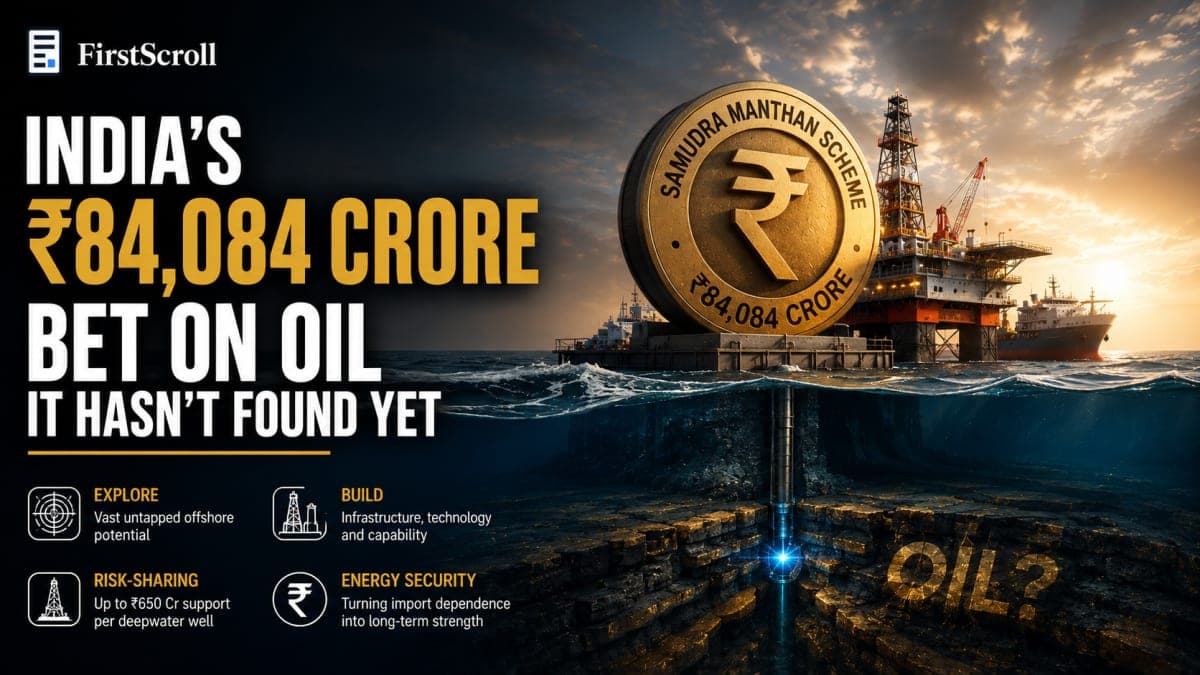
In today's FirstScroll, we break down the Samudra Manthan scheme and explain why India is spending a fortune looking for oil under its own seabed, decades after mostly giving up.
With that out of the way, let's dive into today's story.
The Story
In Hindu mythology, the Samudra Manthan is the churning of the ocean. Gods and demons pull on a serpent wrapped around a mountain, the sea froths, and eventually treasure comes up from the deep.
Last week, the Union Cabinet borrowed that name for something less poetic and far more expensive. It approved Samudra Manthan, the National Offshore Exploration Scheme, with an outlay of ₹84,084 crore running through FY 2030-31. The treasure this time is hydrocarbons. The government believes the churning could add more than 600 million metric tonnes of oil equivalent to India's reserves.
Here's what makes the timing interesting. Over the past decade, India essentially made peace with importing its energy. Our dependence on imported crude rose from 77% to 88%, and we import nearly half our natural gas too. Buying was cheaper, faster, and easier than finding.
Then a strait 33 kilometres wide nearly closed, and buying stopped looking easy.
So the question is, why is India suddenly spending ₹84,084 crore searching for oil at home, after spending twenty years learning to live without it?
To understand the answer, you need to understand why nobody was drilling in the first place. Offshore exploration, especially in deep water, is one of the worst risk-reward propositions in business. A single deepwater exploratory well can cost hundreds of crores, take years, and most of the time finds nothing. It's a lottery ticket where each ticket costs as much as a mid-sized company.
Private players looked at that maths and stayed away. Even state-owned explorers drilled cautiously. The result: vast stretches of India's Exclusive Economic Zone, the sea area where India holds sovereign rights over resources, have never been properly surveyed, let alone drilled.
Samudra Manthan attacks exactly that maths. The core of the scheme is risk-sharing: the Centre will cover up to ₹650 crore per exploratory well drilled in deepwater and ultra-deepwater blocks, with more than ₹43,200 crore of the outlay reserved for deep-sea drilling support. The rest funds seismic surveys, shared production infrastructure, and a dedicated manufacturing and services zone for offshore technology.
In plain words: the government is buying the lottery tickets so companies will play the lottery.
The incentives line up neatly. Explorers get their downside capped, which changes the drilling decision entirely. The government converts a foreign exchange problem into a domestic investment problem, and every barrel found at home is a barrel not paid for in dollars during the next crisis. Union Minister Ashwini Vaishnaw made the pitch explicit, calling it a game-changer that will save significant foreign exchange.
But there's a twist here, and it's about time. Exploration runs on geological clocks, not political ones. From seismic survey to first commercial oil, a deepwater discovery typically takes the better part of a decade. The scheme itself runs to FY 2030-31, and that's just the exploration phase. Which means Samudra Manthan does nothing for the crisis India just lived through. It's a defence against the crisis after next. This quarter's ₹49 billion oil bill was the invoice for decisions not taken in 2016.
Now to be clear, that's an argument for the scheme, not against it. The only wrong time to start a ten-year project is never. And even if the drilling disappoints, the seismic data, the infrastructure, and the offshore services ecosystem stay behind as assets.
Still, it's worth remembering how the original Samudra Manthan ends. The churning brought up treasure, yes. But the first thing that surfaced was poison. Exploration works the same way: you pay for a lot of dry wells before the ocean gives you anything back.
Whether India's seabed holds 600 million tonnes of treasure, or mostly expensive lessons, is something only time will tell.
Until then…
If this story helped you make sense of India's big energy bet, share it with a friend on WhatsApp, LinkedIn or X.