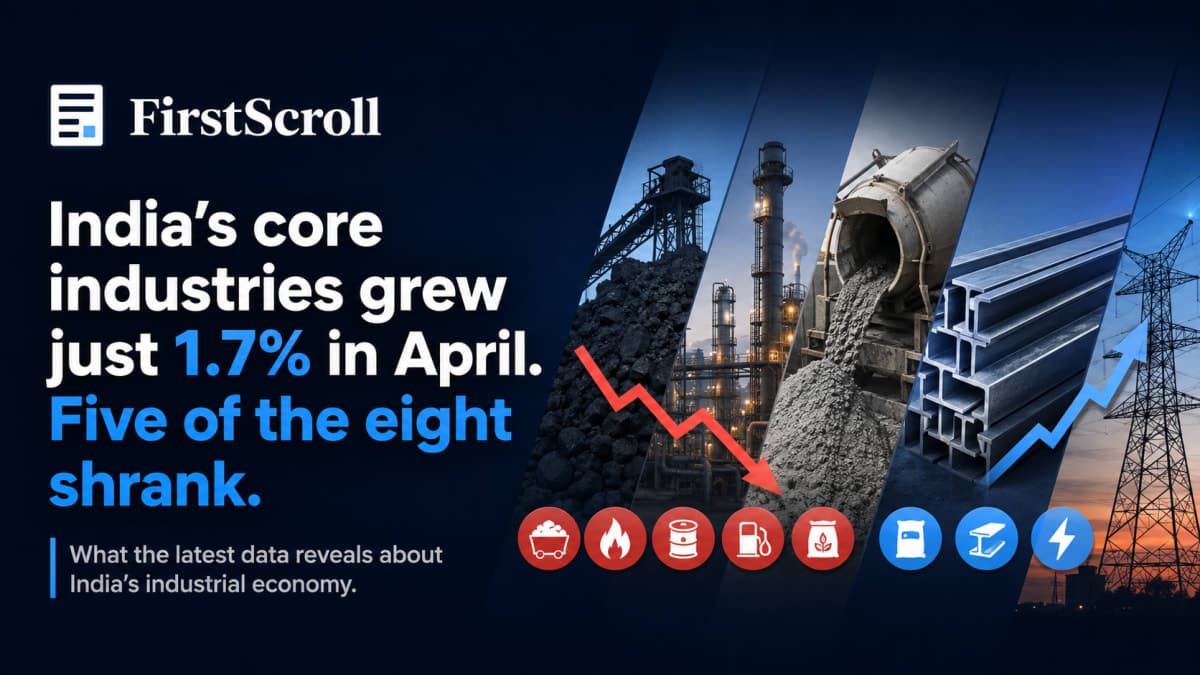
Every month, the government releases a number that works like an early pulse check on the economy. April's reading was weak, and the detail underneath it was weaker still.
In today's FirstScroll, we unpack the core sector data, why five of India's eight foundational industries are contracting, and what it signals about the year ahead.
The Story
On May 20, the Ministry of Commerce and Industry released a number that did not make many front pages, but should have. India's eight core infrastructure industries grew just 1.7% in April 2026 compared with the same month a year earlier.
Now, 1.7% might not sound alarming on its own. But two things make it worth a closer look. First, it is a very low number for an economy that is supposed to be the fastest-growing major economy in the world. Second, and more importantly, the headline hides something the detail reveals. Of the eight core industries, five actually shrank.
To understand why this matters, you first need to understand what the core sector is and why economists watch it so closely.
For the uninitiated, the Index of Eight Core Industries, often just called the core sector, tracks the output of eight foundational industries: coal, crude oil, natural gas, refinery products, fertilisers, steel, cement, and electricity. These are not random industries. They are the raw inputs on which almost all other economic activity is built. A factory needs electricity. Construction needs cement and steel. Transport needs refinery products. Farming needs fertiliser.
This is why the core sector is treated as an early pulse check. It is released before the broader industrial production data, and it accounts for about 40.27% of the total weight of the Index of Industrial Production, the wider measure of factory output. So when the core sector is weak, it is usually a reliable warning that overall industrial growth will be weak too.
Think of the core sector as the foundation and the plumbing of a building. You do not see it when you walk into a finished apartment. But if the foundation is shaky and the pipes are weak, everything built on top eventually feels it.
So let's look at what April's reading actually showed, because the average of 1.7% is hiding a sharply divided picture.
Three industries did well. Cement production was the standout, jumping 9.4%, the strongest performer of all eight. Steel production rose 6.2%. Electricity generation grew 4.1%. These three are the reason the headline number stayed positive at all.
But the other five all contracted.
Coal production fell 8.7%. Fertiliser output dropped 8.6%. Natural gas declined 4.3%. Crude oil output fell 3.9%. And refinery products slipped 0.5%.
Read that again. Five of the eight foundational industries of the Indian economy produced less in April 2026 than they did in April 2025.
So what is going on? Why is the picture so split?
The first thing to notice is that the weakness is heavily concentrated in one place: energy and fuel. Coal, crude oil, natural gas, and refinery products are all energy industries, and all four are shrinking. Fertiliser, the fifth contracting sector, is itself highly energy-dependent, because natural gas is a key raw material for making it.
This pattern points back to a story you have seen repeatedly in recent FirstScroll coverage: the West Asia crisis and the disruption to global energy. ICRA economist Rahul Agrawal, reacting to the data, noted that the contraction across several sectors reflects how economic activity in some parts of the economy is being affected by the ongoing crisis in West Asia. Elevated and volatile global crude prices, supply uncertainty, and the squeeze on India's oil marketing companies all ripple through these energy-linked industries.
The second thing to notice is what is holding up. Cement and steel are the building blocks of construction and infrastructure. Their strong growth, cement up 9.4% and steel up 6.2%, tells you that construction activity, government infrastructure spending, and real estate are still reasonably healthy. Electricity growth of 4.1% reflects ongoing demand from homes and industry. So the demand side of the economy, the part that builds and consumes, is still moving. It is the supply side of energy that is stalling.
Now, here is an important piece of nuance, and it is worth being precise about.
The 1.7% figure for April was actually an improvement over the recent trend. The final growth rate for March 2026 was just 1.2%, and April last year was around 1%. So April 2026's 1.7% was, technically, a two-month high. Some headlines framed it that way.
But economists were quick to flag that this small uptick is not a sign of strength. ICRA's Agrawal pointed out that the improvement remained limited despite a favourable base effect, and was driven largely by just a few sectors, mainly electricity and cement.
For the uninitiated, the "base effect" is a simple but crucial idea in reading economic data. Growth is always measured against the same month a year earlier. If that earlier month was itself weak, then even modest output this year shows up as a healthy-looking growth percentage, simply because the comparison point is low. So a low base can flatter the numbers. When economists say the April number got help from a favourable base effect, they are warning you not to read 1.7% as genuine momentum. Strip out the statistical flattery, and the underlying picture is one of an industrial economy growing slowly and unevenly.
There is also the full-year context. For the entire financial year 2025-26, April to March, cumulative core sector growth was 2.7%. Within that, steel grew a strong 9.5% for the year and cement 8.7%, while crude oil and natural gas each contracted around 2.8%, and coal, refinery products, and fertilisers were roughly flat or marginally negative. The same split, strong construction materials, weak energy, runs through the full-year data, not just April.
So why does all of this matter to you?
Three takeaways.
One, watch the industrial production data that follows. Because the core sector makes up about 40% of the broader Index of Industrial Production, a weak core reading usually flows through to a weak IIP reading. ICRA's Agrawal explicitly said this slowdown is likely to be reflected in tepid IIP growth for April. If you are an investor, industrial output is one of the clearest signals of how the real, physical economy, beyond the stock market, is actually performing.
Two, understand what is driving the weakness, because it changes how worried you should be. If India's core sector were weak because cement and steel were collapsing, that would signal falling construction and infrastructure demand, a genuinely worrying sign of a slowing domestic economy. But that is not what is happening. Cement and steel are strong. The weakness is concentrated in energy and fuel, and a large part of that traces back to the external West Asia shock rather than to a collapse in Indian demand. An externally-driven, energy-concentrated slowdown is a different and somewhat less alarming problem than a broad-based domestic demand collapse.
Three, connect this to the bigger growth picture. This soft core data does not sit in isolation. It comes alongside forecasters trimming their India growth expectations for the year ahead. The core sector reading is one more data point in a broader picture of an economy that is still growing, still among the fastest-growing large economies, but visibly losing some momentum as the external environment, oil, tariffs, and a weak rupee, takes its toll.
But let's be clear about what this data is not.
It is not a sign that India is heading into a recession or a crisis. A 1.7% core sector print is weak, but the index is still growing, not contracting. Three of the most demand-sensitive sectors, cement, steel, and electricity, are growing solidly, which tells you the domestic engine of construction and consumption is still running. India remains, by most forecasts, the fastest-growing major economy in the world. Slower is not the same as shrinking.
And it is not necessarily permanent. Much of the weakness is concentrated in energy industries hit by an external shock. If the West Asia situation stabilises and global energy markets calm down, the energy-linked sectors, coal, crude oil, natural gas, refinery products, have room to recover. Base effects, too, cut both ways, and can flatter future months just as they have flattered this one.
Step back, and there is a clear and useful signal in this data. The Indian economy in early 2026 is not a single story. It is two stories running at once. One story is domestic, demand-driven, and reasonably healthy, visible in the cement mixers and steel beams of a country still building. The other story is energy-linked, supply-side, and under strain, visible in the contracting output of coal mines, gas fields, and refineries caught in the downdraft of a faraway conflict.
The headline number, 1.7%, is just the average of those two stories. The real insight is in pulling them apart. India's foundations are still being poured. It is India's fuel tank that is running low.
Until next time…