Picture this.
It's 2021. A 26-year-old from Bangalore has an idea. Maybe it's an app that delivers groceries, or a platform that teaches coding, or a tool that helps small businesses manage accounts. He makes a pitch deck. Walks into a room full of investors in expensive sneakers. And within weeks, ₹5 crore is sitting in his startup's bank account.
This was India in 2021. Money was everywhere. Every idea got a cheque. Every founder was a potential billionaire.
Fast forward to today.
That startup? Gone. Along with tens of thousands just like it.
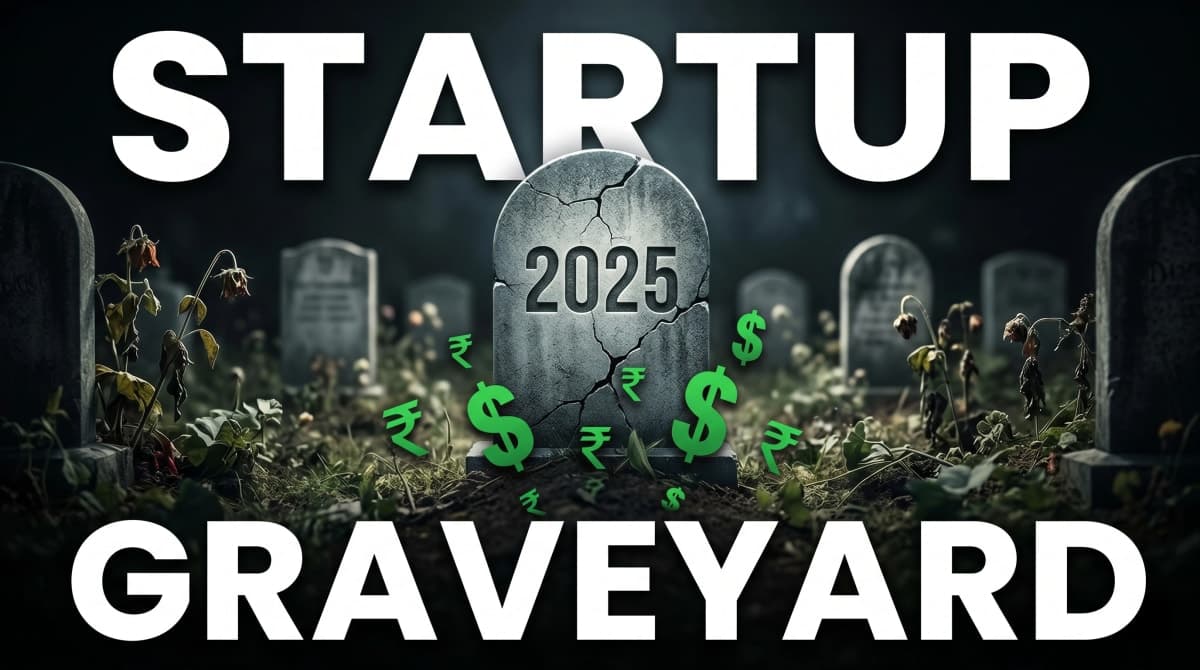
Between 2023 and 2025, over 39,000 Indian startups shut down. At the worst point in 2025, startups were closing at 37 per day. Every single day 37 dreams, 37 teams, 37 ideas quietly disappearing.
India now has what people are calling a startup graveyard.
So what happened? And is there a silver lining buried in all this rubble?
Before the Crash: Understanding the Game
To understand why so many startups died, you first need to understand how they're built.
A startup is not a regular business. It's a business designed to grow extremely fast 100%, 200%, even 500% a year. But that kind of growth costs enormous money. More than most founders have.
That's where venture capitalists come in. VCs pool money from wealthy investors and bet it on startups. Most of their bets fail. But if even one becomes the next Zomato or Flipkart, the returns are massive enough to cover everything else.
Most startups don't make profits in their early years. They deliberately lose money spending heavily on marketing and hiring because the goal is to capture the market fast. They depend on investors writing fresh cheques to keep going. Round A, Round B, Round C... until they either go public or get acquired.
Here's the key lesson: When that funding cycle breaks when investors stop writing cheques startups burning cash have nothing left. They die quickly.
That's exactly what happened.
The Euphoria: 2020–2021
When COVID-19 hit in 2020, the digital economy exploded. Schools moved online. Offices moved online. Shopping, doctors, exercise all online. Every startup that had been struggling to get users suddenly had millions flooding in.
The money followed. Global interest rates were near zero, meaning borrowing was cheap. Investors were flush with cash and desperate for returns. India, with its massive young population and booming internet base, looked irresistible.
Billions poured into EdTech, FinTech, HealthTech, AgriTech. Even startups delivering dog food got funded.
The most extreme example was Byju's an online tutoring platform that reached a peak valuation of ₹1.8 lakh crore ($22 billion) in 2022. It raised over ₹40,000 crore from investors worldwide. It sponsored the FIFA World Cup. It put its logo on the Indian cricket team's jersey.
Everyone thought it was just the beginning.
It wasn't.
The Reckoning: 2022 Onwards
The pandemic ended. Schools reopened. People went back to offices. The habits formed during lockdown started fading but startups had already built massive teams, expensive offices, and bloated marketing budgets, all assuming COVID demand would keep growing forever.
It didn't.
At the same time, global interest rates rose sharply. Money stopped being cheap. Investors who had been writing cheques for everyone became careful. Then cautious. Then extremely selective.
VC investments into Indian startups dropped over 40% after 2022. The funding cycle broke. Startups that had been running on investor money without ever making real profits suddenly had nothing left.
The numbers are brutal.
In three years from 2019 to 2022, about 2,300 startups shut down. Normal, even healthy. Then in just two years 2023 and 2024 over 28,000 startups shut down. A 12x jump. By October 2025, another 11,000 more had closed.
Who Died and Why
The sectors hit hardest tell a clear story.
EdTech was the biggest casualty. Byju's once India's most valuable startup collapsed into bankruptcy. Its founder eventually admitted the company was "worth zero." ₹40,000 crore of investor money, gone. EdTech funding in 2025 fell to an 8-year low, down 56% from the year before. The core problem? Pandemic demand was artificial. When schools reopened, students went back. Startups had built their entire model on behaviour that vanished the moment life returned to normal.
AgriTech ran into a different wall. Startups promising to modernise Indian farming through apps hit a basic reality: rural farmers work on thin margins, have limited smartphone access, and deeply distrust new technology. The product existed. The customer didn't show up.
FinTech got hit by regulators. The RBI tightened rules around digital lending and payments. Several startups had built businesses in legal grey areas. When the crackdown came, their entire model became unviable overnight.
HealthTech followed the EdTech pattern artificial COVID boost, painful normalisation.
The common thread? A philosophy that one analyst described perfectly: "Growth at all costs." Spend, spend, spend. Grow, grow, grow. Worry about profits never. That worked when money was free. When money became expensive, it became a death sentence.
The Human Cost Nobody Talks About
Behind every shutdown statistic is a person.
Byju's laid off over 60% of its workforce at various points during its collapse. These were engineers, teachers, sales teams people who had left stable corporate jobs to join what they believed was India's most exciting company.
Across the broader ecosystem, over 16,000 startup employees were laid off in just the first half of 2023 alone. Many worked for months without getting paid, hoping the next funding round would come through. It often didn't. Some found out their company was closing through a WhatsApp message.
This is the side of the startup story that the glossy pitch decks and hustle-culture Instagram posts never show.
Was It All Bad? Understanding Market Corrections
Here's where the story gets more complicated.
A quick lesson: When too much money chases too many bad ideas, a correction eventually happens. Weak businesses die. The survivors emerge stronger and more disciplined. It's painful in the short term but in the long term, it cleans up the system.
Think of it like a forest fire. Devastating to witness. But it clears the dead wood and makes room for stronger growth.
India's startup crash is exactly this kind of correction.
The word that startups used to laugh at profitability became the new obsession. Investors stopped asking "how fast are you growing?" and started asking "when do you break even?" Founders who had once chased user numbers started obsessing over whether they made money on each transaction, after all costs.
Look at Zerodha India's most successful bootstrapped startup. Built slowly. Profitable from year one. No VC money. No hype cycle. Its founder once said he didn't even know what a VC was when he started in 2010. Today it's one of India's most valuable financial companies.
The graveyard is teaching one lesson above all else: sustainable beats spectacular.
The New Dawn: 2026
Here's the thing about graveyards they're usually next to places where new life begins.
India's startup ecosystem in early 2026 is showing real recovery. Not the reckless 2021 kind but something quieter, more purposeful, and arguably healthier.
In just the first quarter of 2026, Indian startups raised nearly ₹33,000 crore. Early-stage funding the kind backing brand new, unproven ideas jumped 58% year on year. That means investors are back to believing in new founders and new ideas, not just propping up survivors of the last cycle.
The biggest deal tells you exactly where the excitement is now. An AI infrastructure company raised ₹10,000 crore in a single round the largest AI funding round in Indian startup history. Artificial intelligence is the new frontier. And this time, the investors writing cheques are asking much harder questions before signing.
There's also a generational shift. A new wave of founders is entering many of them second-time entrepreneurs who failed in the last cycle, learned hard lessons, and are coming back with far more realistic plans.
Seed-stage deals the smallest, earliest investments now make up 67% of all funding activity. That's the ecosystem being rebuilt from the ground up.
Five Lessons From the Graveyard
India's startup crash isn't just a story about companies dying. It's a story about how economies learn. Here's what it's teaching us.
1. Free money is dangerous. When capital is cheap and abundant, it funds bad ideas as easily as good ones. The 2020–21 boom funded startups with no real business model. Easy money made everyone feel like a genius until it didn't.
2. Growth without profit is a ticking clock. A startup that loses ₹100 for every ₹10 it earns can survive only as long as investors keep funding it. Byju's spent ₹2.5 lakh crore in 24 months and never built a reliable way to make money. The clock ran out.
3. Real demand matters. Pandemic demand was artificial. Millions used EdTech because schools were shut not because they preferred it. When schools reopened, the demand vanished. Build for real behaviour, not temporary circumstances.
4. The ecosystem is maturing. Going from 2,300 shutdowns in three years to 28,000 in two sounds like a disaster. But look at what's on the other side: profitable survivors, disciplined founders, investors asking harder questions. That's what a grown-up ecosystem looks like.
5. The next wave is already here. AI, deep tech, electric vehicles, defence technology these are attracting serious money in 2026. And unlike 2021, the investors backing them want real businesses, not just big ideas on a slide.
Is India's Startup Story Over?
Not even close.
India is still the third-largest startup ecosystem in the world. It has over 1.5 lakh recognised startups and 117 unicorns. The talent, the engineering colleges, the growing middle class, the digital infrastructure all of it is still here and still expanding.
What's over is the era of easy money and reckless growth.
What's beginning is something more interesting: the era of startups that actually work.
The graveyard was real. The pain was real. Tens of thousands lost jobs. Hundreds of thousands of crores vanished. But graveyards are where the past rests not where the future is buried.
India's startup story is being rewritten. This time, on a foundation that lasts.
This article is for informational and educational purposes only. It does not constitute financial or investment advice.