Two inflation numbers came out last week. One was alarming. The other was calm. Both are measuring the same economy.
In today's FirstScroll, we unpack the strange gap between India's wholesale and retail inflation, and what it tells us about who is silently paying for the West Asia crisis.
The Story
If you only read the retail inflation number for April, you'd think the Indian economy was sailing through a global oil shock with hardly a scratch. Consumer Price Index inflation came in at 3.48%, well within the RBI's comfort band, and food inflation was a benign 3.87%.
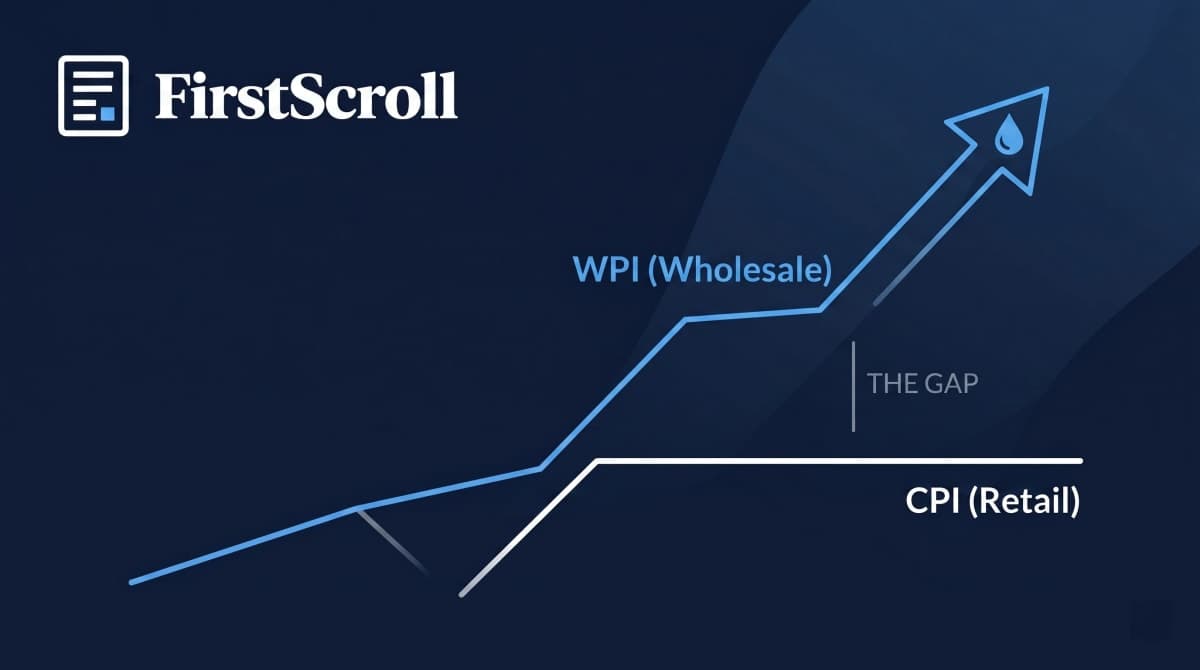
If you only read the wholesale number, you'd think a fire had broken out somewhere upstream. Wholesale Price Index inflation jumped to 8.30% in April from 3.88% in March, a 42-month high, and far above the 5.5% that analysts had penciled in.
So which number is real?
Both are real. They are measuring different things, and the gap between them right now is one of the most interesting economic stories in India.
For the uninitiated, India tracks two main inflation measures. The Consumer Price Index, or CPI, tracks the basket of goods and services that an average household actually buys. Vegetables, rice, fuel for cooking, school fees, doctor visits, soap, mobile recharges. The Wholesale Price Index, or WPI, tracks the prices that businesses and factories pay each other before things reach the shelf. Think of it as the price tag at the warehouse versus the price tag at the kirana shop.
Most of the time, the two numbers move together with a small lag. When wholesale prices rise, factories pass it on, retailers pass it on, and a few weeks later, you feel it in your monthly grocery bill. When wholesale prices fall, the relief eventually shows up at the till.
Right now, that link is broken. WPI is running more than twice as hot as CPI. So what is going on in the gap?
The answer, in one word, is fuel.
WPI inflation in the fuel and power group jumped to 24.71% in April, from just 1.05% in March. That is a near 24 percentage point swing in a single month. Within that segment, petrol inflation hit 32.40%, diesel 25.19%, and LPG 10.92%. Crude petroleum and natural gas inflation surged to 88.06%, the highest since October 2021.
These are not subtle moves. They are the kind of numbers that show up when a war disrupts a major shipping route.
The trigger is the US-Israel war on Iran and the resulting tightness in the Strait of Hormuz, the narrow waterway through which a large share of India's crude oil imports passes. Global Brent crude has surged roughly 50% in three months. India imports about 90% of the crude it consumes, so every move in global oil prices shows up almost instantly in what Indian refiners pay for their feedstock.
That price shock has registered in full at the wholesale level. WPI captures it because it tracks producer prices, factory gate prices, and crude input costs directly.
But at the retail level, the same shock has barely moved the needle. CPI fuel inflation is muted because the government and the three big public sector oil marketing companies, IOC, BPCL, and HPCL, have been holding pump prices nearly flat. Until last Friday, the price of petrol in Delhi had not been revised since April 2022. On May 15, the government finally raised petrol and diesel by ₹3 per litre each, which is a small fraction of what global crude moves would have warranted.
This is the heart of the divergence. The pain is real, but it has not been allowed to reach the consumer.
So who is absorbing it?
Three groups, in this order.
The first is the OMCs themselves. Oil Minister Hardeep Singh Puri said the three OMCs together are losing around ₹1,000 crore per day from selling petrol, diesel, and LPG below cost. That is roughly ₹30,000 crore a month being absorbed on three balance sheets that the government also owns.
The second is the manufacturing sector. Manufactured products inflation in the WPI climbed to 4.62% in April. Basic metals were up 7%, textiles up 7.3%, and chemicals up 5.09%. These are the input costs that factories are paying right now, but have not yet passed on to their customers. Core WPI inflation, which strips out food and fuel, hit 5% in April, a 43-month high. That tells us the pressure is no longer confined to volatile categories.
The third group is logistics and transport. Higher diesel and freight costs are quietly inflating the cost of moving goods across the country, but most of that has not yet shown up on retail price tags.
Think of it like a sponge. The global oil price shock hit India in February. The sponge of OMC balance sheets, factory margins, and freight operators has been soaking it up for three months. Eventually, the sponge gets full.
When does the rest of it reach you?
Economists usually estimate that wholesale price increases take one to three months to filter through to retail prices, depending on the category. India Ratings director Megha Arora told Business Standard that WPI inflation could rise to 9% in May before the transmission begins in earnest. CareEdge Ratings chief economist Rajani Sinha said the acceleration in wholesale inflation raises the risk of second-round effects spilling into retail.
The earliest signs will likely show up in transport fares, packaged foods, edible oils, dairy, and fresh produce. Sectors with longer inventory cycles, like apparel, consumer durables, and household goods, may take two to three months. Some economists now place May retail inflation in the 3.8% to 4.2% range, with risks tilted higher if the OMCs raise pump prices further.
But let's be clear about what this divergence does not mean.
It does not mean the official numbers are wrong or manipulated. WPI and CPI use different baskets, different weights, and different methodologies. Fuel and power have a much larger weight in WPI than in CPI, which is one reason WPI moves more violently when crude prices spike. According to ICRA, the volatility of WPI between FY17 and FY26, measured by standard deviation, was almost three times higher than that of CPI. This divergence has happened before, and it has resolved before.
It also does not mean the RBI is about to slam the brakes. Barclays expects the Monetary Policy Committee to look through the supply-shock-driven inflation and persist with a pause for the rest of 2026. The RBI's standard playbook is to ignore supply-driven shocks that are likely to fade, and react only when inflation looks like it is becoming entrenched in core demand. Governor Sanjay Malhotra used the words "prudent to wait and watch" at the April MPC.
So how should you think about all this as an Indian household or investor?
Three takeaways.
One, do not be fooled by the calm retail number. The 3.48% CPI for April is a function of a lag, not a function of a healthy economy. The wholesale data is telling you what is coming. If crude stays elevated through the summer, expect retail inflation to drift higher in June and July, particularly in food, transport, and FMCG.
Two, watch the next fuel price revision closely. The May 15 hike of ₹3 per litre was the first in four years, and the government's appetite for further hikes is limited. But Barclays expects another ₹5 per litre revision is imminent if Brent stays above $100. Every ₹1 per litre rise in petrol and diesel adds roughly 20 basis points to retail inflation over the following weeks.
Three, watch the rupee. The rupee touched 95.75 against the dollar earlier this month, a record low. A weaker rupee makes imported oil even more expensive in rupee terms, which compounds the pressure on both WPI and eventually CPI.
Step back, and the bigger picture here is about how a developing economy chooses to absorb an external shock. India has, for now, chosen to protect the household consumer at the cost of the OMC balance sheet and the manufacturing margin. That choice has political logic. It also has a shelf life. The ₹1,000 crore per day OMC bleed cannot continue indefinitely, and factory owners cannot quietly absorb 5% to 7% input cost rises forever without raising selling prices.
The wholesale number is the early warning. The retail number is the lagging confirmation. Right now, the warning light is on, but the alarm has not yet sounded in your kitchen.
Watch the gap. It is closing.
Until next time…