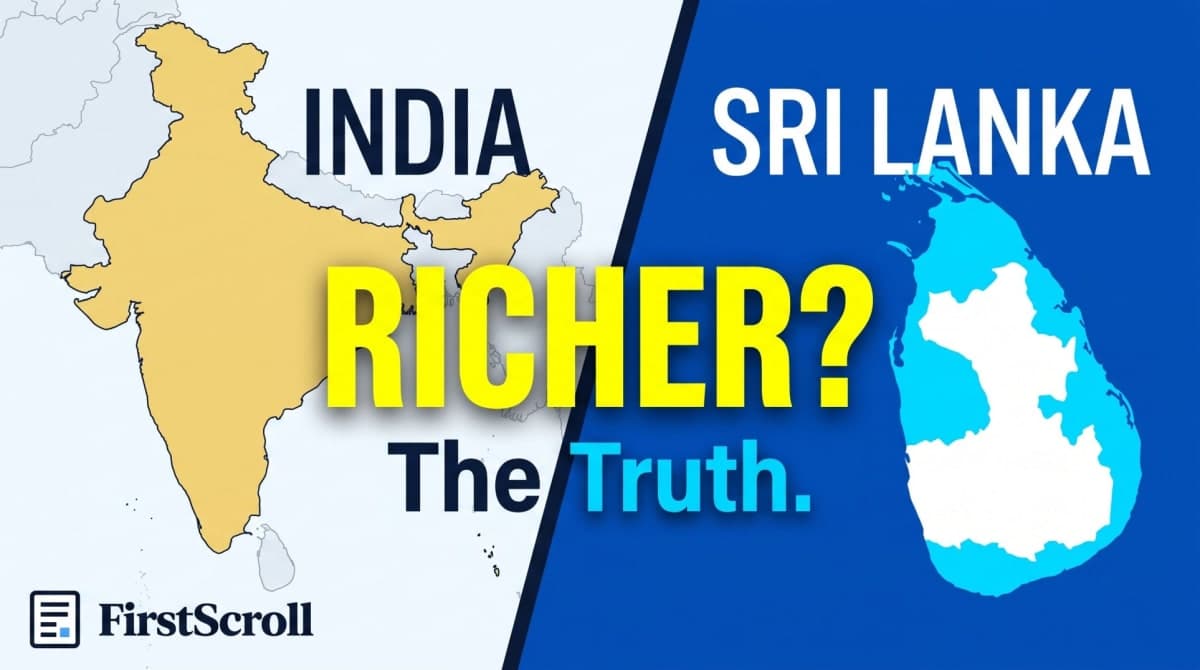
In today's FirstScroll, we break down why the World Bank just ranked Sri Lanka a category above India, and explain why the country we bailed out four years ago isn't actually richer than us.
If you enjoy stories like this, subscribe to FirstScroll and get one simple business story in your inbox every morning. With that out of the way, let's dive into today's story.
The Story
Cast your mind back to the summer of 2022.
Sri Lanka was on fire. Quite literally, in places. The country had run out of dollars. Petrol pumps had queues stretching for kilometres. Hospitals were rationing medicines. Power cuts lasted half the day. And in July, protesters stormed the presidential palace and took a swim in the president's pool while he fled the country.
That same year, Sri Lanka did something no South Asian country had done before. It defaulted on its foreign debt. The government simply said: we can't pay.
And who came to the rescue? India, mostly. New Delhi extended close to $4 billion in credit lines, currency swaps, and shipments of fuel, food, and medicine. More immediate support than anyone else, including the IMF, provided in those chaotic months.
Fast forward four years. Last week, the World Bank released its annual country income classifications. And there it was, in black and white: Sri Lanka has been promoted to an upper-middle-income economy.
India? Still lower-middle-income. Same bracket as Bangladesh, Kenya, and Nigeria.
So here's the question: how does a country that went bankrupt in 2022, and needed our money to buy petrol, get ranked a full category above the world's fourth-largest economy?
Well, to answer that, you need to understand how the World Bank actually builds this list.
You see, every year on July 1st, the World Bank sorts 218 economies into four buckets: low income, lower-middle, upper-middle, and high income. And the sorting isn't based on the size of your economy. It's based on something called GNI per capita.
Simply put, GNI (Gross National Income) is everything a country's residents earn in a year, including money earned abroad. Divide that by the population, and you get GNI per capita. Think of it as the average income per person, not the size of the national wallet.
And this year's cutoffs look like this: earn less than $4,636 per person, and you're lower-middle-income. Cross it, and you're upper-middle. Cross $14,375, and you're officially a rich country.
Now you can probably see where this is going.
India's economy is massive, over $4 trillion. But that income is split across more than 140 crore people. So our GNI per capita still sits under $3,000. Well short of the cutoff.
Sri Lanka's economy, meanwhile, is tiny. Smaller than the GDP of many Indian states. But it's divided among just 2.2 crore people. Roughly the population of Mumbai. So even a modest economy produces a per-person figure high enough to clear the bar.
In other words, this isn't a ranking of who's richer as a nation. It's a ranking of the average person's income. A country the size of one Indian city will always have an easier time on that maths.
But hold on. That explains the arithmetic. It doesn't explain the timing. Sri Lanka was broke in 2022. How did its average income recover this fast?
Three things happened.
First, the economy genuinely bounced back. Real GDP grew 5% in 2025, powered by a tourism revival and a recovering financial sector. Second, inflation cooled and the rupee, the Sri Lankan one, stopped falling. That matters because the World Bank measures everything in US dollars. When your currency stabilises, your dollar income jumps even if life on the ground barely changes. Put together, Sri Lanka's per-capita income rose 11.2% in a single year. And third, the painful IMF-mandated reforms, tax hikes and all, started showing up in the numbers.
The result? Sri Lanka crossed the $4,636 line. Barely. The World Bank itself admitted the country only narrowly cleared the threshold.
And here's a detail most headlines missed. This isn't even new territory for Sri Lanka. It held upper-middle-income status before, back in 2019, before the crisis dragged it down a bracket. So this is less a medal and more a return to where it already was. A recovery, not an overtaking.
But there's a twist here. This "promotion" could actually cost Sri Lanka money.
You see, these classifications aren't just for bragging rights. They decide which countries qualify for concessional loans, which is cheap, long-term credit reserved for poorer nations. Move up a bracket, and some of that cheap money starts drying up. For a country still buried under restructured debt and IMF conditions, losing access to soft loans is a real price to pay for a nicer label.
And ask an ordinary Sri Lankan family if they feel upper-middle-income. Food prices are still elevated. Taxes went up sharply under the IMF programme. The debt burden hasn't gone anywhere. A per-capita average, remember, says nothing about how income is actually distributed. The country got a better report card. Most households didn't get a raise.
So no, Sri Lanka isn't "richer" than India. Its economy is a fraction of ours, and India remains one of the fastest-growing major economies on the planet, clocking 7.7% growth last fiscal year. What Sri Lanka has is fewer people to divide its income by, a stabilised currency, and a genuinely impressive recovery from rock bottom.
But the headline still stings for a reason. Because it's a reminder of the one number India can't brag about. We can celebrate being the fourth-largest economy all we want. But until the average Indian's income roughly doubles, the World Bank will keep filing us next to countries a tenth of our size. Economists reckon that's still the better part of a decade away, even at our current pace.
Which raises the real question. Not whether Sri Lanka deserves its upgrade, but how long a $4-trillion economy is content being called lower-middle-income.
Only time will tell.
Until then…
If this story helped you make sense of the World Bank's rankings, share it with a friend on WhatsApp, LinkedIn, or X.