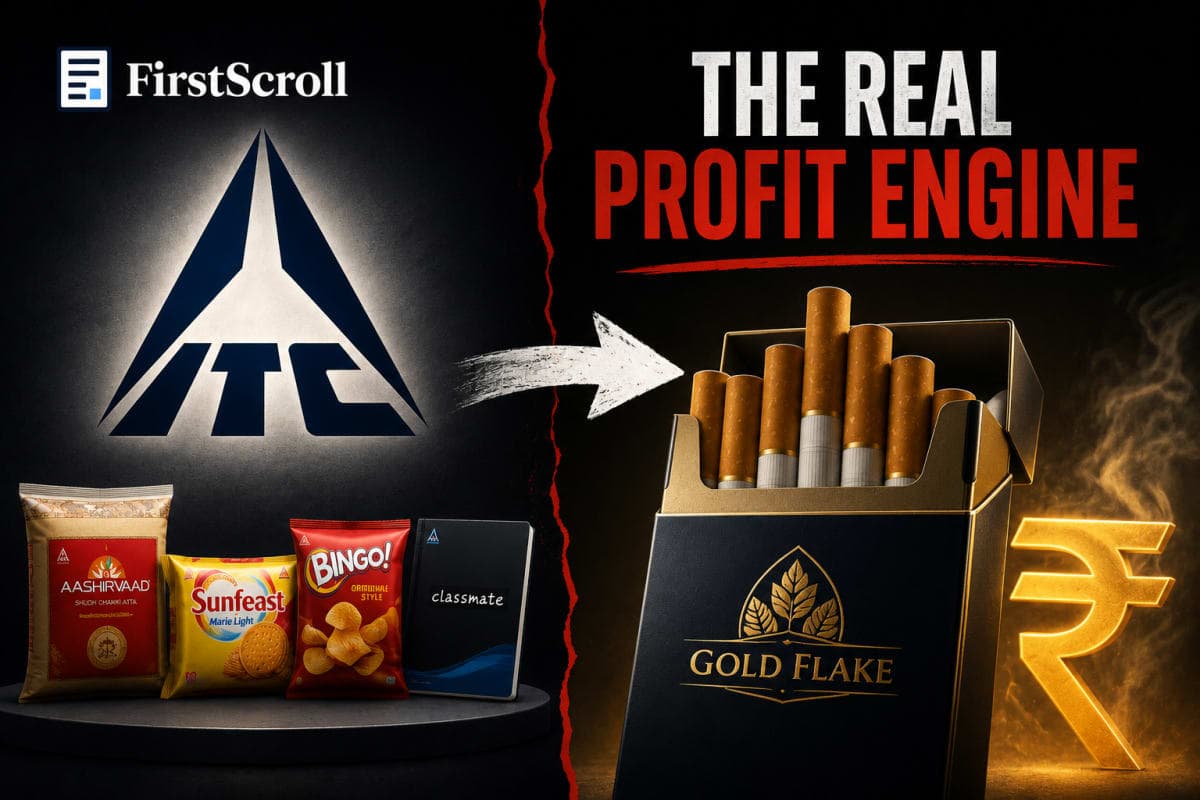
In today's FirstScroll, we talk about the strange reality that the company behind your atta, your biscuits, and your notebooks lives and dies on the stock market by something else entirely: the cigarette.
The Story
Walk into any Indian kitchen and you'll likely find a packet of Aashirvaad atta. Open the snack cupboard, there might be Sunfeast biscuits, Bingo chips, or Yippee noodles. Check the bathroom shelf for Savlon. Look in a schoolbag for a Classmate notebook.
Every one of those belongs to a single company. ITC.
And here's the part that surprises people. That same company is also India's largest cigarette maker, the one behind Gold Flake and Classic. So the business that stocks your kitchen is the same business that the government has spent this year taxing into a corner.
This year, ITC's stock has fallen roughly 33% over twelve months, recently hitting a 52-week low around ₹275. The trigger, as we've covered before, was a brutal cigarette tax hike. But that fall reveals something genuinely odd about ITC, and it's worth understanding, because it's a lesson that applies far beyond this one company.
ITC is, in effect, four or five different businesses bundled inside one company. Yet the stock market mostly judges it on just one of them.
Let's pull the businesses apart.
For the uninitiated, a company like ITC reports its results in "segments," which are simply its distinct business lines, each measured separately. ITC has four main ones, plus some sizeable subsidiaries. And once you see the split, the company looks very different from the cigarette giant most people imagine.
The first segment is the famous one: cigarettes. The second is "FMCG Others," which is all the non-cigarette consumer stuff, the atta, biscuits, chips, noodles, soap, and stationery. The third is paperboards, paper, and packaging, a quiet but real industrial business making the cardboard and packaging that products ship in. The fourth is the agri business, which deals in things like wheat, spices, and leaf tobacco. On top of these sit subsidiaries like ITC Infotech, a technology services arm, and ITC Hotels, the hospitality business it recently spun off.
For the full financial year, ITC posted standalone revenue of around ₹81,640 crore, up about 10%, and a net profit from continuing operations of roughly ₹21,018 crore. By any measure, this is a giant, diversified, profitable conglomerate.
So if it's this diversified, why does the whole stock swing on cigarettes alone?
Because of one crucial distinction that every investor needs to understand: the difference between revenue and profit.
Revenue is how much money a business brings in. Profit is how much it actually keeps after costs. And a business can have lots of one and very little of the other. ITC's non-cigarette businesses bring in plenty of revenue. The trouble is, they don't bring in nearly as much profit.
Here's why. Selling atta and biscuits is a brutally competitive, low-margin game. You're fighting price wars against rivals on every shelf, your input costs (wheat, edible oil, packaging) swing wildly, and customers will switch brands to save a few rupees. So even when ITC sells a mountain of Aashirvaad and Sunfeast, the profit it squeezes out of each rupee of sales is thin.
Cigarettes are the opposite. They're addictive, they command fierce brand loyalty, ITC utterly dominates the legal market, and smokers keep buying even when prices rise. That combination makes cigarettes extraordinarily profitable. A very large share of ITC's actual operating profit still comes from this one segment, even though the company has spent two decades trying to diversify away from it.
Think of ITC like a household with several earning members. The atta-and-biscuits business is like a hardworking member with a big, impressive-sounding job title but a modest take-home salary after expenses. The cigarette business is the quiet member who says little but quietly pays for most of the house. When that quiet earner's salary gets cut, by a tax hike, the whole household feels it immediately, no matter how busy and important the others look.
That's exactly why a cigarette tax shock sends the entire ITC stock tumbling, even as Aashirvaad and Sunfeast keep flying off the shelves. The market isn't being irrational. It's correctly recognising that the profit engine, the part that actually funds everything, just took a hit.
So why has ITC spent decades building all these other businesses if cigarettes are the real money-maker?
Because it saw this exact day coming.
ITC's management has long understood the fundamental vulnerability of its core business. Cigarettes are a "sin good," something the government is permanently committed to discouraging through ever-higher taxes and tighter rules. A company that depends entirely on a product the state wants to shrink is a company living on borrowed time. So ITC made a deliberate, long-term bet: use the enormous cash thrown off by the cigarette business to build new businesses that one day won't depend on cigarettes at all.
This is the genuinely smart, patient strategy hiding inside ITC. The cigarette is the cash cow being milked to fund the farm of the future. Every packet of Sunfeast, every Classmate notebook, every cloud kitchen and FMCG factory is, in a sense, financed by the cigarette.
And it has worked, partly. The non-cigarette FMCG business has grown from almost nothing into a serious operation generating tens of thousands of crores in revenue. Some of these brands are now household names. The problem is simply one of timing and profitability. These businesses are growing, but they're still nowhere near profitable enough to replace what cigarettes contribute. The farm is being planted, but the harvest that can feed the whole household is still years away.
So what should you, as an investor or just a curious observer, take from all this?
A few genuinely useful lessons.
First, always look past the headline business to find the profit engine. Many Indian companies present themselves as diversified, sprawling across many sectors. But diversification of revenue is not the same as diversification of profit. The real question to ask of any conglomerate is: where does the actual profit come from, and how vulnerable is that one source? For ITC, the honest answer is that despite all the brands you see, the profit still leans heavily on cigarettes, which is precisely why the stock is so sensitive to tobacco taxes.
Second, understand what you're really betting on when you buy a stock like this. Buying ITC isn't simply a bet on whether Indians keep eating biscuits. It's substantially a bet on the future of its cigarette business, on whether ITC can keep raising prices to offset taxes without losing too many smokers to illegal alternatives, and on how fast its other businesses can grow into genuine profit engines. Two different stories, one stock.
Third, notice the silver lining the market often overlooks on days of panic. Even with cigarettes under pressure, ITC remains a cash machine. It is nearly debt-free, and it pays one of the most generous dividends among large Indian companies, with a dividend yield recently around 5% and a payout ratio of roughly 74%. For a certain kind of long-term investor, a beaten-down, cash-rich, high-dividend business going through a tax storm is not obviously a disaster. It may even be an opportunity, though that depends entirely on how the cigarette saga plays out, and nobody can be sure.
But let's be clear-eyed about the other side too. The diversification, however smart, hasn't yet freed ITC from its cigarette dependence, and that day may still be a long way off. Meanwhile, the non-cigarette businesses face their own pressures, the agri business was recently hit by global disruptions, and the paper business by cheap imports. Diversification reduces risk, but it doesn't eliminate it, and a collection of lower-margin businesses doesn't automatically add up to a high-margin one.
Step back, and ITC is a fascinating case study in a truth that applies to many companies and even many careers. What you're most known for is not always what actually pays the bills. Most Indians know ITC as the friendly brand in their kitchen and their child's schoolbag. The stock market knows it as a cigarette company that happens to also sell atta.
Both views are correct. The art, for an investor, is in holding both at once, seeing the impressive, growing, diversified consumer giant, while never losing sight of the quiet, addictive, heavily-taxed product that still, for now, quietly funds the whole thing.
ITC is four companies wearing one trenchcoat. The trick is remembering which one is actually carrying the wallet.
Until next time…