In today's FirstScroll, we break down why Japan just found the richest gold deposit ever recorded on Earth, and why that jackpot might be worth more sitting untouched at the bottom of the sea than dug up.
With that out of the way, let's dive into today's story.
The Story
Every so often a headline arrives that sounds like the plot of a treasure film. This month it was Japan's turn. Roughly 360 kilometres south of Tokyo, in a submerged volcanic crater called the Higashi-Aogashima caldera, scientists found gold. Not a little. The highest concentration of gold ever recorded anywhere on the planet.
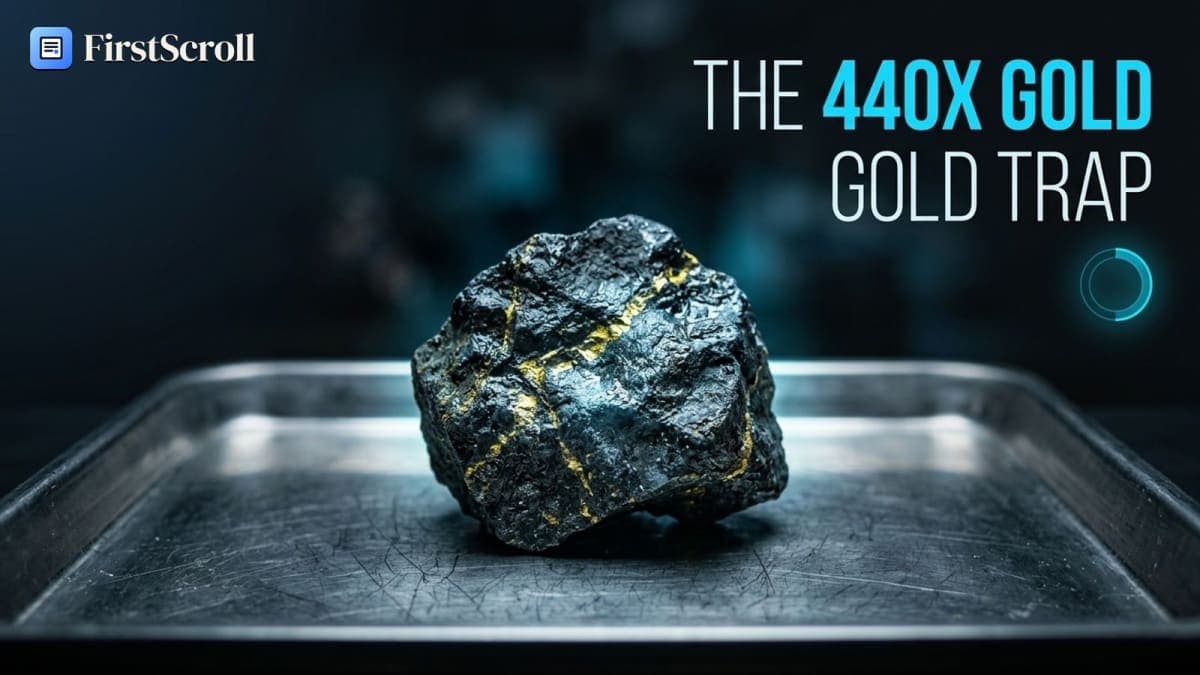
The numbers are genuinely staggering. The gold turned up at levels of up to 1.9% by weight inside the rock, published in the journal Scientific Reports. To put that in perspective, other known deep-sea gold sites carry gold measured in tiny fractions of that, and this deposit is more than 440 times richer than the global norm for undersea gold. And it sits relatively shallow, around 750 metres down, far easier to reach than most.
There is even a delicious irony baked in. The gold is hidden inside pyrite, the mineral nicknamed "fool's gold" for fooling prospectors into thinking they had struck it rich. This time, real gold was hiding inside the fake stuff.
So Japan, a resource-poor island nation that imports almost everything, appears to have won the geological lottery.
So the question is, if this is the richest gold ever found, why are the scientists who found it so careful to say it may never become a mine?
The answer is one of the most useful distinctions in all of economics, and once you have it, half the "country sitting on trillions" headlines you will ever read fall apart in your hands. It is the difference between a resource and a reserve.
A resource is simply the amount of a thing that physically exists in the ground, or in this case, under the sea. A reserve is the portion of that resource you can actually extract and sell at a profit, with today's technology, at today's prices. The two are worlds apart. The planet is stuffed with resources that will never be reserves, because getting them out would cost more than they are worth. Gold at the bottom of the ocean is the textbook case.
And here the "1.9%" number needs a caveat that most of the excited coverage skipped. That figure is the concentration inside particular grains of pyrite, not the makeup of the whole deposit. As one careful write-up stressed, it does not mean 1.9% of the entire underwater field is gold. It is a spectacular reading from the richest pockets, not a promise about the average.
Then there is the word "invisible," which is doing a lot of quiet work. This is not gold you could pan for or pluck out in nuggets. It is dispersed so finely within the pyrite's crystal structure that you cannot see it even under an ordinary microscope. Locked in that way, it cannot be melted out with a simple furnace. Scientists around the world are still trying to work out how to pull invisible gold out of seafloor rock cheaply and efficiently at all. The extraction method, the thing that would turn this resource into a reserve, does not really exist yet.
Now, why should you care about a mining distinction on the far side of the ocean? Because this exact gap, between what exists and what pays, is the trap in a hundred breathless stories about hidden national wealth. Every few months a country is reported to be "sitting on" trillions of dollars of lithium, or rare earths, or oil shale, and the number is almost always the resource, priced as if it could be sold tomorrow. The reserve, the part you can profitably get out, is usually a small fraction of it, and sometimes zero. Learn to ask "resource or reserve?" and you will never be fooled by a treasure headline again.
But here's the twist, and it is the part that turns this from a mining lesson into a genuine dilemma. There is a second reason this gold might stay in the sea, and it has nothing to do with cost.
Those "black smoker" chimneys spewing out the gold are not dead rock. They are rare, living ecosystems, home to specialised creatures found almost nowhere else, tubeworms, crustaceans, corals, whole webs of life that evolved around these volcanic vents in the deep dark. Marine scientists have been openly warning that these active vents need protecting from commercial mining, not opening up to it. Which means the true cost of this gold is not just the money and machinery to extract it. It is the destruction of an ecosystem we barely understand, for a metal that mostly ends up sitting in vaults and jewellery boxes.
So a full reckoning of this "jackpot" has to weigh the price of the gold against the price of what mining it would erase, and that second price does not show up on any commodities screen. Sometimes the most valuable thing about a resource is the argument for leaving it exactly where it is.
There is an Indian angle worth pausing on too. India is one of the world's hungriest buyers of gold, and those imports are a major reason its trade deficit runs so wide. It is tempting to think a giant new gold find somewhere would ease prices for Indian buyers. But this is precisely why gold stays scarce and expensive. Finding gold and being able to cheaply, cleanly sell it are two entirely different things, and the gap between them is the whole reason the metal holds its value. A record deposit that cannot be mined changes the price of gold in your local shop by exactly nothing.
So the treasure-film headline resolves into something more interesting than treasure. Japan has found an extraordinary amount of gold it may be unable, and perhaps unwilling, to ever bring up. The record-breaking number describes a resource, not a reserve. The extraction technology is not ready. And even if it were, the bill would include an ecosystem that took millennia to build and would take minutes to bury.
Whether that gold ever leaves the seafloor is a decision less about geology than about what we are willing to trade for a metal we mostly just look at.
Until then…
If this changed how you read a "hidden trillions" headline, share it with a friend on WhatsApp, LinkedIn or X.