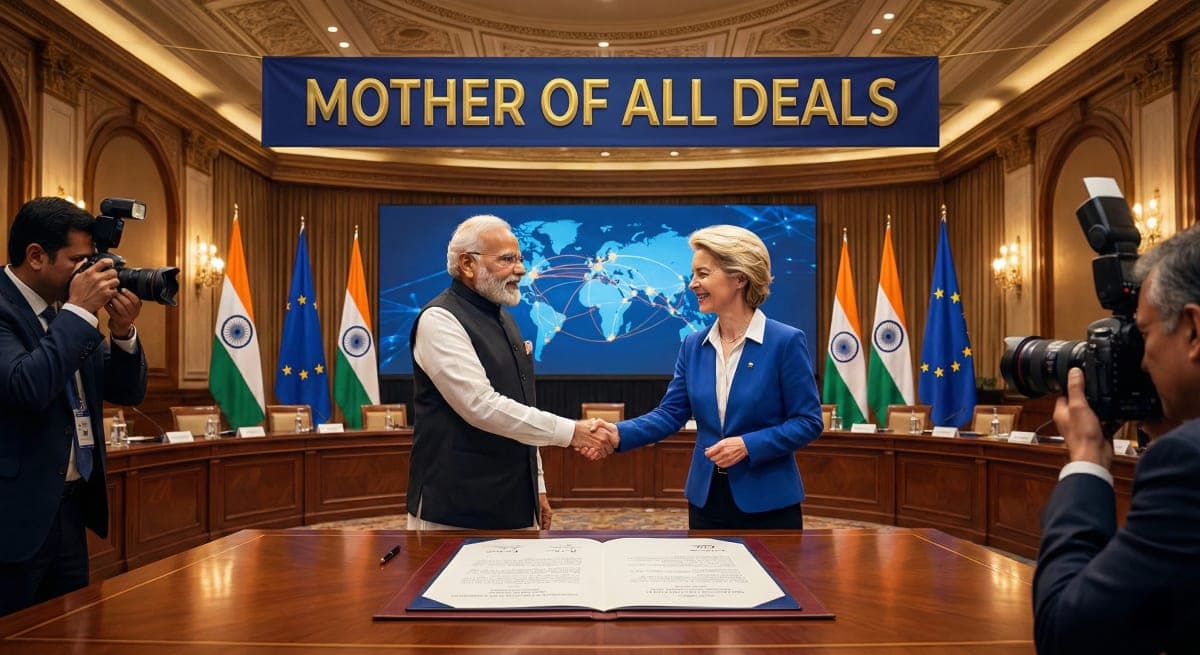
On January 26, 2026, if the global economy were a wedding venue, the champagne would be flowing. After 15 years of “it’s complicated,” India and the European Union have finally signed on the dotted line.
At First Scroll, we’re calling this the “Mother of All Deals.” We aren’t just talking about a few containers of basmati rice; we’re talking about a landmark Free Trade Agreement (FTA) that links the world’s 4 th largest economy (India) with the 2 nd largest economic bloc (the EU).
This isn’t just news it’s a geopolitical earthquake. Let’s scroll through why this matters for your wallet, your business, and the Indian markets.
For over a decade, talks between New Delhi and Brussels were stuck in a loop of “wine vs. visas.” The EU wanted lower taxes on their cars and scotch; India wanted easier work permits for its IT pros. Today, that deadlock is officially dead.
The deal, concluded during the high-level summit following India’s Republic Day celebrations, covers goods, services, and investments.
The Numbers That Matter:
- GDP Impact: The agreement governs a market representing nearly 25% of global GDP.
- The Consumer Base: It connects nearly 2 billion consumers across two continents.
- Current Trade: Bilateral trade already stands at $136.5 billion, and experts predict this could double within the next five years.
From a finance perspective, this isn’t just about removing tariffs. It’s about “Risk Diversification.”
1. The China+1 Strategy: With global supply chains still jittery, the EU is desperate to find a stable manufacturing alternative to China. By signing this deal, India has effectively put up an “Open for Business” sign for European giants like Siemens, Volkswagen, and Airbus.
2. Market Access for the “Made in India” Label: For Indian exporters, this is like getting a VIP pass to the world’s most premium club.
- Textiles & Apparel: India can now access a $263.5 billion textile market with zero-duty access a massive blow to competitors like Bangladesh and Vietnam.
- Pharmaceuticals: European standards for generic drugs are notoriously tough. This deal includes “Mutual Recognition Agreements,” meaning an Indian lab test might soon be valid in Berlin or Paris.
3. The $4.2 Trillion Magnet: India is now a $4.2 trillion economy. For EU firms, the deal provides a predictable legal framework to invest in India’s infrastructure, renewable energy, and digital sectors without fearing sudden regulatory shifts.
- Agriculture and Spirits: India has agreed to a phased reduction in the 150% duty on European Scotch and Wines. In return, the EU has opened its doors wider to Indian organic produce and marine products.
- The “Digital” Bridge: India’s IT sector is the big winner. The deal provides easier movement for “Mode 4” services (professional visas). If you’re a software architect in Bengaluru, your path to a project in Munich just got a lot smoother.
- The Green “Catch”: Manufacturers must now navigate the CBAM (Carbon Border Adjustment Mechanism) a tax on “dirty” imports like steel and aluminum. Sustainability is no longer optional.
1. Bank Strike 2026: The United Forum of Bank Unions (UFBU) is on a nationwide strike demanding a 5-day work week, bringing loan processing and physical documentation to a standstill for 800,000 employees.
2. The “Halwa” Ceremony: Finance Minister Nirmala Sitharaman performed the traditional ceremony at North Block, marking the final “lock-in” for Budget 2026-27. Expect massive incentives for Semiconductors and Green Hydrogen on Feb 1.
The markets closed on a high yesterday, with the Sensex ending 319 points higher. Our advice? Keep an eye on mid-cap textile and pharma stocks. However, don't ignore the “Green Risk” companies that don't invest in sustainable manufacturing might find themselves locked out of the very market we just opened.
Final Thoughts: India has cemented its place as a pillar of the new global trade order. Are you ready for the “Euro-India” boom, or are you still waiting for the next SIP cycle?