Imagine you're at a bazaar. You're selling mangoes. Business is good.
Then someone starts a rumour "the mango seller is going broke." A few people believe it. They stop buying. Others see fewer customers and think, "maybe the rumour is true." They stop buying too. And suddenly, the mango seller actually starts struggling not because anything was wrong, but because everyone believed something was wrong.
That's roughly what was happening to the Indian rupee.
So what actually happened?
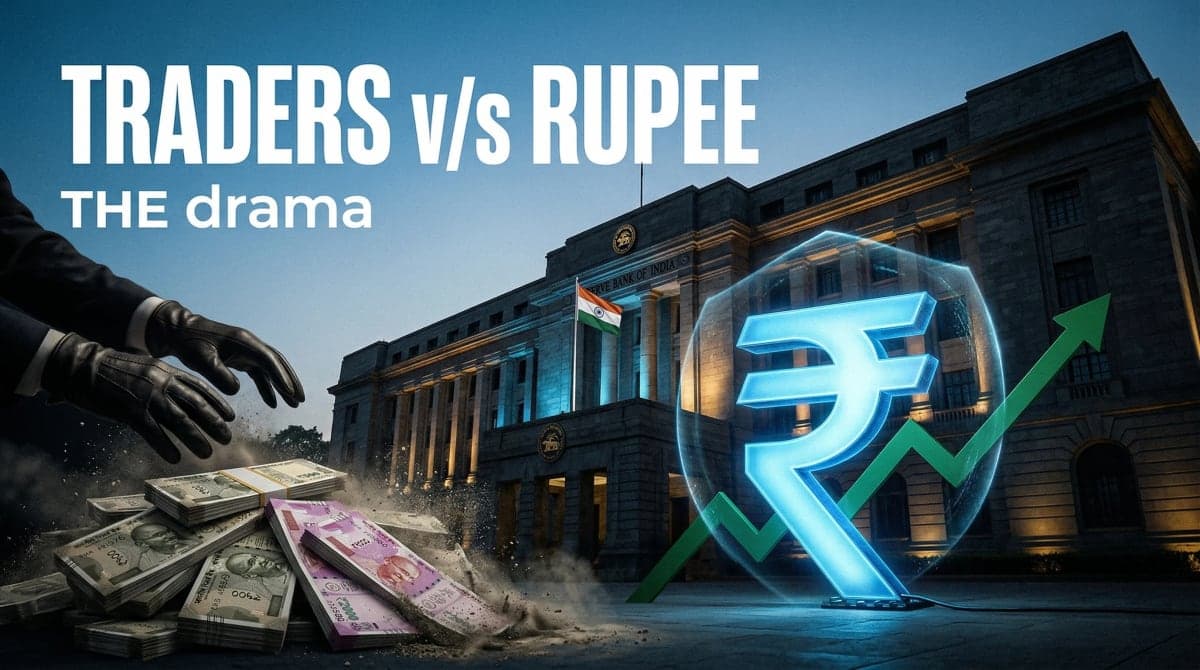
In early April, large traders the kind who move billions of dollars started "shorting" the rupee. Shorting means betting that something will fall in value. You borrow rupees, sell them, wait for the price to drop, buy them back cheaper, and pocket the difference.
The problem? When big money shorts a currency, it can become a self-fulfilling prophecy. Sell enough rupees, the price drops, others panic and sell too, and suddenly the currency is in freefall not because India's economy collapsed, but because a bunch of traders made a bet.
The rupee had already slipped to around ₹93 to the dollar. Foreign investors were pulling money out. Global uncertainty from the US-Iran standoff was spooking markets. The conditions were ripe.
Then the RBI walked in.
The Reserve Bank of India decided it had seen enough. It cracked down hard on speculative activity essentially telling traders: not on our watch.
The rupee responded immediately. On April 3rd, it posted its biggest single-day gain in over 12 years. Not a small jump. The kind of move that makes traders check their screens twice.
It was a signal. The RBI was watching. The RBI was willing to act. And the RBI had the reserves to back it up India's forex reserves sit at over $650 billion, enough firepower to defend the currency for a long time.
Why should you care about the rupee?
Fair question. You probably don't trade currency. So why does any of this matter?
Here's the thing the rupee's value touches almost everything.
India imports roughly 85% of its crude oil. Oil is priced in dollars. When the rupee weakens against the dollar, we pay more rupees for the same barrel of oil. That cost doesn't stay in some oil company's spreadsheet it flows through to petrol prices at the pump, LPG cylinder costs, freight charges, and eventually the price of almost everything that gets transported anywhere.
A weaker rupee also makes imported goods electronics, machinery, raw materials more expensive. Which pushes up inflation. Which makes the RBI nervous about cutting interest rates. Which keeps your home loan EMI stubbornly high.
So yes, the rupee drama is your drama too.
The rate decision nobody can ignore.
This week, the RBI's Monetary Policy Committee meets to decide interest rates. The market is watching closely.
Here's the dilemma the RBI faces: India's economy could use a rate cut to boost growth. Cheaper loans mean more spending, more investment, more jobs. But cutting rates when inflation is already elevated and oil prices are spiking because of Middle East tension risks making things worse.
SBI has warned that CPI inflation could stay above 4.5% for the next three quarters. That's above the RBI's comfort zone. So a rate cut, though desirable, isn't a given.
The rupee, oil prices, global uncertainty, and your EMI are all sitting in the same waiting room right now waiting for Wednesday's announcement.
The bigger picture.
Foreign Portfolio Investors the big global funds that invest in Indian stocks and bonds sold nearly ₹30,000 crore worth of Indian equities in just three trading days in April. That's not a small number. That's a fire sale.
But here's the interesting part: domestic investors people like you, investing through SIPs and mutual funds largely held steady. Indian retail investors have quietly become a stabilising force in markets that used to be at the mercy of foreign money.
A decade ago, when FPIs sneezed, Indian markets caught a cold for months. Today, domestic flows cushion the fall. That's a genuine structural shift and it's one of the underreported stories of India's financial maturity.
What should you actually do?
Nothing dramatic.
If you have ongoing SIPs, this is not the moment to stop them. Volatile periods are exactly when rupee-cost averaging works in your favour you're buying more units at lower prices.
If you're planning a foreign trip or sending money abroad, the weaker rupee means it costs more in Indian terms. Keep that in mind when budgeting.
If you have a home loan on a floating rate, watch Wednesday's RBI announcement. A rate cut even a small one could trim your EMI meaningfully.
And if you're tempted to "time the market" based on currency movements? Don't. The RBI just reminded everyone that currency markets can reverse sharply and suddenly. The best edge most investors have is patience.
The bottom line.
The rupee had a dramatic week a speculative attack, a central bank smackdown, and a 12-year record recovery, all in a few trading sessions. The drama isn't fully over. Oil tensions, FPI outflows, and the RBI's rate decision will keep things interesting through April.
But underneath the volatility, the fundamentals are intact. India's forex reserves are strong, domestic investors are resilient, and the RBI showed it's willing to act decisively when it needs to.
The rupee will be fine. And if you stay calm and keep investing, so will your portfolio.
Until then... keep an eye on portfolio⏳