In today's FirstScroll, we break down why a 250-year-old French drinks giant is thinking about listing its Indian arm on our stock exchanges, and why the more interesting question is not whether India is big, but what the parent company back home actually needs the money for.
With that out of the way, let's dive into today's story.
The Story
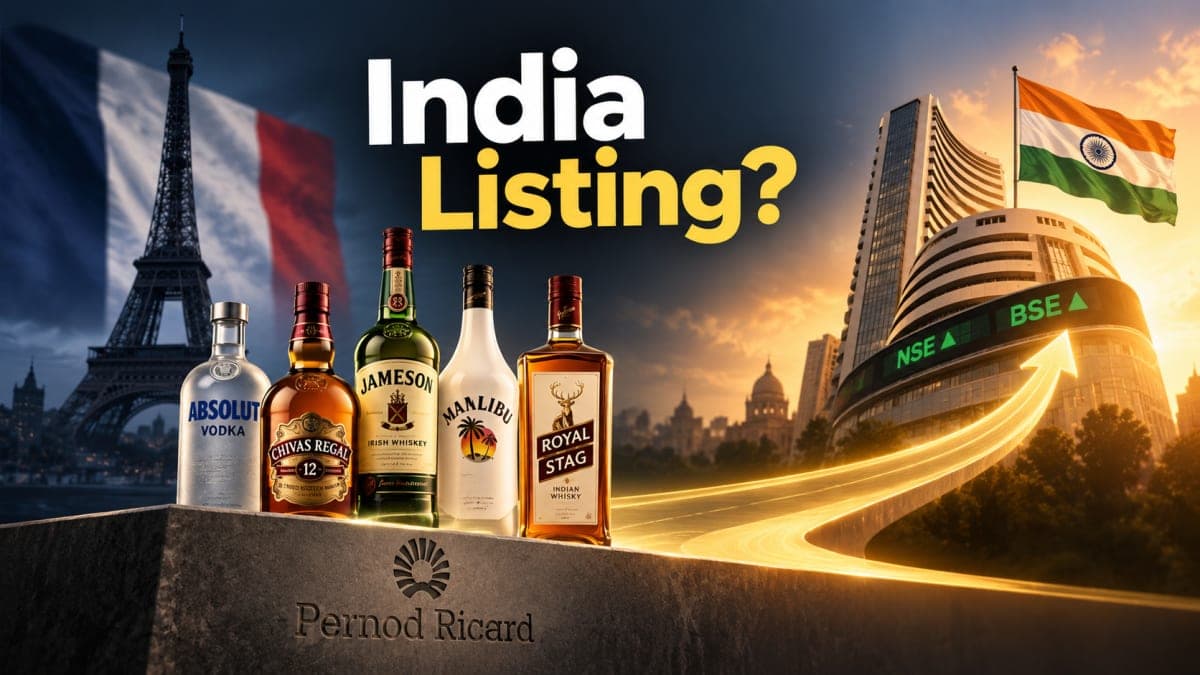
Pernod Ricard is about as French as a company gets. It owns Absolut, Chivas Regal, Jameson, Malibu, the kind of bottles that sit behind every airport bar in the world. It is headquartered in Paris. And for most of its life, its centre of gravity has been firmly in the West.
So it says something that the company's chief executive stood up at the latest results and called India, not France, not America, "quite phenomenal."
Here is why. In the year to June 2026, Pernod Ricard's global sales actually fell 3.9%. China was weak. Global travel retail, the airport-bar business it calls a "must-win," shrank. The mature markets it has leaned on for decades were flat or falling. And in the middle of that gloom, one market went up 7% and kept going: India.
That growth has quietly rearranged the company. India is now Pernod Ricard's second-largest market by value, behind only the United States, having overtaken China. By sheer volume of bottles, India is the biggest market it has anywhere on earth. The Indian arm booked revenue of around ₹27,446 crore in FY25. Its home-grown whisky Royal Stag is now the best-selling Indian whisky in the world.
And now the parent is "taking some legal preparatory steps" toward possibly listing that Indian business on Indian stock exchanges.
So the question is, if India is growing so beautifully and throwing off this much cash, why would Pernod Ricard sell a slice of it to the public at all?
This is the part worth slowing down on, because the instinct is exactly backwards. When a business is your single best growth engine, the natural move is to own more of it, not less. You sell shares in the parts that disappoint you. You cling to the parts that shine. So a plan to list the crown jewel needs an explanation.
Start with what an IPO of a subsidiary actually is. Pernod Ricard India is today a wholly-owned subsidiary of the French parent. A listing would carve out a minority stake, say 10 or 15%, and sell it to Indian investors, while the parent keeps control. The parent does not lose the business. It simply puts a public price tag on it and takes some cash off the table.
Why would it want that cash? Here is the thread the company keeps trying not to pull on. Back in February 2026, Pernod Ricard's finance chief laid out a plan to bring the group's debt down, specifically to get its net-debt-to-EBITDA ratio below 3 by 2029. Net debt to EBITDA is just a plain measure of how heavy a company's borrowings are relative to its yearly earnings, and a number above 3 is the kind of thing that makes lenders and credit-rating agencies uneasy. The group is carrying more debt than it wants to.
Now, officially, the company insists the India listing is not part of that debt-reduction plan. And maybe that is technically true. But step back and look at the shape of it. A heavily indebted parent, its traditional markets sputtering, sitting on one soaraway asset in a country where investors are paying rich prices for exactly this kind of premium-consumer story. Listing a minority stake would raise a large pile of cash against that asset without giving up control of it. Whether or not it is filed under "deleveraging," the money would spend the same way.
But here's the twist, and it is a genuinely clever one. There is a second reason to list in India that has nothing to do with the parent's balance sheet, and it may matter more.
India is the world's largest whisky market, and the whole game right now is "premiumisation," the slow, lucrative shift of Indian drinkers trading up from cheap bottles to expensive ones. To win that game you have to keep investing locally, in brands, in marketing, in the premium end. A locally listed company can raise money directly from Indian investors to fund that push, rather than waiting for rupees to be routed through Paris. It also hands the business a public Indian identity, useful in a country where alcohol is politically sensitive and being seen as a local, listed, tax-paying company rather than a foreign multinational carries real weight.
And that tax point is not small. In FY24 alone, Pernod Ricard India paid over ₹14,000 crore in excise duty to state governments, more than five times its own profit. This is a business whose single biggest "cost" is the government's cut. Wearing a local badge, in that environment, is worth something.
Now, why should you care about a French company's internal debt math? Because it reframes how you should read every "global giant to list its India business" headline you will see over the next few years, and there will be many. The India growth story is real, but it is often also the most sellable thing a struggling parent owns. When you see a multinational carving out its Indian arm, the honest question is not just "how good is the India business," it is "what does the parent need, and is India the strongest card in its hand to play?" Sometimes the listing is a vote of confidence in India. Sometimes India is simply the rescue boat.
None of this means the listing is a bad thing, for the company or for an Indian investor. A well-run, fast-growing, cash-generating spirits business with the country's top brands is a genuinely attractive asset, and a listing would let ordinary Indians own a piece of it for the first time. The point is only to see it clearly: the reason this jewel might go on sale has as much to do with a debt ratio in Paris as with a growth chart in India.
Whether Pernod Ricard actually pulls the trigger, and at what price it asks India to buy back a slice of its own whisky habit, is the part still to be written.
Until then…
If this helped you read past a feel-good "India is winning" headline, share it with a friend on WhatsApp, LinkedIn or X.