You know that one cousin at Indian weddings who usually sits quietly in the corner, but suddenly decides to chug three Red Bulls and take over the DJ console?
That cousin is silver right now.
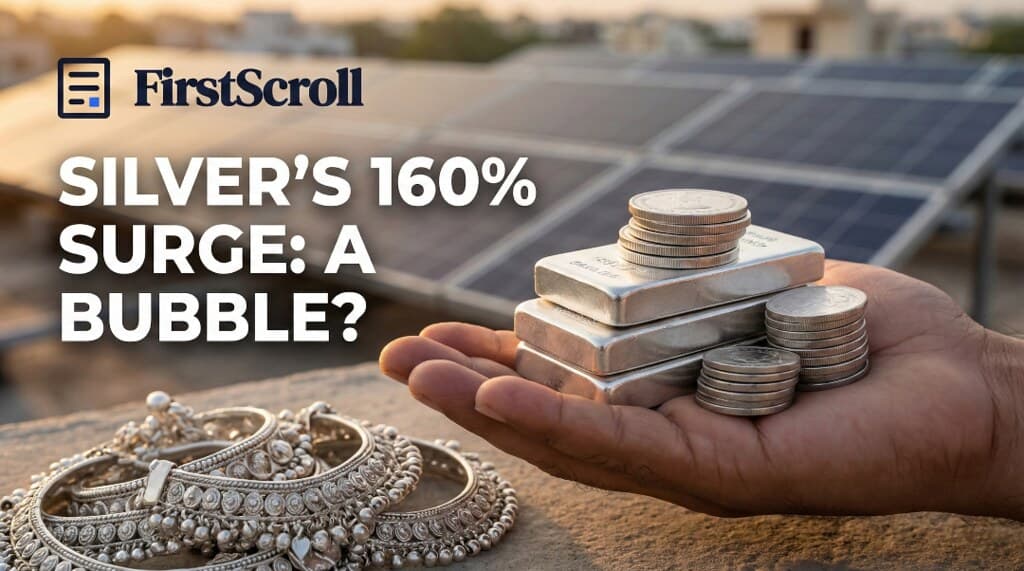
For decades, silver was the “poor man’s gold”. The metal you bought when gold felt too expensive. It lived quietly in anklets, dinner plates, and small Diwali coins.
While most of us were not paying attention, silver stopped being polite and started screaming.
The news: As of this week, silver prices in India have smashed all previous records, with futures trading near ₹2.40 to ₹2.42 lakh per kg. In 2025 alone, silver has delivered roughly 160 percent returns, comfortably beating gold and leaving equity indices behind.
Unlike gold, which mostly sits in lockers, silver actually goes to work.
Roughly 55 to 60 percent of global silver demand comes from industry. Solar panels. Electric vehicles. 5 G infrastructure. Power electronics.
At the same time, supply is tight. The world has been running a silver supply deficit for four consecutive years. We are consuming more silver than we mine.
Add fresh speculation that China may tighten silver exports from January 2026, and you get the perfect recipe for panic buying.
Gold is like a retired government employee. Stable. Predictable. Bought when people want safety.
Silver is a startup founder. Volatile. Industrial. Capable of doubling fast or crashing just as hard.
Right now, the startup is booming because everyone needs its product, but the supply chain is broken.
1. Solar transition shock
An average solar panel uses about 20 grams of silver. With prices exploding, the cost of India’s renewable energy push quietly rises. Manufacturers may be forced to pass these costs to consumers.
2. Wedding budget squeeze
Silver dinner sets and bridal jewellery are common gifts. At ₹2.4 lakh per kg, items that once cost ₹50,000 now cost closer to ₹1.5 lakh. Families will either downsize or switch to plated alternatives.
3. The FOMO trade
Silver ETFs in India have seen massive inflows. Some funds are up over 160 percent this year. When retail money rushes in this fast, volatility usually follows.
India’s silver import bill jumped to $2.71 billion in October 2025 alone.
Any asset that rises 160 percent in a single year deserves suspicion.
Silver is famously high beta. It rallies harder than gold in good times and crashes faster when sentiment turns.
Part of the current rally is real. Industrial demand and supply constraints are genuine. But part of it is also speculation.
If global growth slows in 2026 and factory demand cools, silver has a long way to fall. History has seen this movie before.
Watch the gold to silver ratio. Historically, one ounce of gold buys around 80 ounces of silver. That ratio has dropped near 65. If it falls toward 50, silver is officially expensive relative to gold.
Also watch January 2026 closely. If China’s export curbs materialise, today’s prices may not be the top.
Do not sell family silver yet.
Do not mortgage your house to buy silver futures either.
If you are sitting on 100 percent plus gains, consider booking capital and letting profits ride.
The Bottom Line: Silver has evolved from a precious metal into a critical industrial asset. But parabolic moves rarely end without a hangover.
Fun fact: Silver is the most conductive metal on Earth. That is why high efficiency solar panels cannot function without it.
If markets stress you out, you are not alone.
That is exactly why we built First Scroll. It is a daily, five minute, mobile first finance read that explains what happened, why it matters, and what to remember without hype or panic.
Subscribe to First ScrollSources: World Gold Council | Times of India | Live Mint | Good Returns India