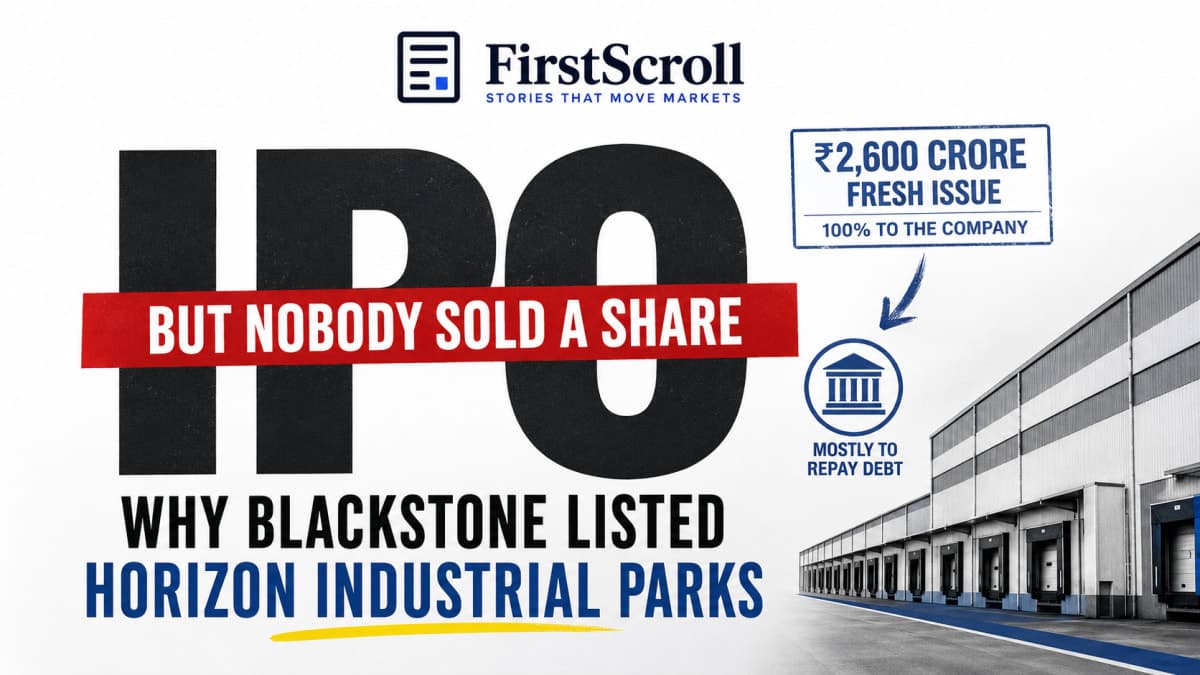
In today's FirstScroll, we break down the Horizon Industrial Parks IPO, and explain why the owner of India's largest warehouse platform put it on the market without taking a rupee off the table.
This one is about structure rather than share price, so stay with us through the middle. With that out of the way, let's dive into today's story.
The Story
Drive out of Bhiwandi on a weekday morning and you pass them for twenty minutes without registering what they are.
Long grey sheds set back from the road, forty feet high, with truck bays down one side and no signage worth reading. Inside is the thing that makes your two day delivery possible, and increasingly your ten minute one.
Seven years ago, almost none of this existed in organised form. India stored its goods in whatever a local landlord had built, and a "warehouse" was often a shed with a leaking roof and no fire system.
Then the private equity money arrived. Blackstone bought the Embassy warehousing business in 2021, kept buying, and assembled a platform that today runs 45 assets across 10 cities with more than 60 million square feet of space.
On 17 August, that platform went to the public market. And it did something unusual on the way in.
The entire ₹2,600 crore issue was new shares, with no offer for sale component. Blackstone, which controls the company, sold nothing at all.
So here's the question: why would the world's largest landlord list its Indian warehouse business and not sell a single share of it?
You see, every IPO is really two questions stacked on top of each other. The first is what the company is worth. The second, which gets far less attention, is where your money actually goes once you hand it over.
In an [Offer for Sale](INTERNAL: what is an offer for sale) structure, existing shareholders sell their shares and the cash lands in their bank accounts. In a [fresh issue](INTERNAL: oyo ipo fresh issue explained), the company prints new shares and keeps the money. Same listing, completely different destination.
Horizon is the second kind. Which then raises the obvious follow up: what does the company do with ₹2,600 crore?
Mostly, it pays lenders. The prospectus earmarks ₹2,250 crore of the proceeds for repaying borrowings, against outstanding debt of ₹6,884 crore as of March 2026.
And this is where the business model becomes visible. Building warehouses is a borrowing exercise: you take on debt, put up a shed, sign a ten year lease, and collect rent for a decade.
The rent is beautiful. Revenue climbed from ₹246 crore in FY24 to ₹768 crore in FY26, at an EBITDA margin near 79%, because a leased shed costs almost nothing to run once it is full.
But here's the twist. That 79% margin is measured before the two costs that define this business.
Horizon reported a restated loss of ₹204 crore in FY26, because roughly ₹539 crore of finance costs and ₹266 crore of depreciation sat below the EBITDA line. Interest on the debt that built the sheds, and the ageing of the sheds themselves, are not adjustments to look past here. They are the industry.
Which reframes the whole issue. Read this way, the IPO is not a growth round dressed as a listing. It is a refinancing, swapping expensive debt for permanent equity so the interest bill stops eating the rent.
So who wants what?
For Blackstone, the logic is patient. It gets a public price for an asset it has built from scratch, it keeps its entire stake, and it hands the company a cheaper balance sheet without writing another cheque itself. At the top of the band, the post money valuation is around ₹17,250 crore.
For the company, a lighter interest bill is the shortest path from EBITDA to actual profit.
Now, why list as a company at all? Blackstone's other Indian property bets went the REIT route, and a REIT is the natural home for rented buildings. But SEBI's rules require a REIT to keep 80% of assets completed and rent generating, and to pay out most of its cash flow to unitholders.
Horizon still has 2,293 acres of land waiting to be built on. A REIT could not fund that and pay out at the same time, which is precisely why this listed as a company instead. Retained cash is the point.
Now to be clear, the market did not exactly rush in. The issue was subscribed 1.45 times overall, with institutions taking 1.85 times their quota while the retail portion closed at 96%, short of its own reservation.
That split tells you something. The anchor book had already filled at ₹60 from 54 anchor investors including large global funds, so the professionals showed up. Retail investors, who have spent two years being trained to chase listing pops, looked at a loss making landlord and passed.
So, is a no exit IPO a vote of confidence? Well, it is certainly a different signal from the ones this market is used to reading, where the interesting number is usually how much the early backers are taking out.
Here nobody takes anything out, and most of what goes in goes straight to a bank. Whether that reads as conviction or as a balance sheet that needed the help is something the listing, and the decade of leases behind it, will settle slowly.
Until then…
If this story helped you make sense of the Horizon Industrial Parks IPO, share it with a friend on WhatsApp, LinkedIn or X. You might also enjoy our story on PhonePe's Lunch.