In today's FirstScroll, we break down the slow crack in India's UPI duopoly and explain why a dozen apps are fighting over a market that pays them nothing.
With that out of the way, let's dive into today's story.
The Story
Think about the last time you paid for chai. You scanned a faded QR code taped to the counter, your phone buzzed, and you walked away without a second thought.
For most of a decade, that scan almost certainly went through one of two apps. PhonePe or Google Pay handled the overwhelming majority of India's digital payments, and the chai seller, the app, and you never had a reason to care.
The two giants had turned UPI, the government-backed rails that let any app talk to any bank, into a comfortable duopoly. Everyone else was a rounding error.
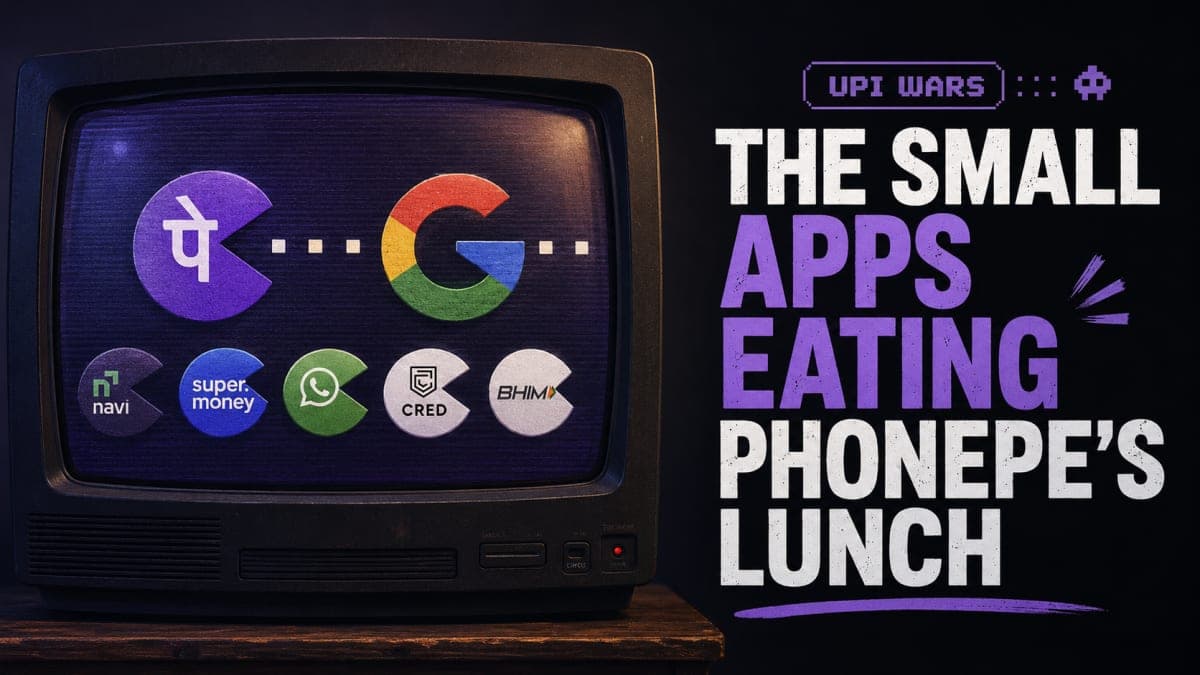
Then, the rounding errors started adding up. In May 2026, PhonePe and Google Pay's combined share of UPI transactions fell below 80% for the first time since app-wise data began being published.
The names taking those scans are not household giants. Sachin Bansal's Navi and Flipkart's super.money, both barely two years old, have together captured 5.5% of the market. Even BHIM, the government's own app that everyone forgot, grew five-fold in two years.
So here's the question: why would anyone fight this hard for a market where nobody earns a single rupee per transaction?
You see, UPI payments are free by design. The government scrapped the merchant fee, the small cut that card networks charge shopkeepers, back in 2020, which means no app makes money from the payment itself. Every scan is a cost, not a revenue line.
So the payment is not the product. The payment is the bait.
This is where Navi's playbook comes in. For them, the logic is simple: a person who pays through your app ten times a day is a person you can offer a loan to, and lending is where the actual money lives. Navi went from less than 0.01% of UPI in December 2023 to roughly 3.6% today, largely by handing out cashback on every scan.
And for super.money? It is Flipkart's way of keeping shoppers inside its own loop. Every bill you pay earns points that pull you back to the store, so the free payment quietly subsidises the next sale.
There's a referee in this game too. The NPCI, the umpire that runs UPI, has long wanted no single app to control more than 30% of all transactions, and the deadline for that cap has been pushed to the end of 2026. A market that deconcentrates on its own saves the umpire from ever having to blow the whistle.
But here's the twist. Count the money instead of the scans, and the revolution shrinks.
In June, WhatsApp Pay processed 15.1 crore transactions worth ₹11,391 crore. CRED processed fewer transactions, 14.2 crore, but they were worth ₹55,116 crore, nearly five times as much. The challengers are winning the ₹40 chai payments while the serious money still flows through a handful of apps.
And the giant hasn't exactly fallen. PhonePe alone still holds about 46% of all UPI volume, which is one and a half times the legal ceiling the NPCI wants to enforce. If the cap ever bites, the market leader would have to somehow turn away half its own customers, and nobody has explained how that would work.
Now to be clear, the small apps' gains may not even stick. In June, the collective share of the smaller players slipped to 3.6% from 4.3% the month before. Cashback buys a download; it doesn't buy a habit. The moment the rewards dry up, the scans may drift right back to the app with the fastest, most familiar screen.
So, is the duopoly actually cracking? The honest answer is that the edges are crumbling while the core holds. UPI now moves over 23 billion payments a month, and the fight is really over what each of those free scans can be converted into: a loan, a shopping trip, a credit score.
Which means the app on your home screen isn't competing to move your money. It's competing to know you. Whether that turns out to be worth more than a merchant fee ever was is something only time will tell.
Until then…
If this story helped you make sense of the UPI wars, share it with a friend on WhatsApp, LinkedIn, or X. You might also enjoy our story on Shiprocket IPO.