In today's FirstScroll, we break down why a Danish government fund is buying into Indian electric buses, and why the real product here isn't the bus at all.
With that out of the way, let's dive into today's story.
The Story
Somewhere in Bihar or Andhra Pradesh right now, a woman is boarding a clean, quiet electric bus for her commute. No diesel fumes, no engine roar, a panic button by the door. She probably has no idea that the machine she's riding was made possible by pension money from Copenhagen, roughly 6,000 kilometres away.
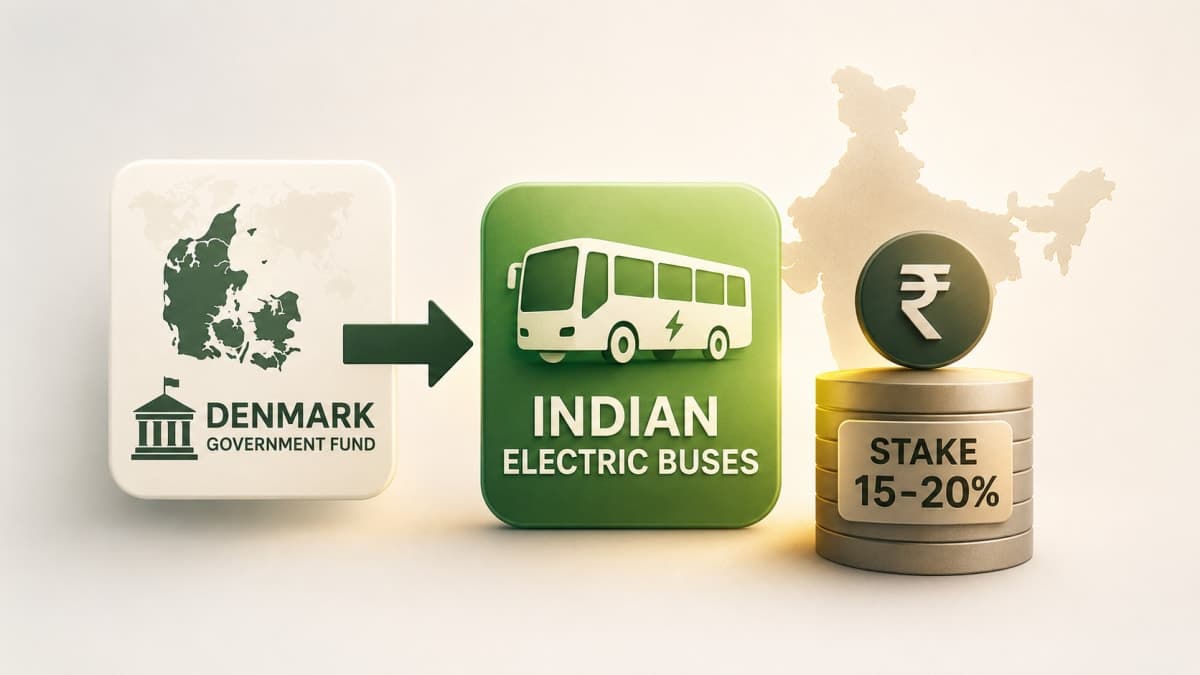
That's the strange thread we're pulling on today. A Danish state-backed fund is reportedly set to buy a 15 to 20% stake in Greencell Mobility, an Indian electric-bus operator, for around ₹500 crore, valuing the company at nearly ₹3,000 crore.
The fund is Impact Fund Denmark, formerly called IFU, and it's the Danish government's development finance institution, backed in part by large Danish pension funds. Its whole job is to put risk capital into developing countries and earn a return while doing measurable good.
So here's the question: why would a Danish pension-linked fund want a slice of buses running through Puducherry and Madhya Pradesh?
You see, to understand the appeal, you have to stop thinking of Greencell as a bus company. It doesn't build buses. It's OEM-agnostic, meaning it buys them from manufacturers. What it actually sells is a service the industry calls electric-mobility-as-a-service, or eMaaS: it owns the buses, operates them, charges them, and maintains them, all as one package.
And here is the part that makes an investor's eyes light up. Most of Greencell's business runs on what's called a Gross Cost Contract, or GCC, with state and city transport bodies. Under a GCC, the government pays the operator a fixed amount per kilometre the bus runs. Greencell doesn't carry the risk of empty seats or ticket collection. Whether the bus is full or half-empty, it gets paid to simply keep the wheels turning.
Think of it as the difference between owning a restaurant and being paid a flat fee to cook. One depends on how many customers walk in. The other is a contract. For a foreign investor nervous about the messiness of Indian consumer demand, a long-term government payment is about as close to a bond as an equity stake gets.
Now layer on the tailwind. India is pushing hard on electrification through programmes like the PM Seva E-Mobility initiative and the National E-Bus Program, which auction off big fleets to operators. Greencell has been winning them. It's scaling from around 1,200 buses toward roughly 3,700, and even bagged a single 915-bus order in Hyderabad earlier this year. Government-backed demand, government-backed payments, and a clean-energy label that ticks every ESG box. For a development fund, that's the dream deal.
And Greencell? For them the logic is just as simple. Buying and running thousands of electric buses is brutally capital-hungry, and each new investor cheque lets them bid for the next fleet. They've already pulled in money from the world's biggest development financiers, including the IFC, British International Investment, and Tata Capital, who put in $89 million in January alone. A Danish fund is another deep, patient pocket.
But here's the twist. This "as safe as a bond" story has one uncomfortable dependency: the government.
The entire GCC model rests on state transport bodies paying operators on time, for years. In a country where public transport undertakings are famously cash-strapped, that promise is only as strong as the state's budget. If payments slow, the operator that so cleverly offloaded demand risk is suddenly holding a very expensive fleet and a very slow-paying customer.
Now to be clear, this is exactly why the money keeps coming from development institutions rather than ordinary venture funds. DFIs like Impact Fund Denmark are built to take on precisely this kind of long-horizon, policy-dependent risk that scares off regular investors. Their patience is the product. That's also why Greencell's recent raises lean on mezzanine funding, a debt-equity hybrid that funds expansion without heavily diluting existing owners.
So, is a Danish fund really betting on Indian buses? Not quite. It's betting on Indian government contracts, wrapped in a clean-energy story, priced for patient capital. The bus is just the thing that carries the deal. Whether that bet pays off depends less on how many passengers climb aboard and more on whether India's states keep their end of the bargain. And that is something only time will tell.
Until then…
If this story helped you make sense of how a Danish fund ended up in Indian buses, share it with a friend on WhatsApp, LinkedIn or X.